Seasonal Playbook
Black Friday and Cyber Monday (BFCM) have officially arrived in India’s D2C calendar.
What started as a Western retail event has become one of the highest-volume ecommerce windows in India, running from mid-to-late November alongside Diwali’s tail end, competing directly for consumer attention and ad inventory.
For D2C brands, BFCM 2026 represents both the biggest revenue opportunity of the year and the easiest way to generate revenue that looks strong on a dashboard and produces very little real profit.
CPMs double. Return rates spike. Discount wars compress margins. Agencies recommend scaling based on volume metrics. And without a clear framework for measuring profitability in real time, brands come out of BFCM having spent more than they earned.
This is the complete playbook for doing it differently.
Before planning a single campaign, run this calculation. At your planned BFCM discount depth, what is your break-even ROAS?
Break-even ROAS = 1 ÷ Effective Margin % (at promotional price)
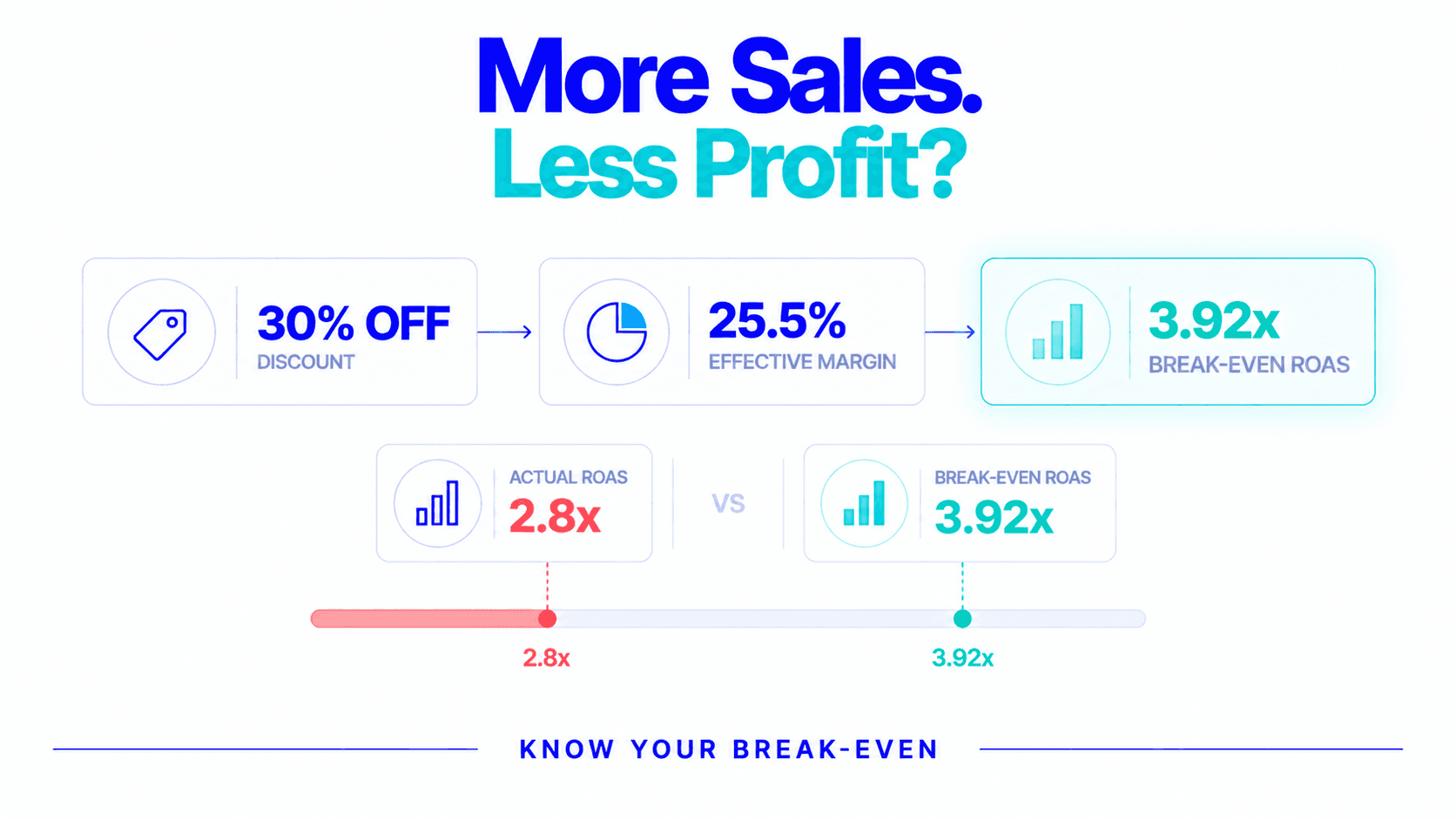
A fashion brand planning 30% off for BFCM
At 30% off during BFCM, when CPMs have doubled and competition is highest, you need to sustain 3.92x ROAS just to break even.
If your campaigns run at 2.8x ROAS during BFCM (common as audience quality dilutes at scale during peak periods), you’re losing money on every order, efficiently, at high volume.
Run this calculation for your specific discount depth and category before setting any BFCM campaign live. It will tell you more about your BFCM strategy than any benchmark.
Phase 1 · 6–8 weeks before, mid-October
This is the most underinvested phase for most D2C brands and the one with the highest leverage.
Build your warm audience pool before CPMs spike.
CPMs in the 6–8 weeks before BFCM are significantly lower than during BFCM week. A warm audience member acquired at ₹180 CPM in October converts during BFCM at a fraction of the cost of a cold audience member reached at ₹350+ CPM during peak week.
Visitors who engage with your brand in October are cheaper to acquire and convert better in BFCM retargeting than visitors reached cold during peak week.
Run a “BFCM Early Access” lead capture: “Join the early access list for our biggest sale of the year.” Subscribers acquired now cost ₹15–30/subscriber. During BFCM week, they convert at near-zero marginal cost.
BFCM buyers research heavily before purchasing. Brands with 500+ reviews convert significantly better than brands with 50. Give yourself the social proof asset you’ll need before the sale starts.
Not all products should be discounted. Only SKUs with sufficient CM1 to absorb the planned discount and still produce positive POAS should be in BFCM campaigns. Run your SKU margin analysis now.
Phase 2 · 2–3 weeks before, early November
CPMs start rising. Purchase intent rises. This is when your warm audience from Phase 1 starts converting.
Convert warm audiences at moderate CPMs before peak pricing.
Your email and WhatsApp subscribers get BFCM pricing 48 hours early. This converts your warm list before CPMs hit their peak, reduces your effective CAC on these customers, and creates genuine urgency around the early access window.
Run full-price campaigns and BFCM promotional campaigns simultaneously but separately. This lets you see which audience segments convert at full price (and thus don’t need a discount) vs which need the promotional offer to convert.
For every BFCM campaign, establish the minimum POAS below which you’ll reduce budget, and set automated rules to flag when it’s approached. Don’t wait for your weekly review to catch a campaign that went below break-even on Tuesday.
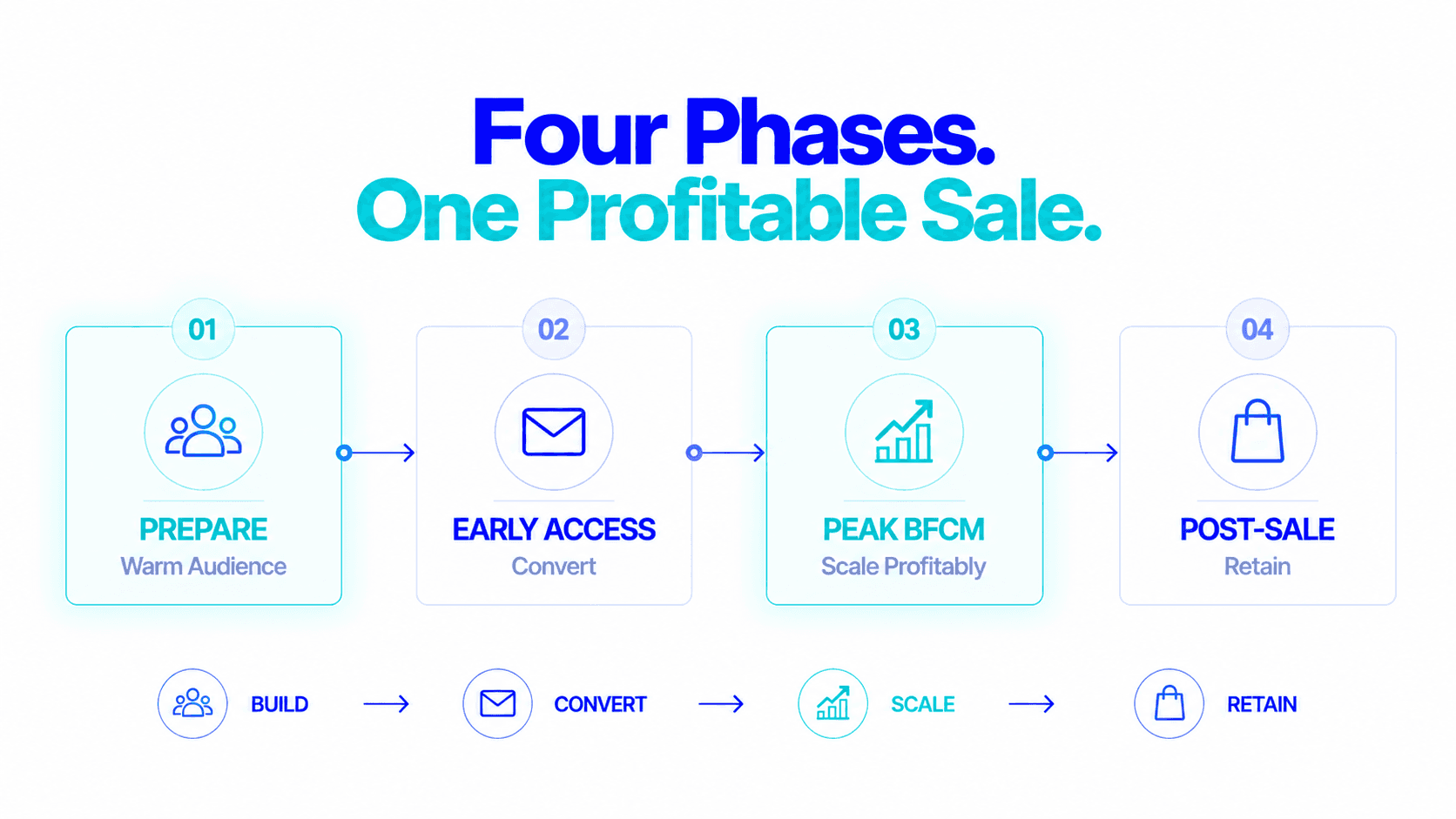
Phase 3 · Black Friday + Cyber Monday week
Maximise profitable conversion volume. Not all volume, profitable volume.
Peak BFCM is the period where discipline matters most. CPMs are highest, competition is most intense, return rates are most elevated, and the temptation to scale everything is strongest.
What to scale
What to cap or pause
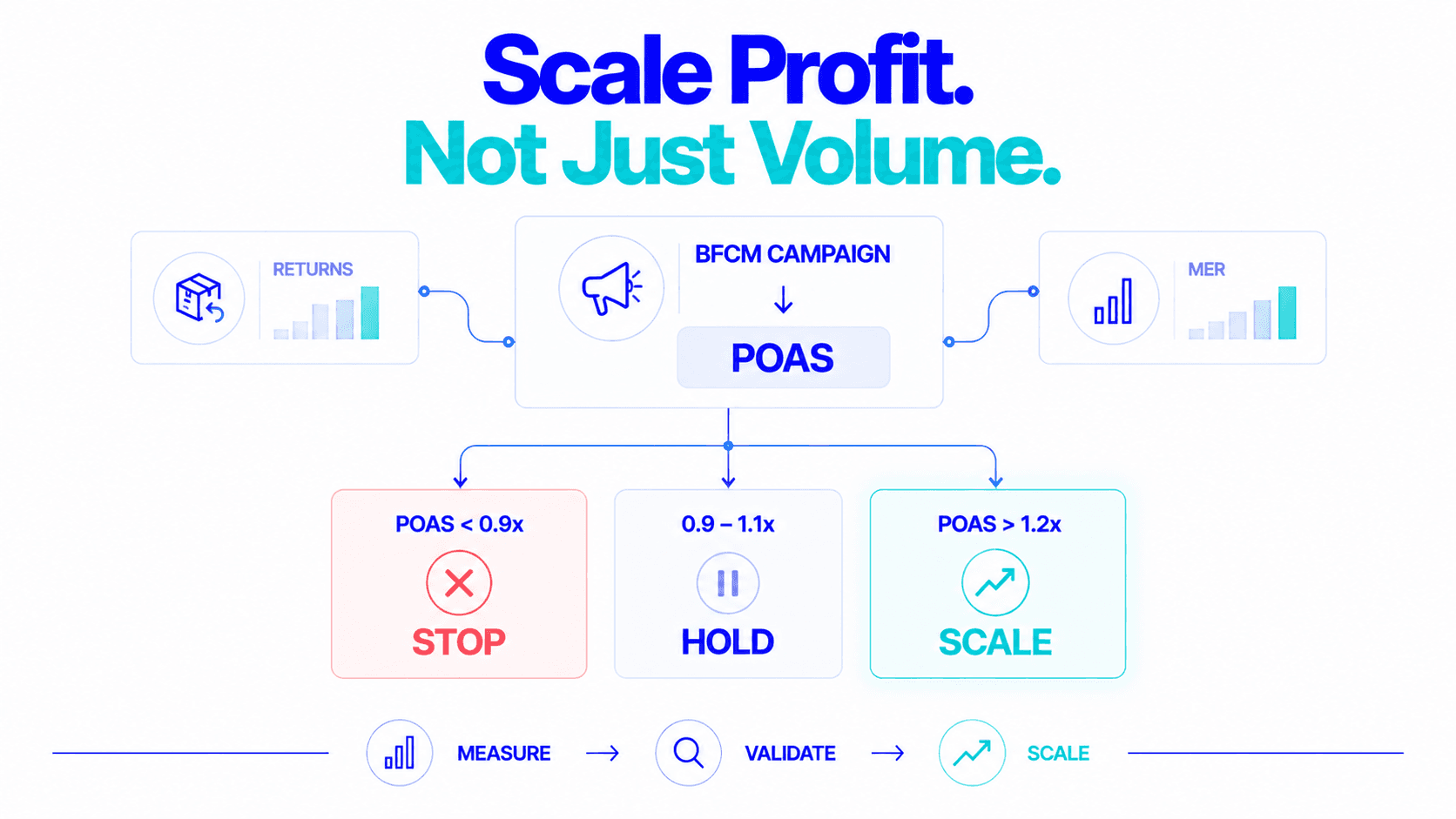
The POAS rule during peak: Check per-campaign POAS every 72 hours during BFCM.
< 0.9x
Sustained
0.9–1.1x
Diagnose
> 1.2x
Profitable volume
Phase 4 · 2–4 weeks after, December
Manage the return wave and convert BFCM awareness into full-price repeat buyers.
The return wave
Your net revenue diverges sharply from gross revenue during this period. Do not make scaling decisions based on gross revenue that hasn’t netted down yet. Wait for Shopify net revenue to stabilise before calculating your real BFCM MER.
Gift season
Customers who received your products as BFCM gifts (or who gifted your products) are entering a natural consideration window for repurchase or gifting again. A December campaign targeting BFCM buyers with a “Now buy for someone else” or “Add to your collection” angle often converts well at normal CPMs.
Win-back
BFCM buyers who haven’t repurchased by Day 45 receive a value-first win-back message. Not another discount, a new reason to engage. New product, updated formulation, relevant January content (new year, new routine). BFCM-acquired customers who repurchase at full price within 90 days are your highest-value customers. Target them with appropriate retention investment.
D2C brands should build content around BFCM keyword opportunities before the season. High-volume keywords to target:
Informational (pre-BFCM)
Commercial intent (during BFCM)
Metric-focused (brand authority)
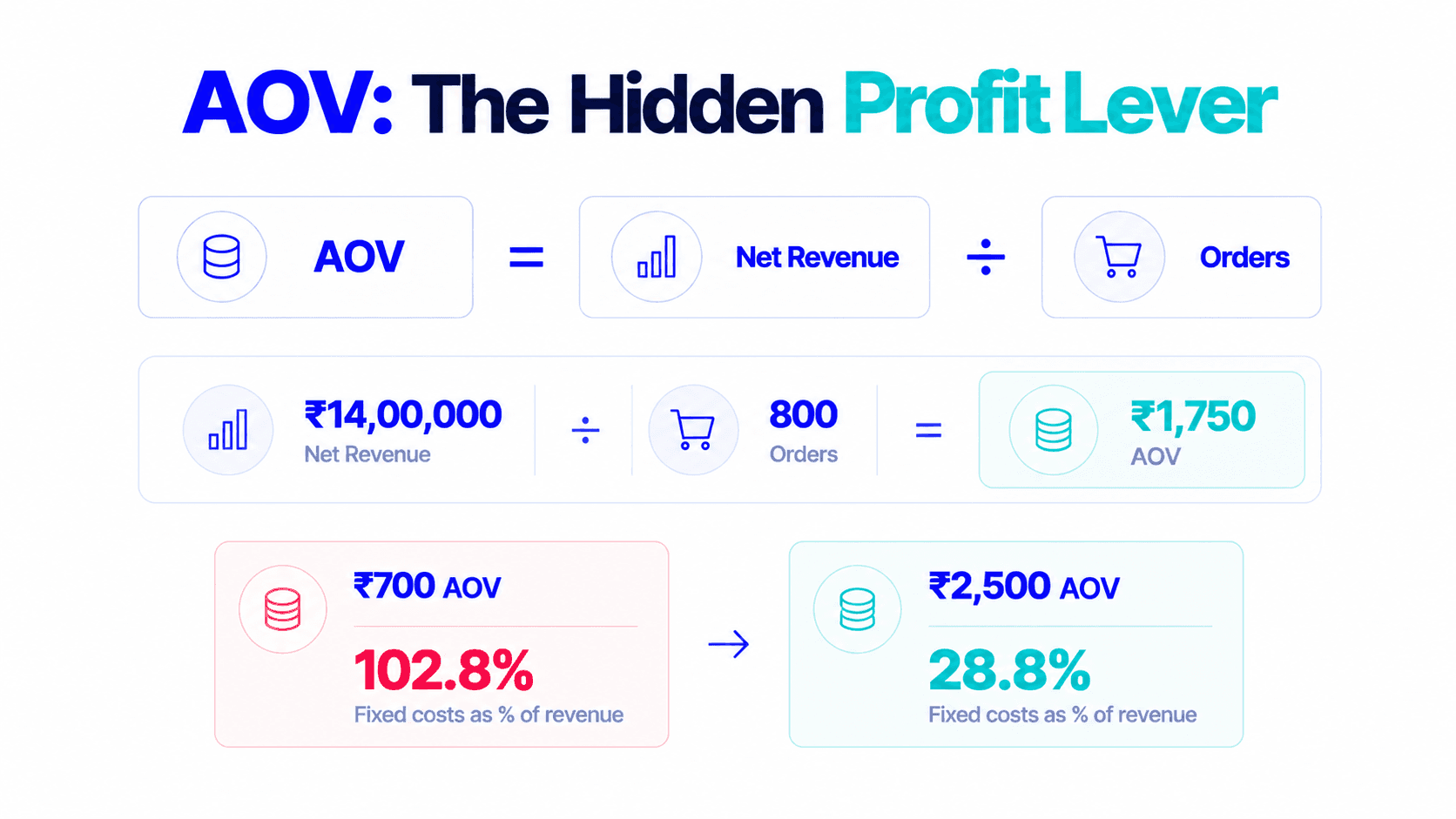
The dominant BFCM strategy for most brands is discount depth, bigger percentage off drives more conversions. But there’s a more margin-efficient alternative: AOV optimisation.
Higher AOV during BFCM improves economics in three simultaneous ways:
1
Fixed shipping cost as a % of revenue falls as AOV rises. At ₹800 AOV, ₹120 shipping is 15% of revenue. At ₹2,400 AOV, ₹140 shipping is 5.8% of revenue.
2
Bundle and high-AOV buyers are more deliberate, lower return rates than single-unit, impulse-driven purchases.
3
A 2.0× AOV improvement with the same conversion volume produces the same revenue as doubling conversion volume, but with far lower fulfilment cost per revenue rupee.
Track these throughout BFCM, not just at the end:
| Metric | Check frequency | Target | Red flag |
|---|---|---|---|
| POAS per campaign | Every 72 hours | Above 1.1x | Below 0.9x for 3+ days |
| Return rate (week-to-week) | Weekly | Within 6pp of baseline | Above 8pp of baseline |
| MER (rolling) | Weekly | Holding vs pre-BFCM baseline | Declining >15% |
| AOV vs full-price baseline | Daily | Rising (bundles working) | Flat (only discounts converting) |
| New customer CAC | Weekly | Within target LTV:CAC | Rising >25% vs pre-BFCM |
| Subscriber conversion rate | Per send | Email >12% / WhatsApp >18% | Below 8% indicates list quality |
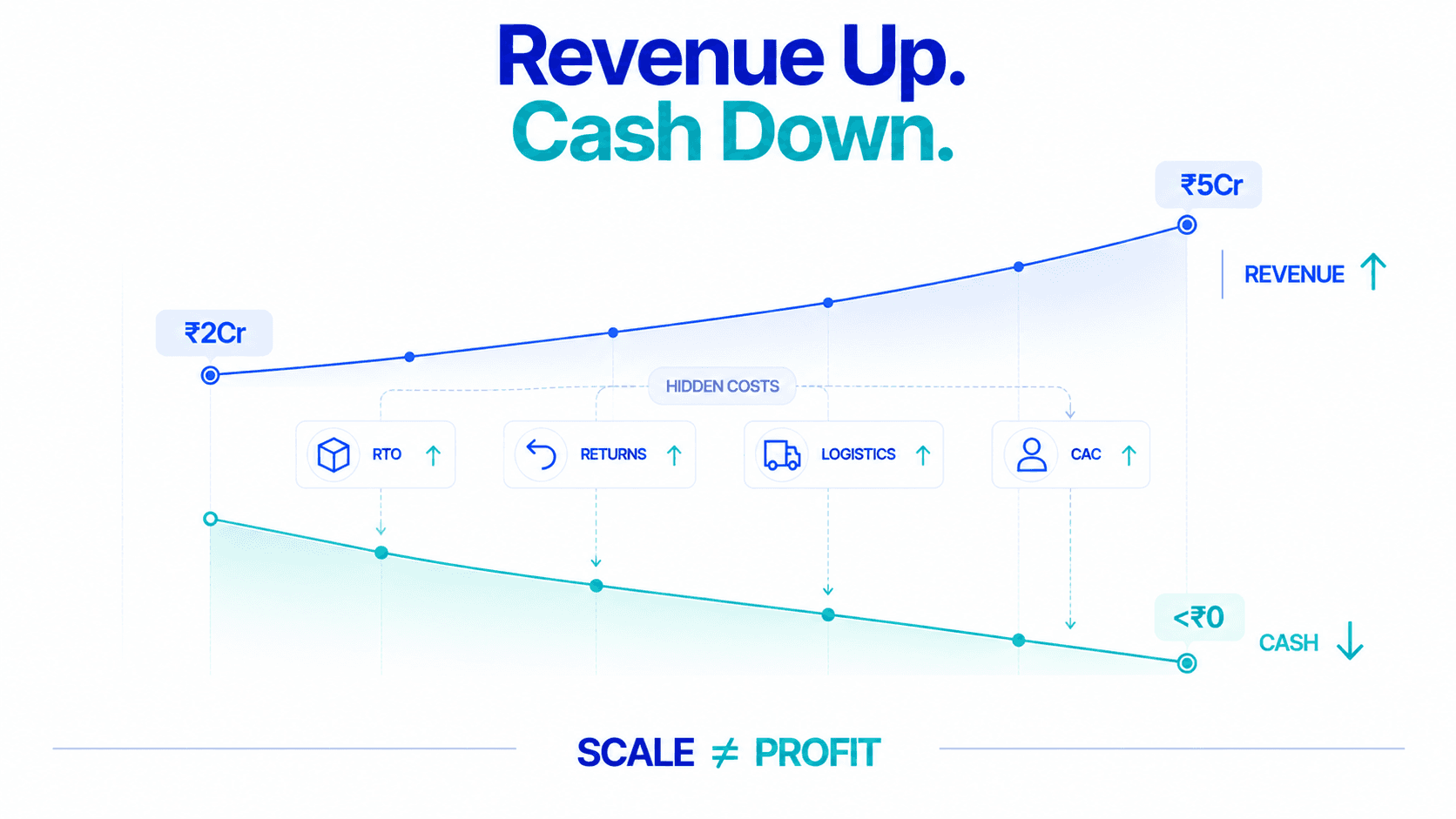
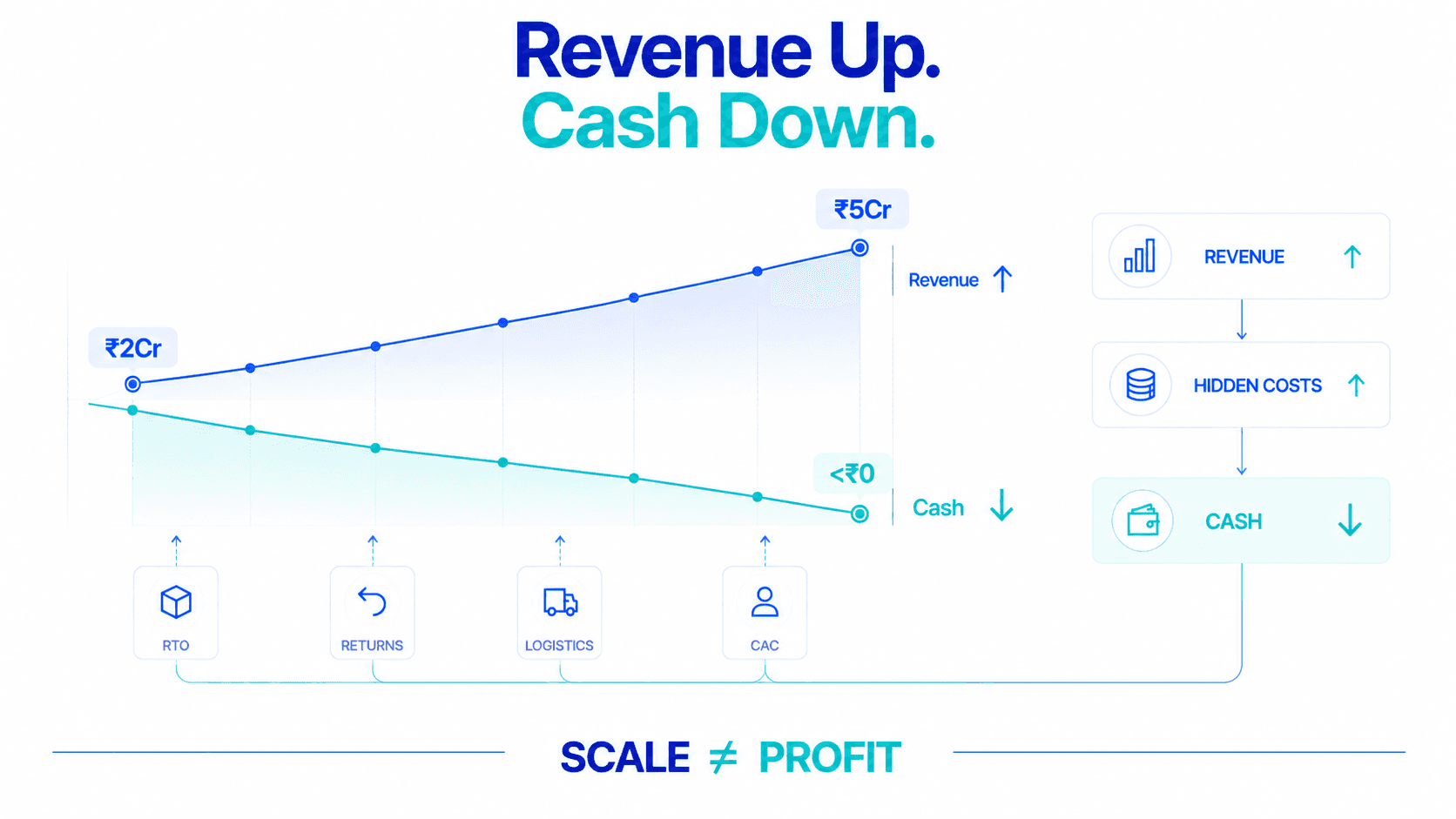
More revenue during BFCM is not always better.
BFCM A
BFCM B
The second leaves less cash depleted from returns, less operational strain, and a customer base with higher average LTV.
The brands that “win” BFCM on gross revenue metrics often enter Q1 cash-flow constrained, carrying high return volumes, and serving a customer list full of discount hunters who won’t repurchase at full price.
The brands that win BFCM on contribution margin enter Q1 with a stronger cash position, a higher-quality customer base, and a BFCM story they can actually be proud of.
Scale the right revenue. Let the wrong revenue stay in your competitor’s dashboard.
BFCM stands for Black Friday and Cyber Monday, the four-day sale window running from Black Friday through Cyber Monday, typically in late November. In India, BFCM has become an established D2C sale event that runs alongside the Diwali festive tail and often extends through December.
Break-even ROAS = 1 ÷ Effective Margin % (at promotional price). Where Effective Margin = Gross Margin at discounted price − Shipping % − Returns Cost % − Payment %. Calculate this before setting any BFCM campaign live. If your break-even ROAS exceeds what your campaigns realistically achieve, the campaign will lose money at scale.
Target ROAS = POAS Target ÷ Effective Margin %. Set your tROAS in Meta and Google based on your POAS target (typically 1.2–1.4x for most D2C categories), not on industry ROAS benchmarks. At promotional prices, your effective margin is lower, meaning your required tROAS to hit the same POAS target is higher.
Flable tracks real-time POAS per campaign throughout BFCM, showing which campaigns are above break-even and which are destroying margin, before the weekly review cycle catches it. This lets you make immediate budget decisions during fast-moving BFCM campaigns rather than discovering the damage a week later.
Flable AI tracks POAS per campaign through BFCM, so margin-destroying campaigns get caught in hours, not at next week’s review.