Metrics Explained
Here’s a math problem most D2C brands never solve.
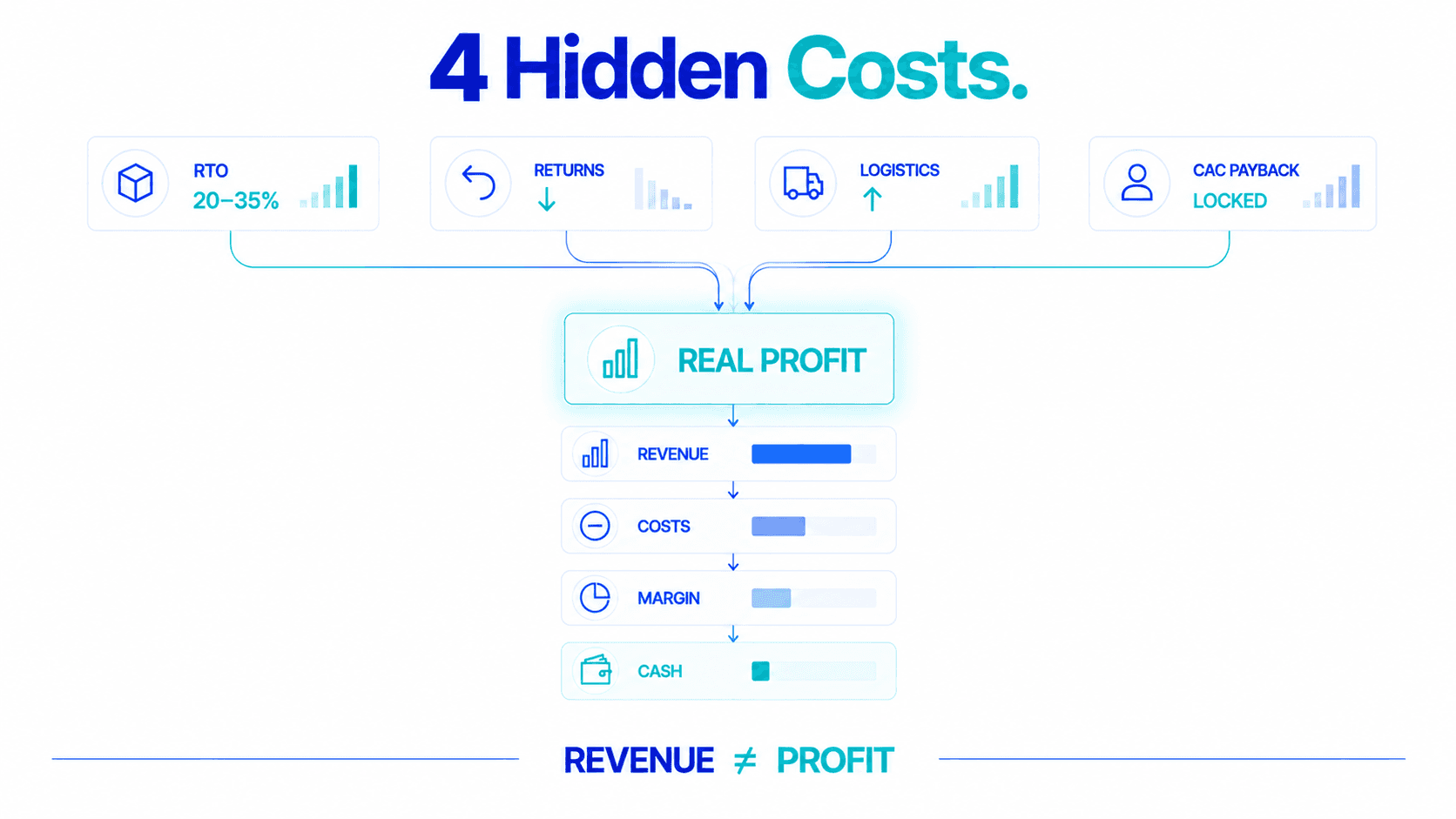
Your bestselling product: ₹699. Shipping cost: ₹115. That’s 16.5% of revenue absorbed by shipping before COGS is even subtracted. On a 50% gross margin product, you have 33.5% left for everything else, ad spend, payment fees, returns, and profit.
Add a 15% return rate. Add 2.5% payment fees. Add ₹35 in return processing cost.
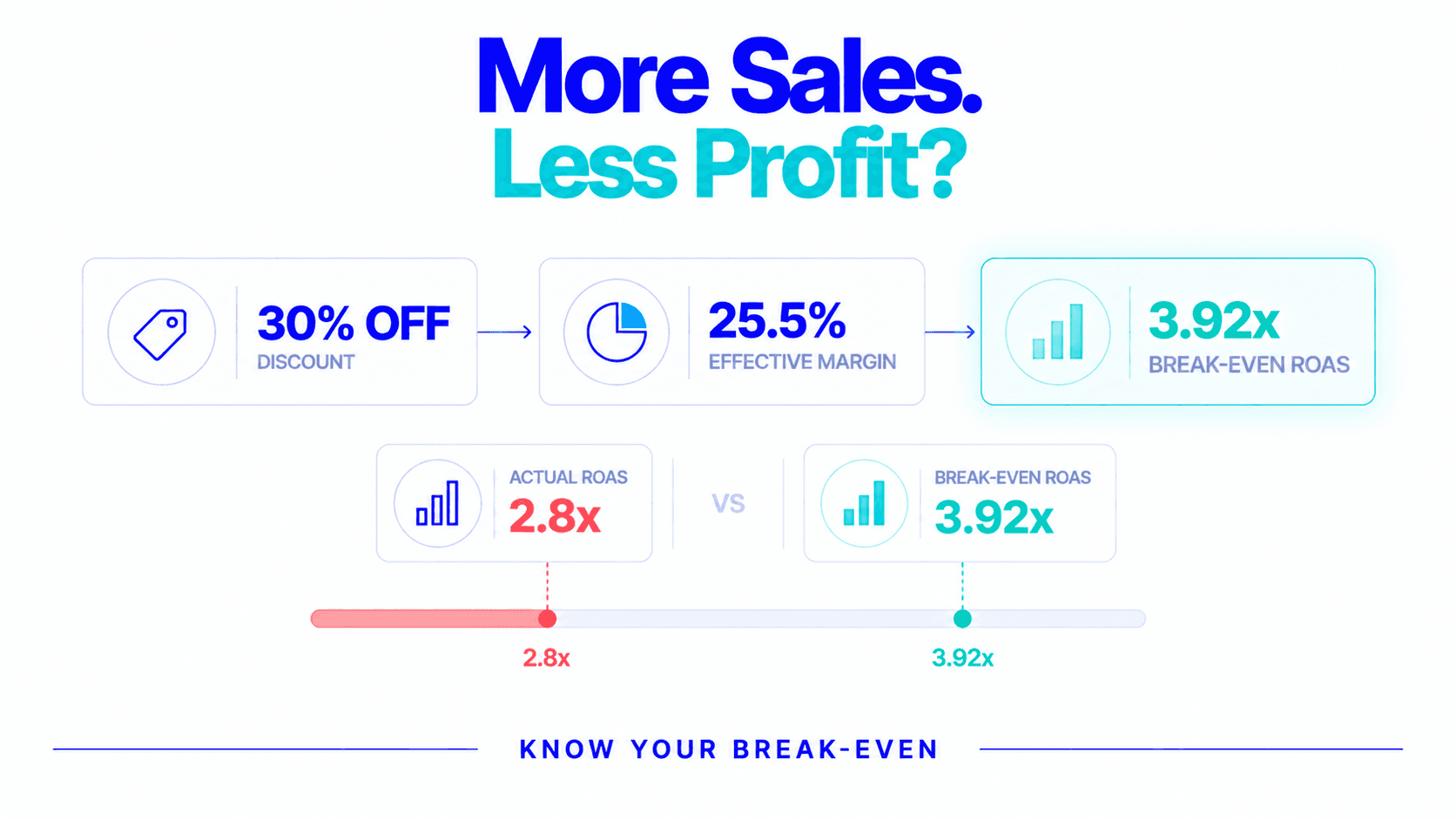
16.5%
₹115 on a ₹699 order
~14%
After returns and fees
7.14x
Rarely sustainable
No D2C brand consistently sustains 7x ROAS. Which means this ₹699 product, at this shipping cost, cannot be profitably advertised in most channel configurations.
The solution isn’t a better campaign. It’s a better offer structure.
Bundles.
Bundling improves contribution margin through three simultaneous mechanisms:
Fixed shipping cost spread across higher revenue.
| Order | Shipping as % of revenue |
|---|---|
| Single unit at ₹699 | 16.5% |
| Bundle of 3 at ₹1,797 (full price) | 6.4% |
| Bundle of 3 at ₹1,600 (10% bundle discount) | 7.2% |
Even with a 10% discount, the bundle’s shipping cost as a percentage of revenue is less than half the single unit’s. This alone can move a product from negative POAS to positive POAS.
Bundle buyers are more deliberate than single-unit buyers. The higher purchase commitment (₹1,600 vs ₹699) selects for customers who are more confident in the product.
Empirically: bundle return rates are typically 8–12 percentage points lower than single-unit return rates for the same product. A 20% return rate on single units becomes 10–12% on bundles.
Lower return rate → more net revenue retained → better CM2.
At higher unit volumes, some packaging costs are more efficient. A 3-pack shipped in one outer box uses marginally less packaging per unit than three individual shipments. Small percentage improvement, but real.
Pick the right structure
Type 1
Buy 2, Buy 3, Buy 6, all of the same product.
Best for: Consumables with high repurchase rates. Supplements (buy 3 months’ supply, save 12%), skincare, coffee, pet food, cleaning products.
The mechanics: The customer is buying forward, stocking up to avoid running out. The incentive is savings. The business benefit is immediate: lower effective CAC per order (you’ve acquired multiple orders in one transaction), lower return rate, lower shipping cost per unit.
Offer structure: Discount should increase with volume. Buy 1 at full price. Buy 2 at 8% off. Buy 3 at 15% off.
The discount at Buy 3 should still leave you with better CM2 than a single unit at full price, because shipping and return economics more than compensate.
Type 2
Products from your catalogue that solve related problems or are used together.
Best for: Fashion (top + bottom), skincare (cleanser + serum + moisturiser), supplements (protein + creatine + multivitamin), home goods (bedsheet + pillowcase set).
The mechanics: Increases AOV by showing the customer products they were likely to buy anyway, but making the combination easier to choose. Higher AOV improves shipping economics. Complementary bundles also tend to generate higher satisfaction (the complete solution works better than one product alone) → lower return rates.
Offer structure: Small bundle discount (5–10%) or bundle-exclusive free gift. The offer should create enough perceived value to motivate the add-on without eroding the margin improvement that larger AOV brings.
Type 3
A lower-price introduction to multiple products, designed for first-time buyers who aren’t ready to commit to full-size orders.
Best for: Brands with complex product ranges where new customers don’t know where to start. Skincare routines, supplement stacks, meal kit samplers.
The mechanics: Lowers the entry barrier. Converts fence-sitters. Introduces customers to multiple products simultaneously, increasing the probability that they fall in love with at least one and become repeat buyers.
The CM2 caveat: Trial bundles are typically priced at or below cost to drive trial. They don’t improve CM2 on the first order, they improve LTV by generating higher-quality customers who make a more informed second purchase. Only viable if your LTV model supports it.
Type 4
Pre-built gift sets with premium packaging for festive season, occasions, or gifting events.
Best for: Every D2C category during Diwali, Christmas, Valentine’s Day, Mother’s Day.
The mechanics: Gifting customers pay a premium for presentation. A ₹1,200 gift set (3 products + premium packaging + card) with ₹420 COGS generates better CM1 than the same 3 products sold individually. The premium packaging adds perceived value that justifies a price above the sum of individual parts.
The CM2 improvement: Higher price per product unit + lower return rate (gifts are rarely returned) + festive demand spikes that justify premium pricing.
Don’t build full product landing pages and inventory packs before validating demand.
Add a bundle option to your existing product page
Use Shopify’s bundle apps (Bundle Bear, Bundler, or Shopify’s native bundle feature).
Offer the bundle on the product page
“Also available as a 3-pack at X% off”, visible on the product page above or below the single-unit add-to-cart button.
Run equal traffic to two versions for 14 days
Single unit vs bundle option visible. Track:
Scale only if the numbers hold
If bundle CM2 exceeds single-unit CM2 and attach rate is above 15%, build the dedicated bundle landing page and start running paid traffic directly to it.
A bundle landing page has a different job than a single-product page. It must justify the higher spend, communicate the value of the combination, and make the savings concrete.
What works
“Normally ₹2,097, yours for ₹1,699. You save ₹398.” Show the individual prices struck through. Make the saving visible at a glance.
What works
Why these products together? “Complete your morning routine” or “The full 30-day programme” or “Start, maintain, and protect”, give the bundle a narrative that makes more sense than the sum of its parts.
What works
“Others who bought this bundle said...” Bundle-specific social proof is more powerful than product-specific reviews for a first-time bundle buyer.
What works
“Add the bundle to cart.” Not three options. Not a comparison table. One bundle, one button, one price.
Before putting ad spend behind a bundle, calculate its CM2 and compare it to your single-unit CM2.
| Metric | Single Unit | 3-Pack Bundle |
|---|---|---|
| Selling price | ₹699 | ₹1,800 (14% off) |
| COGS | ₹315 (45%) | ₹900 (same per unit) |
| CM1 | ₹384 (55%) | ₹900 (50%, discount effect) |
| Shipping | ₹115 (16.5%) | ₹130 (7.2% of revenue) |
| Return cost | ₹45 (20% rate) | ₹25 (10% rate, bundles return less) |
| Payment fees | ₹17.50 | ₹45 |
| Available for ad spend + profit | ₹206.50 (29.5%) | ₹700 (38.9%) |
| Break-even ROAS | 3.39x | 2.57x |
The bundle has a lower break-even ROAS and a higher absolute contribution per order. At the same ad spend, the bundle generates significantly more profit.
Single unit vs 3-pack, per order
This is the table to build before every bundle offer. The math tells you immediately whether the bundle improves or damages your economics.
Bundles are not a marketing tactic. They’re a unit economics lever.
By diluting shipping costs, reducing return rates, and increasing absolute contribution per customer interaction, a well-structured bundle can transform a product that can’t support paid advertising into one that scales profitably.
The improvement is immediate, visible in CM2 within the first week of bundle testing. And it compounds: customers who buy bundles have higher LTV, lower return rates, and lower effective CAC.
Build the bundle. Run the CM2 math first. Then scale what the numbers tell you to scale.
Bundles improve CM2 through three mechanisms: shipping cost dilution (fixed shipping spread across higher revenue), lower return rates (deliberate bundle buyers return less frequently), and slightly improved COGS efficiency. Combined, these can improve CM2 by 8–15 percentage points compared to equivalent single-unit orders.
Calculate CM2 at the bundle discount level before setting the offer. The bundle discount should not reduce CM2 below your minimum viable threshold, typically above 15% for most D2C categories. The shipping and return rate improvements that come with bundles typically allow discounts of 10–20% while still improving CM2 vs single units.
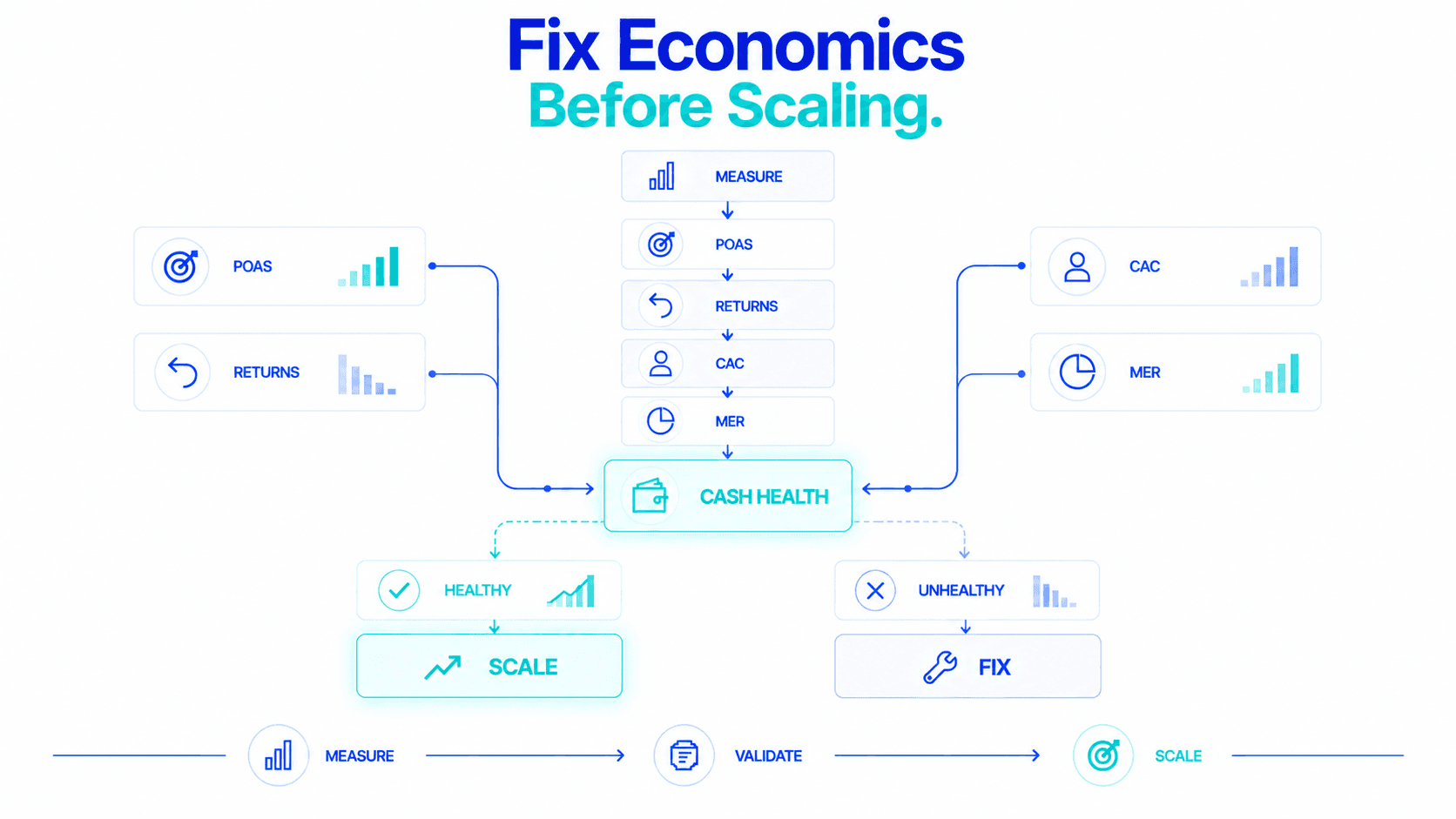
Add a bundle option to the existing product page with a Shopify bundle app, run equal traffic to single-unit and bundle-visible versions for 14 days, and compare attach rate, CM2 per order, 30-day return rate and revenue per session. Build a dedicated landing page only if bundle CM2 beats single-unit CM2 and attach rate is above 15%.
Flable tracks CM2 per product and campaign, so when you introduce a bundle offer, you can immediately see whether bundle orders are generating better contribution margin than single-unit orders. This validates (or challenges) your bundle economics with real data rather than modelled estimates.
Flable AI tracks CM2 per product and campaign, so you see within days whether bundle orders earn more contribution than single-unit orders.