Retention Metrics
The most expensive thing in D2C is the first purchase.
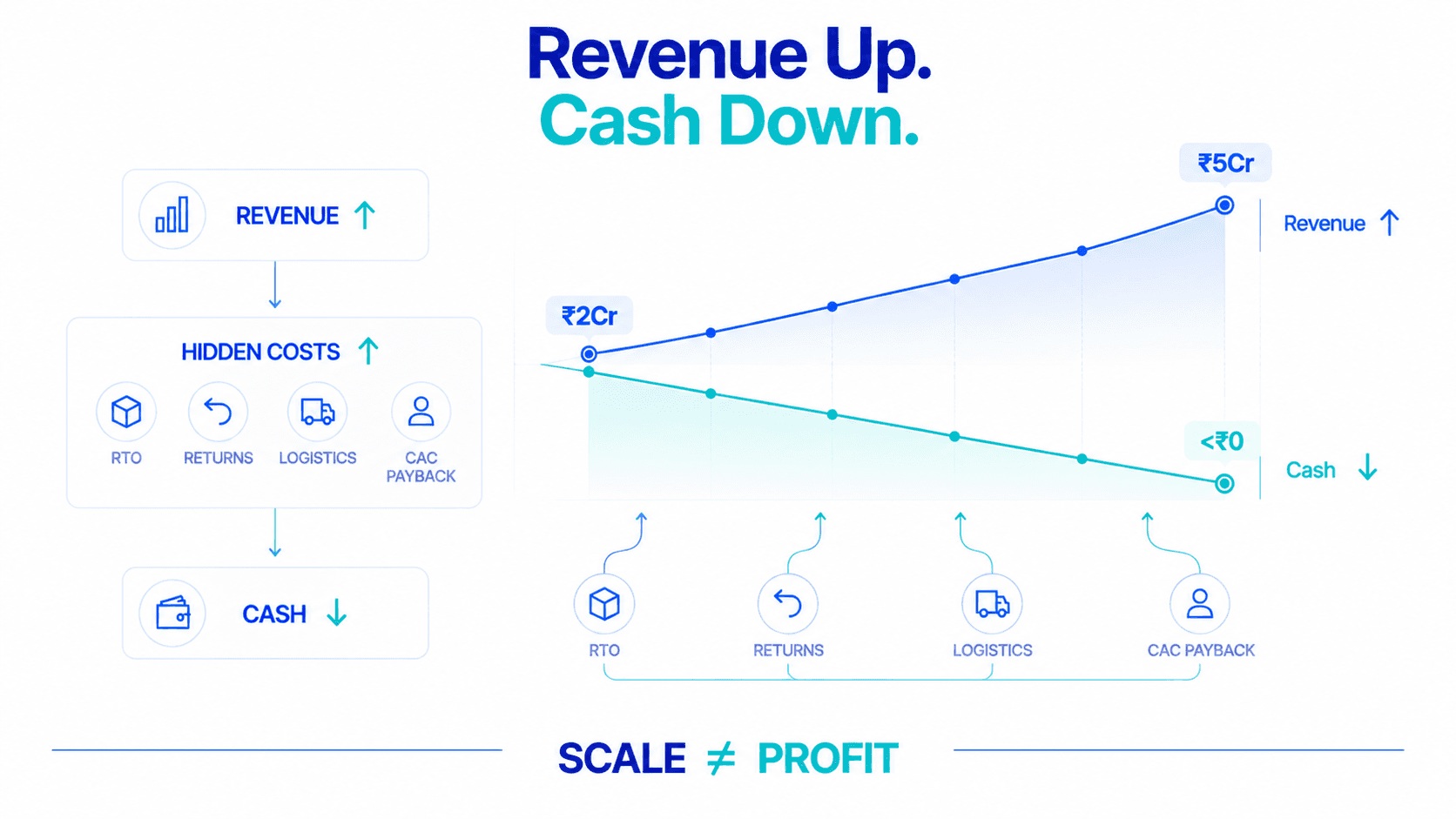
You paid to reach that customer. You paid to convert them. You absorbed the shipping. You paid the payment processing fee. At the end of the first order, in most D2C categories, contribution margin on the acquisition order is thin, sometimes negative.
The economics only work on the second purchase. And the third. And the fourth.
Customer retention isn’t a “nice to have” programme that sits alongside your advertising. It’s the mechanism that determines whether your advertising investment was worth making at all.
This is the complete playbook for building D2C retention that compounds.
The business case for retention is usually framed as LTV: “increasing LTV by 20% improves profitability by X.” That’s true but incomplete.
The more precise case: customer retention is what converts your CAC from a cost into an investment.
Buys once
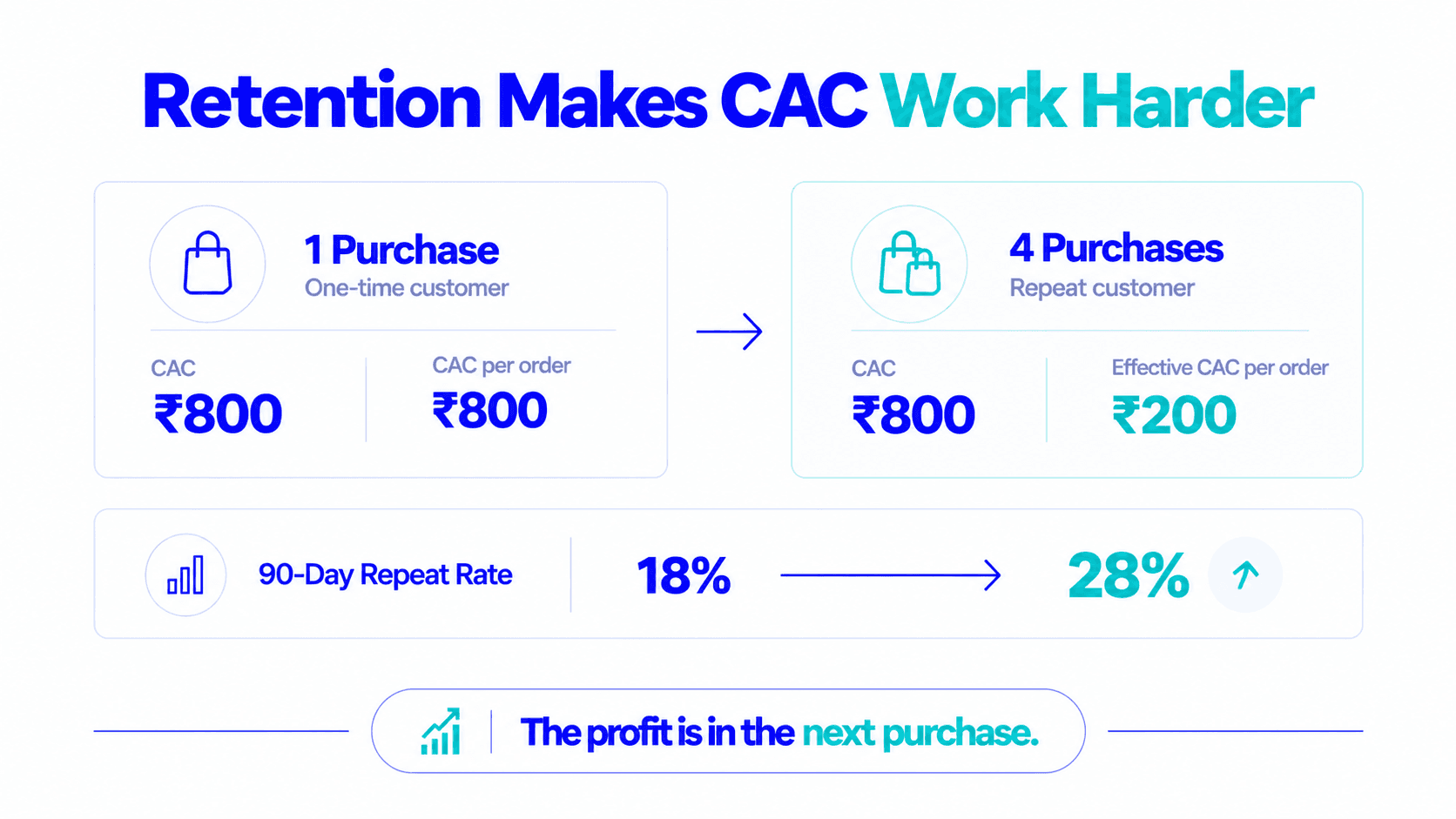
A customer acquired at ₹800 true CAC who only buys once has generated a ₹800 cost.
Buys four times in 18 months
₹800 amortised across four orders. The advertising ROI of the same acquisition campaign is 4× better with a 4× repeat buyer.
This means improving 90-day repeat purchase rate from 18% to 28% is worth more to your business than a 30% reduction in CPMs, even though the CPM reduction gets more attention.
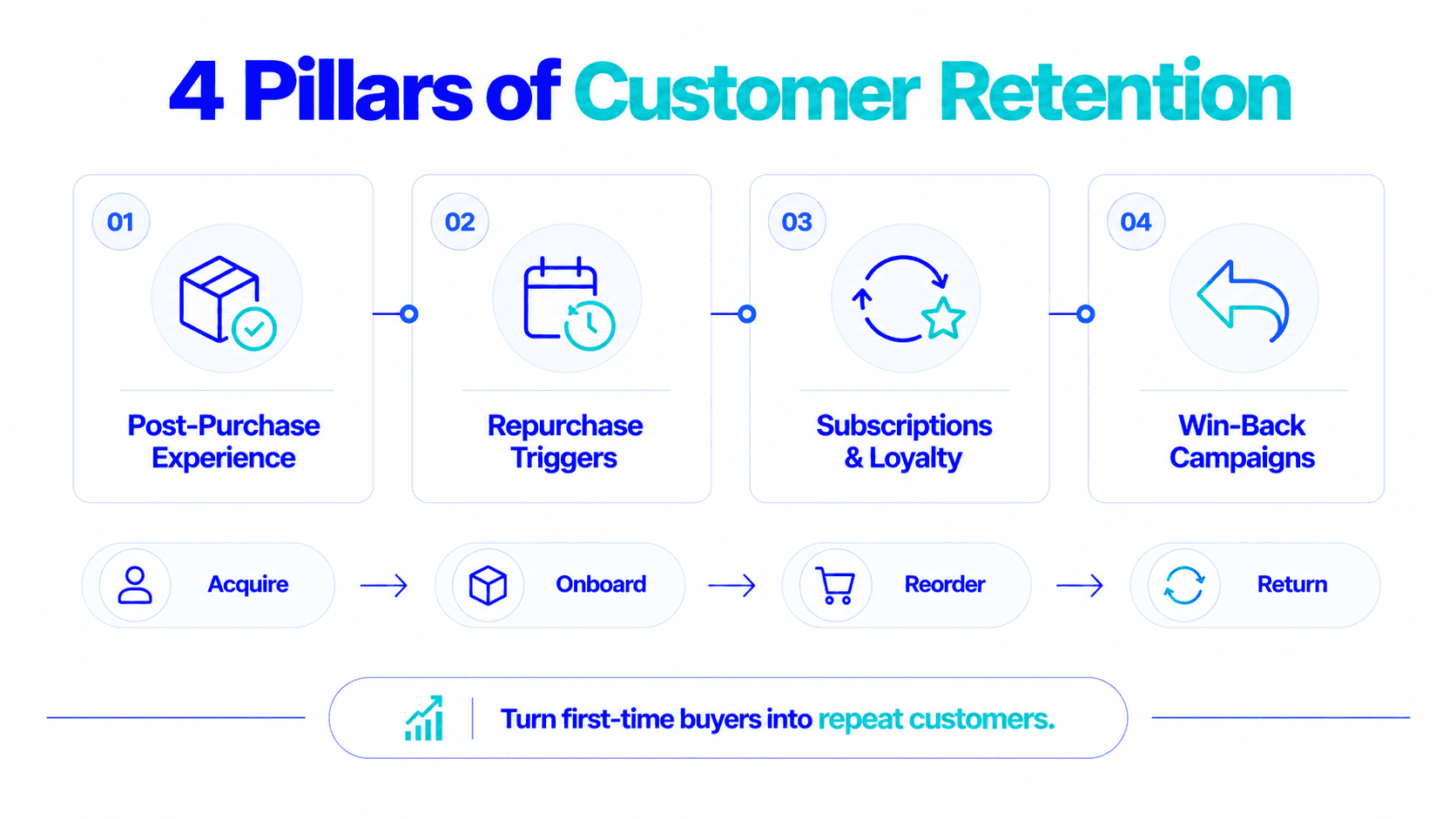
Pillar 1
The window between purchase and delivery is when most returns are decided and most first impressions form. What the customer thinks and feels during this window determines whether they become a repeat buyer.
The core retention communication sequence:
Immediately after purchase
“You made a great choice.” Not a transaction receipt, a brand communication. What should they expect? When will it arrive? Why were they right to choose this?
Day 2
Product education. How to use it. How much to use. What to expect in the first week. For skincare: the 3-4 week expectation timeline. For supplements: how to stack and when to take. For fashion: care instructions and styling options. This message reduces returns and builds product conviction simultaneously.
Day 5 (or delivery day)
Check-in and social proof. “Your [product] should be with you. Here’s what others said in their first week.” Reinforce the purchase decision at the moment the customer first experiences the product.
Day 14
Review request and first cross-sell. If they’re happy, this is the optimal moment to request a review (high satisfaction) and introduce a complementary product (“If you loved X, you might want to try Y, here’s 10% off your first order of it”).
−8–15%
Typical reduction
+5–10 pts
Typical improvement
Pillar 2
For consumable products, supplements, skincare, food, personal care, repurchase is natural. Customers run out and need more. The question is whether they remember to come back to you or drift to a competitor.
The repurchase nudge, sent at 70% of the product’s estimated consumption window, is the single highest-converting retention tactic available to D2C brands.
| Consumption window | Send nudge on |
|---|---|
| 30-day supplement supply | Day 21 |
| 45-day moisturiser | Day 31 |
| Monthly coffee subscription | Day 24 |
| 60-day eye cream | Day 42 |
The message: “Your [product] might be running low. Reorder now and get free shipping / 10% off / early access to our new launch.”
This message converts at 15–25% for brands with a strong post-purchase onboarding sequence, because the customer already trusts the brand and knows the product works for them. The ₹0.50–₹1 WhatsApp message or ₹0 email generates the same revenue per conversion as a ₹300+ Meta retargeting click.
Pillar 3
The structural retention upgrade: convert passive repurchase decisions into active recurring commitments.
Subscribe and Save
Customers opt into a recurring order at a fixed cadence (monthly, bi-monthly, quarterly). For consumable D2C products, subscription attach rates of 15–30% are achievable for brands with strong post-purchase onboarding. Once subscribed, churn rates drop significantly, subscribers cancel at a fraction of the rate of one-time buyers. (D2C subscription models.)
Loyalty programme
Points accumulated with each purchase, redeemable for discounts or free products. Loyalty programmes work best for fashion and beauty brands where there are enough SKUs that repeat purchases mean trying new products rather than reordering the same one.
Easy cancellation
Counterintuitively, making subscription cancellation easy improves retention. Customers who know they can cancel without friction are more willing to subscribe, and brands with easy cancellation see 20–35% of cancel-intent customers choosing to pause instead, with most resuming within 6–8 weeks.
Pillar 4
Every D2C brand has a lapsed customer segment, customers who bought once or twice and stopped. This segment is almost always more cost-efficient to reactivate than it is to acquire equivalent new customers.
The win-back sequence (starting at Day 60–90 post last purchase):
Message 1: Value, not discount
“We’ve launched [new product / improved formulation / new variant].” Give the customer a reason to re-engage that isn’t just a coupon. New products convert at meaningful rates without training customers to wait for discounts.
Message 2 (7 days later if no purchase): Modest incentive
“We miss you. Here’s 10% off your next order, valid for 10 days.” Time-limited incentive, specific value, clear expiry.
Message 3 (10 days later if still no purchase): Final message
“This is the last time we’ll reach out for a while. If it’s not the right time, we understand.” This message converts more than Message 2 in many cases. The sense of finality removes pressure and creates a genuine last-chance feeling.
Customer engagement
Email open rates, Instagram follows, website visits, community participation.
Customer retention
90-day repeat purchase rate, subscription rate, LTV.
High engagement without retention is common in aspirational D2C brands. Customers love the brand, follow on Instagram, open every email, but find the products too expensive to repurchase regularly or don’t have a genuine consumption need.
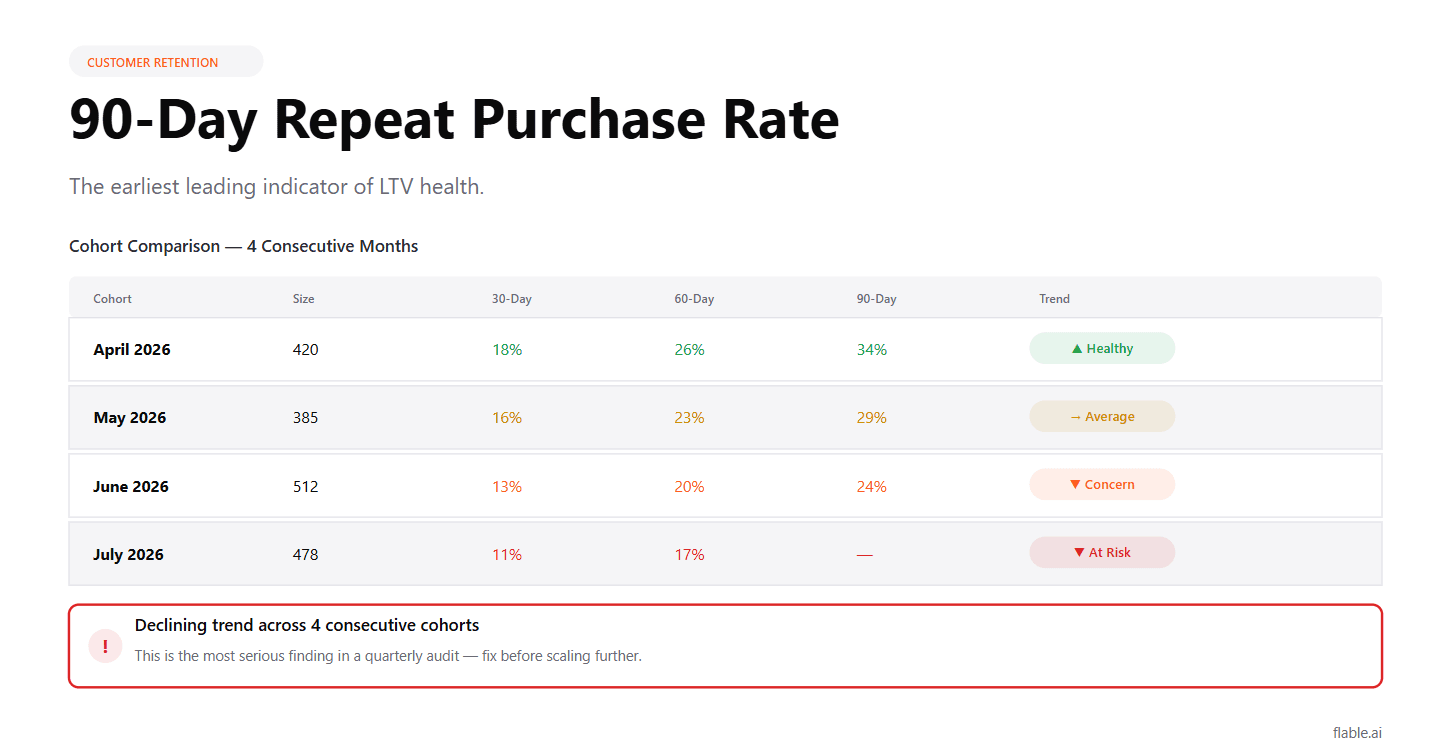
The metric that matters for business performance is retention, not engagement. Track engagement as a leading indicator, customers who engage more tend to retain better, but hold retention as the accountability metric.
| Metric | Formula | Target | Frequency |
|---|---|---|---|
| 90-day repeat purchase rate | Customers with 2+ purchases in 90 days ÷ customers acquired 90 days ago | Category-dependent: Beauty 20%+, Supplements 30%+, Food 40%+ | Monthly |
| Subscription rate | Subscribed customers ÷ Total active customers | 15%+ is strong for consumables | Monthly |
| Email repurchase rate | Repurchases attributed to email ÷ total email subscribers in period | 5–12% per campaign send | Per campaign |
| LTV:CAC ratio | 12-month LTV ÷ True new customer CAC | Above 3:1 is healthy | Quarterly |
| CAC payback period | True CAC ÷ Monthly gross profit per customer | Supplements <4 months, Fashion <8 months | Quarterly |
5 automated flows minimum (welcome series, post-purchase, repurchase nudge, win-back, abandonment). Track revenue per email sent, not just open rate. Open rates are unreliable post-iOS 15. (The 5 email flows.)
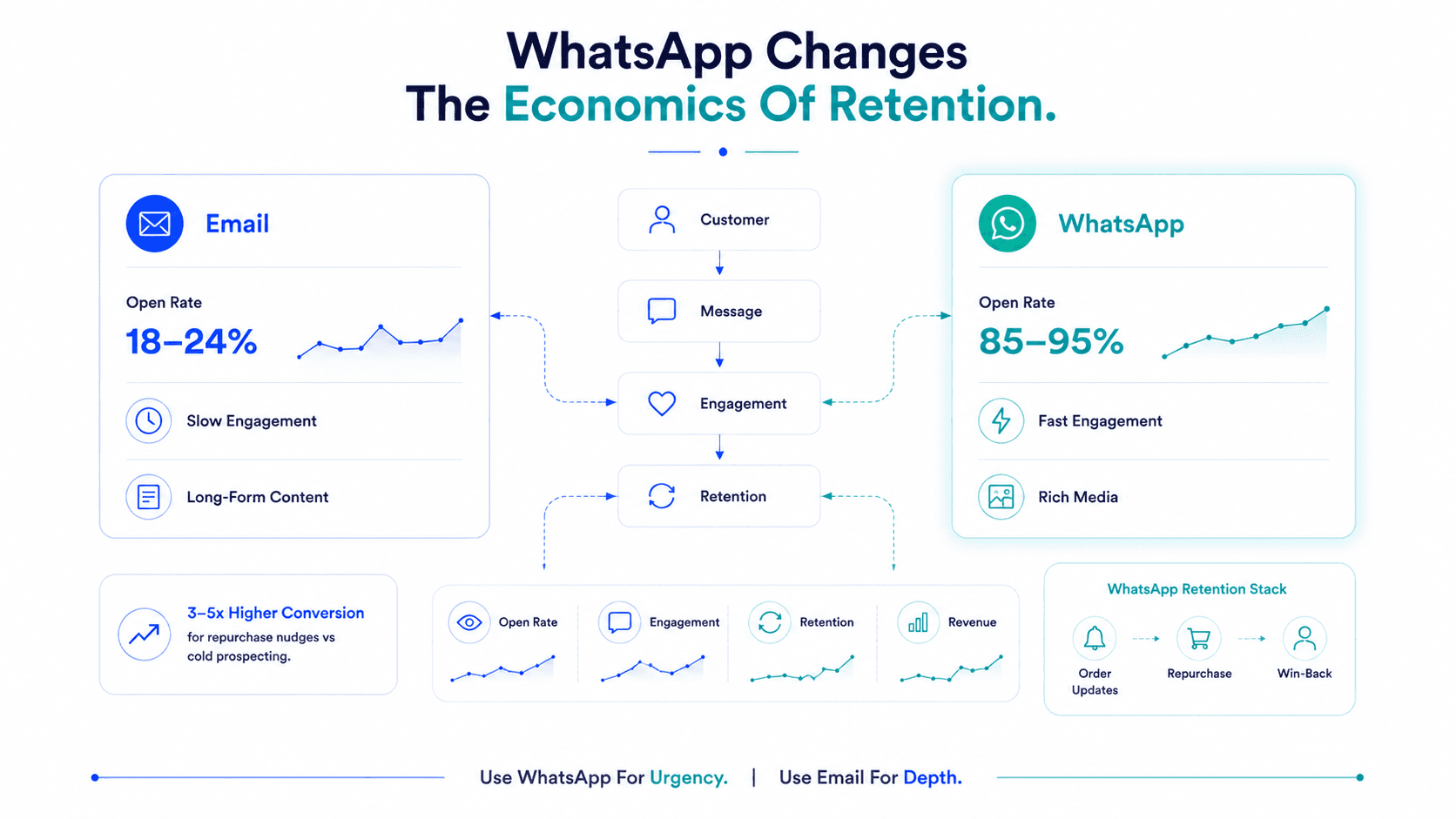
For Indian D2C brands, WhatsApp has 85–95% read rates vs email’s 18–24%. Repurchase nudges and win-back messages via WhatsApp consistently outperform email for the same content. Build your opted-in WhatsApp subscriber list through post-purchase opt-ins and Click-to-WhatsApp Meta ads.
SMS
Lower engagement than WhatsApp for most Indian D2C audiences, but useful for time-sensitive messages (order status, flash sales) where WhatsApp isn’t available.
Push notifications
High-intent customers who have installed your app get real-time notifications. Effective for flash sales and stock alerts for wishlist items.
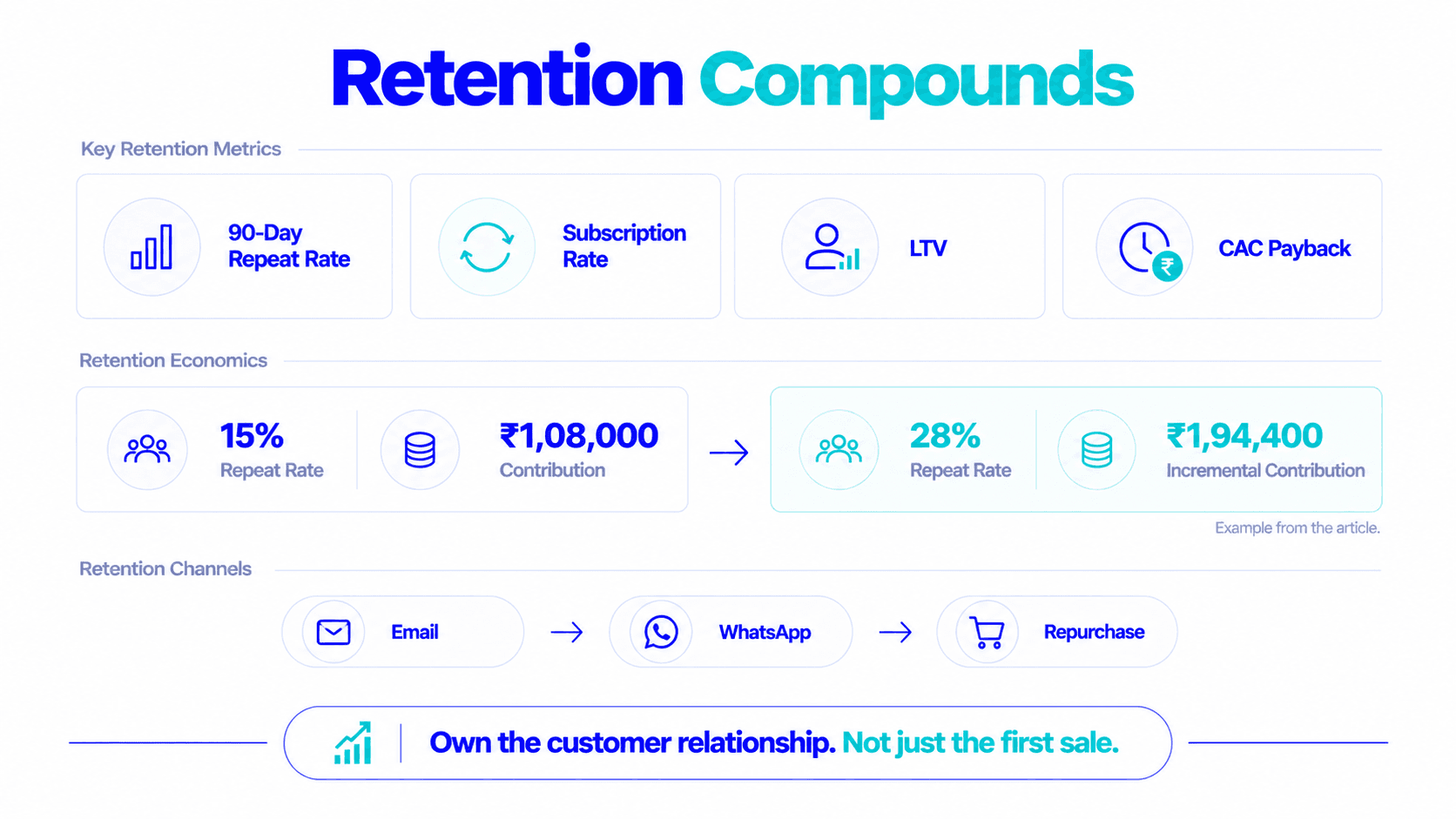
Here’s the calculation that makes retention investment obvious:
A brand spending ₹15L/month on Meta and Google at ₹750 true new customer CAC acquires 2,000 new customers.
15% 90-day repeat rate
28% with ₹1,50,000/month retention investment
The retention investment (email platform, WhatsApp BSP, retention team time) returns 3× in incremental contribution.
The alternative, spending ₹1,50,000 on additional acquisition, buys 200 more new customers at ₹750 CAC. Same contribution but requires ongoing acquisition spend to maintain.
Retention compounds. Acquisition doesn’t.
Customer retention is where the D2C business model pays off.
The acquisition campaign brought them in. Post-purchase onboarding keeps them. Timely repurchase nudges bring them back. Subscription converts passive loyalty into active recurring revenue. Win-back gives lapsed customers a reason to return.
Build all four retention pillars. Measure 90-day repeat purchase rate monthly. Track the trend across cohorts. And invest in retention before hitting the ceiling on acquisition efficiency, because every rupee of retention improvement compounds indefinitely, while acquisition efficiency has a floor.
The brands that win in D2C own their customers. Not just their first purchase.
Customer retention is the ability to bring acquired customers back for repeat purchases. In D2C, it's measured primarily through 90-day repeat purchase rate (% of new customers who make a second purchase within 90 days) and subscription rate. High retention transforms a ₹800 CAC from a one-time cost into an investment amortised across multiple orders.
Customer engagement measures how actively a customer interacts with your brand (email opens, social follows, site visits). Customer retention measures whether they repurchase. High engagement without retention is common, customers may love the brand but not have a consistent consumption need. Retention is the accountability metric; engagement is a leading indicator.
Varies by category: Supplements/food 30–40%+ is strong, Beauty/skincare 20–28%+, Fashion 15–20%+. Below-category benchmarks consistently indicate either a post-purchase experience problem, a product satisfaction issue, or a customer quality problem from acquisition.
Flable tracks true new customer CAC and CM2 per acquisition channel, letting you identify which channels acquire customers who actually return vs one-time buyers. When 90-day repeat data is combined with per-channel acquisition costs, you can clearly see which channels are building LTV and which are producing expensive one-time buyers.
Flable AI tracks true new customer CAC and CM2 per acquisition channel, so you can see which channels build LTV and which buy one-time customers.