Intelligence
500 million Indians use WhatsApp. More than any other app on their phone. It's where they talk to family. Where they share news. And increasingly — where D2C brands generate their highest-POAS revenue.
85% – 95%
vs 18–24% for Email
₹0.35 – ₹0.78
Meta official fee range
3x – 5x
Higher than cold ads
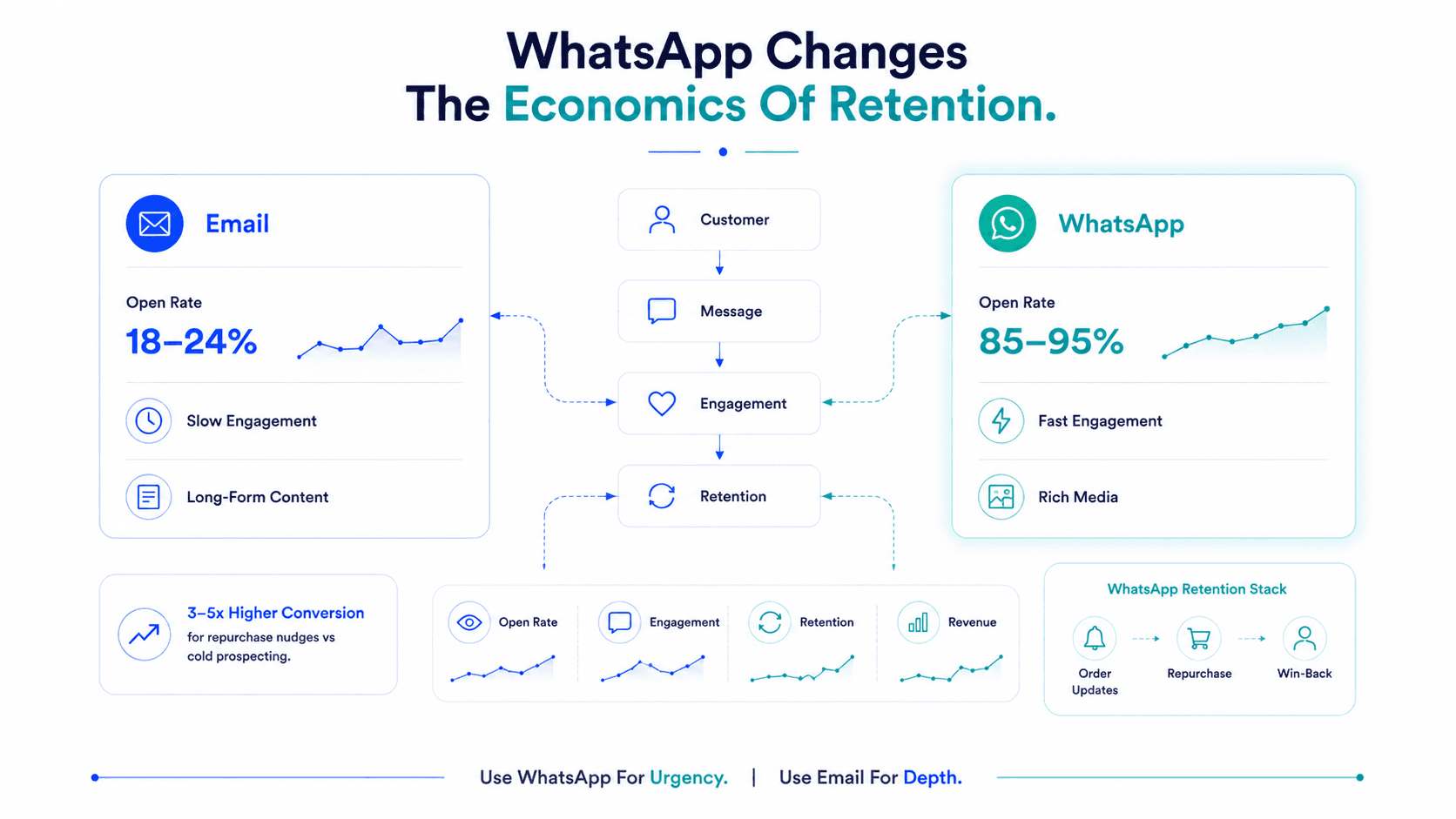
Email open rates for D2C brands in India average 18–24%. WhatsApp open rates average 85–95%.
That gap is not a marketing opportunity. It's a structural advantage, if you build the channel correctly.
Here's how.
Most D2C brands in India have three retention channels: email, SMS, and Instagram DMs. WhatsApp should be the fourth, and for brands targeting Tier 2 and Tier 3 cities, it should be the first.
WhatsApp's retention advantage comes from three things:
Conversational familiarity
WhatsApp is where customers already communicate with people they trust. A message there carries more weight than an email in a Promotions folder.
Read rates that make every other channel jealous
85–95% open rates aren't a benchmark, they're a floor. Most WhatsApp messages from brands customers opted into get read within 15 minutes.
Rich media at no extra cost
Images, videos, PDFs, product catalogues, WhatsApp supports everything that makes a retention message compelling, without the added friction of “click to view in browser.”
For D2C brands where the second purchase is the most important conversion, and where most retention spend goes to email that 75% of customers never open, WhatsApp changes the economics of retention meaningfully.
Most D2C brands find WhatsApp has the best retention economics of any channel they run. The brands that build it now have a retention advantage that compounds every month.
For marketing at scale, you need WhatsApp Business API, not the regular WhatsApp Business app.
The API allows: bulk messaging to opted-in customers, automated sequences, chatbot integration, and analytics. The app is capped at one-to-one conversations and small volumes.
BSP costs typically range from ₹2,500–₹15,000/month depending on message volume and features. WhatsApp charges per conversation (24-hour conversation window): approximately ₹0.35–₹0.58 per user-initiated conversation and ₹0.35–₹0.78 per business-initiated marketing conversation.
WhatsApp marketing is opt-in only. Sending marketing messages to numbers that haven't explicitly consented violates WhatsApp's Business Policy and can result in account suspension.
Post-purchase opt-in
The highest conversion point. After a customer completes an order on your Shopify store, show an opt-in prompt: “Get order updates and exclusive offers on WhatsApp.” Conversion rates from post-purchase prompts typically run 35–55% — significantly higher than email opt-in at the same point.
Website widget
A WhatsApp click-to-chat button on your website (especially on product pages and the cart) invites users to start a conversation. Anyone who messages you has implicitly consented to WhatsApp communication.
Meta Click-to-WhatsApp Ads
Meta ads with a WhatsApp CTA (instead of a website link) send users directly into a WhatsApp conversation. This builds your opted-in list through paid acquisition — and the conversation itself is a warm lead. Cost per WhatsApp conversation is typically 40–60% lower than cost per website click for D2C brands in India.
QR codes on packaging
Every package you ship is a touchpoint. A QR code on your packaging inserts, “Scan to join our WhatsApp community for exclusive offers”, converts customers into WhatsApp subscribers at zero marginal cost.
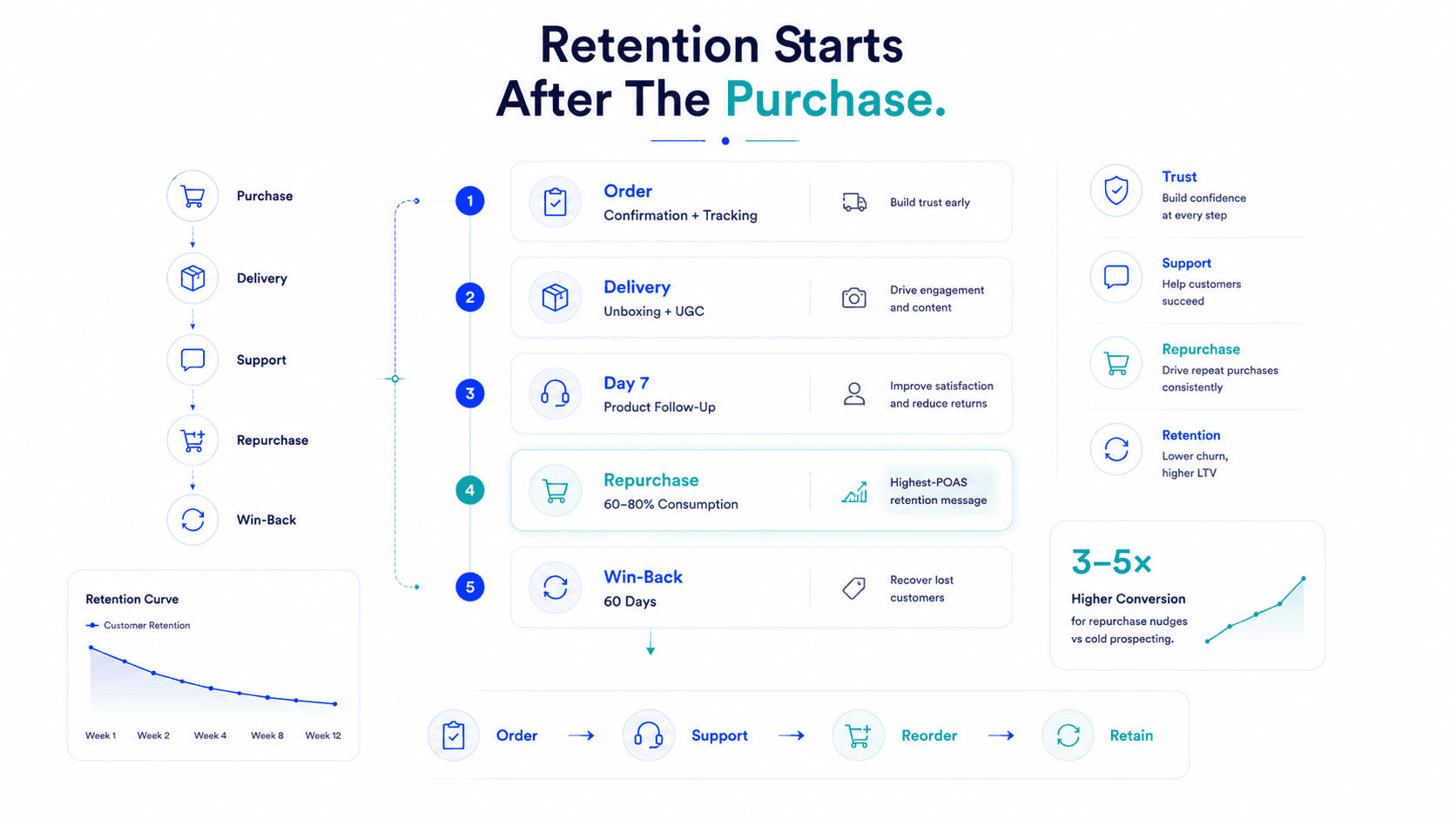
Send immediately after order placement. Include order details, expected delivery date, and a tracking link. This reduces “where is my order?” customer service queries by 40–60% and builds trust before the product arrives.
This is a transactional message: lower cost, higher deliverability, and the foundation of customer communication.
Send when the order is marked delivered. Message: “Your [product name] is here! Share your unboxing with us, tag us on Instagram and get 10% off your next order.”
Two outcomes: reduces return consideration window (customers who engage post-delivery return less) and generates UGC content for your next ad creative.
Seven days after delivery: product check-in. “How are you getting on with [product name]? Here's a quick guide to getting the most from it.” Include usage tips, FAQ, and an invitation to reply with questions.
This message exists to reduce returns and improve product satisfaction, not to sell. Customers who feel supported post-purchase are significantly more likely to repurchase.
For consumable products: send a repurchase nudge at 60–80% of the average consumption window. Supplements (30-day supply): nudge on day 22–25. Skincare (45-day supply): nudge on day 35–38.
Message: “[Product name] running low? Reorder today and get X% off / free shipping / early access to our new launch.”
This is your highest-POAS retention message. The customer already knows the product. The acquisition cost is zero. The conversion rate is typically 3–5x higher than cold prospecting.
Customers who haven't ordered in 60 days receive a re-engagement message. Don't lead with a discount, lead with value. “We've launched [new product] that complements what you bought last time. Here's why you'll love it.” Discount as a last resort if the first message doesn't convert.
| Situation | ||
|---|---|---|
| Urgent time-sensitive offers | ✅ First choice | ❌ Too slow to open |
| Order updates and tracking | ✅ First choice | ⚠️ Backup |
| Repurchase nudges | ✅ First choice | ✅ Supplement |
| Long-form content (brand story, guides) | ❌ Format doesn't suit | ✅ First choice |
| Lapsed customer reactivation | ✅ Strong | ✅ Also strong |
| Tier 2/3 city customers | ✅ First choice | ⚠️ Lower engagement |
| Product launches | ✅ First choice | ✅ Supplement |
Not either/or. WhatsApp and email are complementary. WhatsApp wins on urgency and open rate. Email wins on content depth and long-form storytelling. Use both.
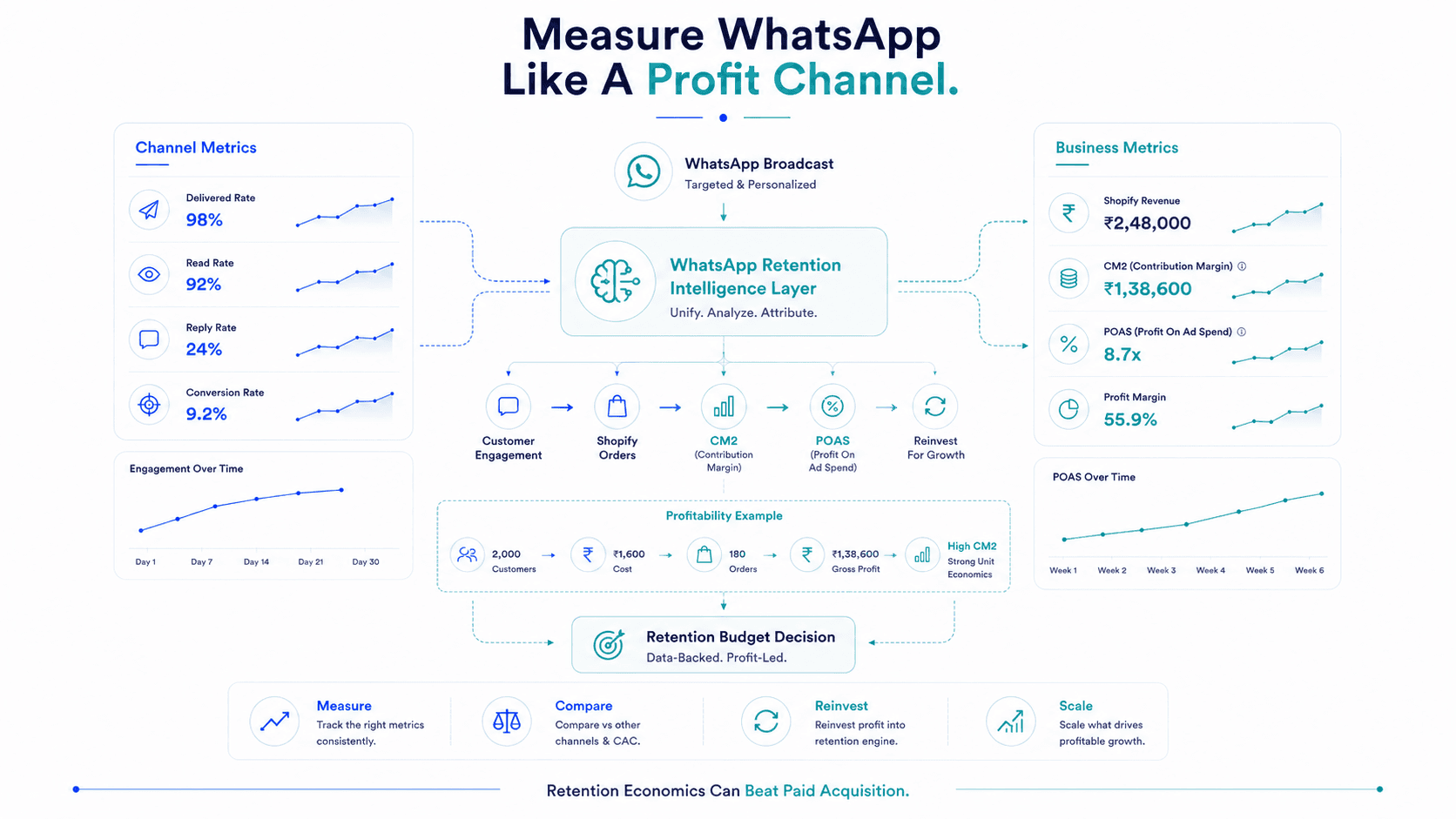
WhatsApp's contribution to revenue needs measurement, otherwise it competes with email and other retention channels for budget based on gut feel rather than data.
Messages sent & Delivered rate
Should be above 90% for healthy lists
Read rate
Above 80% is strong
Reply & Conversion rate
Use UTM links in every message for Shopify tracking
Revenue & Cost per conversation
BSP fee + WhatsApp API fee per broadcast
Because WhatsApp cost is low (₹0.50–₹0.80 per conversation) and it targets existing customers (zero acquisition cost), contribution margin from WhatsApp is almost always significantly better than paid acquisition channels.
A repurchase nudge message sent to 2,000 customers at ₹1,600 total cost (₹0.80/conversation)
Generates 180 orders at ₹1,400 AOV and 55% effective margin
= ₹1,38,600 gross profit on ₹1,600 spend
That is not an exaggerated number. WhatsApp retention economics are genuinely that different from paid acquisition.
WhatsApp is India's most underdeveloped D2C marketing channel, not because brands don't know it exists, but because most haven't built the opt-in list, the sequence infrastructure, or the measurement system to use it properly.
Build the opt-in list through post-purchase prompts and Click-to-WhatsApp ads. Set up the five core sequences. Measure with UTM links. Compare POAS against your paid acquisition channels.
Most D2C brands find WhatsApp has the best retention economics of any channel they run. The brands that build it now have a retention advantage that compounds every month.
Through WhatsApp Business API via a Meta-approved Business Solution Provider (BSP) like Interakt, Wati, Aisensy, Zoko, or Gallabox. The API allows bulk messaging, automated sequences, and analytics, unlike the standard WhatsApp Business app which is limited to small-scale one-to-one conversations.
Yes, when messages are sent only to customers who have explicitly opted in. WhatsApp's policy requires clear consent before sending marketing messages. Sending to non-opted-in numbers violates policy and risks account suspension.
Repurchase nudges, sent to existing customers at 60–80% of their product's consumption window. These messages target customers who already know and trust the product, have zero acquisition cost, and convert at 3–5x the rate of cold prospecting campaigns.
WhatsApp open rates average 85–95% vs email's 18–24%. WhatsApp is significantly better for urgent, time-sensitive messages and for reaching Tier 2/3 city customers where email engagement is lower. Email is better for long-form content and detailed product education. Both channels belong in the retention stack.
Flable measures CM2 per channel, including WhatsApp when UTM tracking is in place. This lets you directly compare the contribution margin from WhatsApp retention campaigns against paid acquisition channels, so budget allocation decisions are grounded in real profitability.
Connect WhatsApp and retention revenue directly to your contribution margin dashboard. Compare retention POAS against paid acquisition with zero guesswork.