Deep Dive
You open Meta Ads Manager on Monday morning. 4.2x ROAS. You flip to Google Ads. 3.8x there. You check your revenue dashboard. The actual number from last week tells a completely different story. Which number do you trust?
ROAS is a simple ratio: revenue generated divided by ad spend. If you spend ₹10L and generate ₹40L in revenue, your ROAS is 4x.
Straightforward in theory. In practice, the "revenue generated" side is where everything gets complicated — and for D2C brands specifically, the gap between reported and real revenue is wider than in almost any other business model.
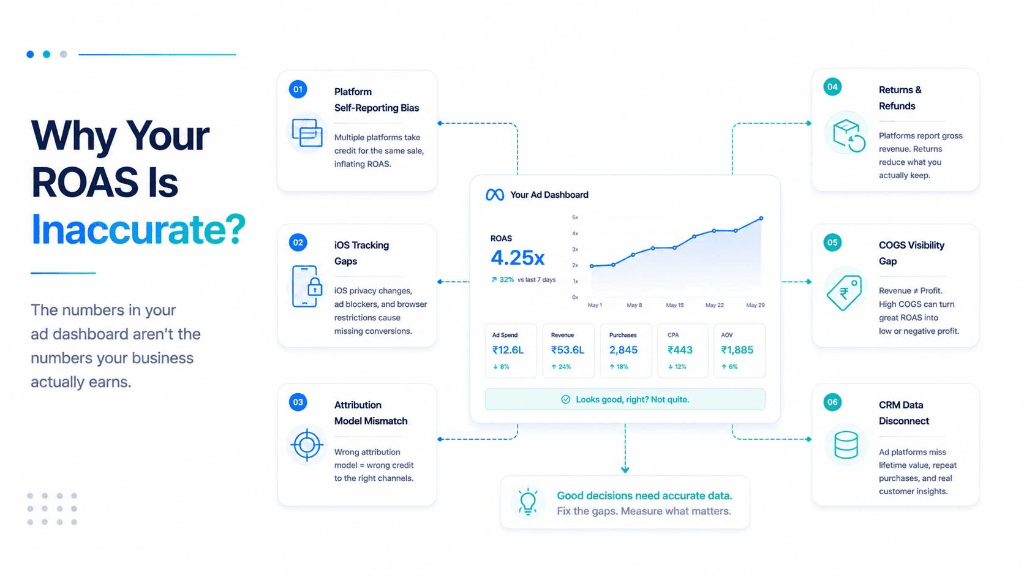
Every major ad platform — Meta, Google, TikTok — uses a self-attribution model. This means each platform measures conversions based on its own rules and takes credit accordingly. The result: multiple platforms routinely claim credit for the same sale.
Apple's App Tracking Transparency framework, introduced with iOS 14.5, was the single biggest disruption to D2C performance marketing in the past five years. When Apple required apps to ask for tracking permission, a large portion of iOS users opted out.
Even with perfect tracking, your ROAS can be misleading if your attribution model doesn't reflect how your customers actually make decisions.
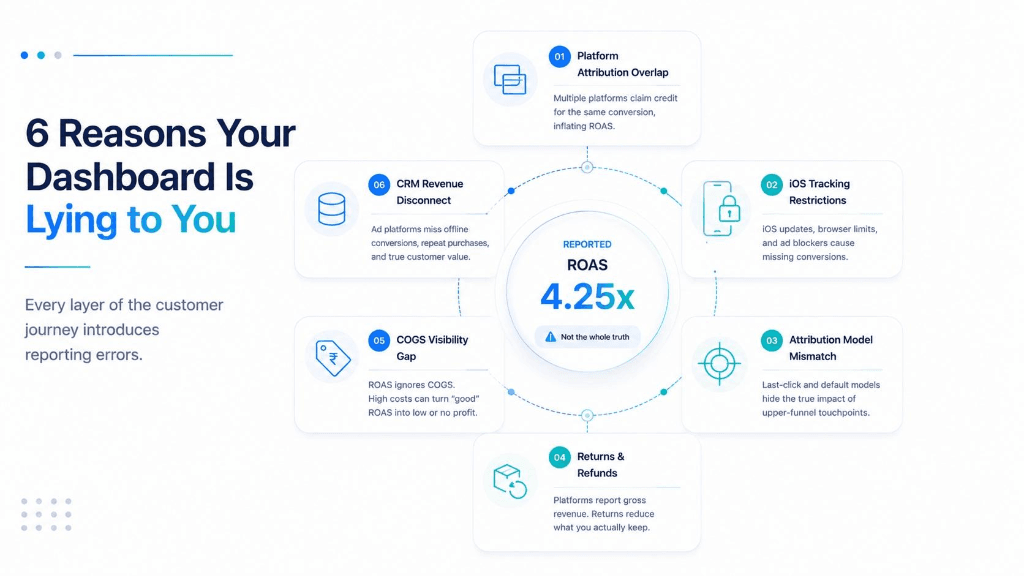
A campaign showing 4x ROAS with a 20% return rate has a real ROAS of approximately 3.2x. That gap — 4x vs 3.2x — changes the scaling decision completely. At ₹10L/month spend, the difference between optimising on reported ROAS vs return-adjusted ROAS can mean allocating ₹2–3L/month to campaigns that are less profitable than they appear.
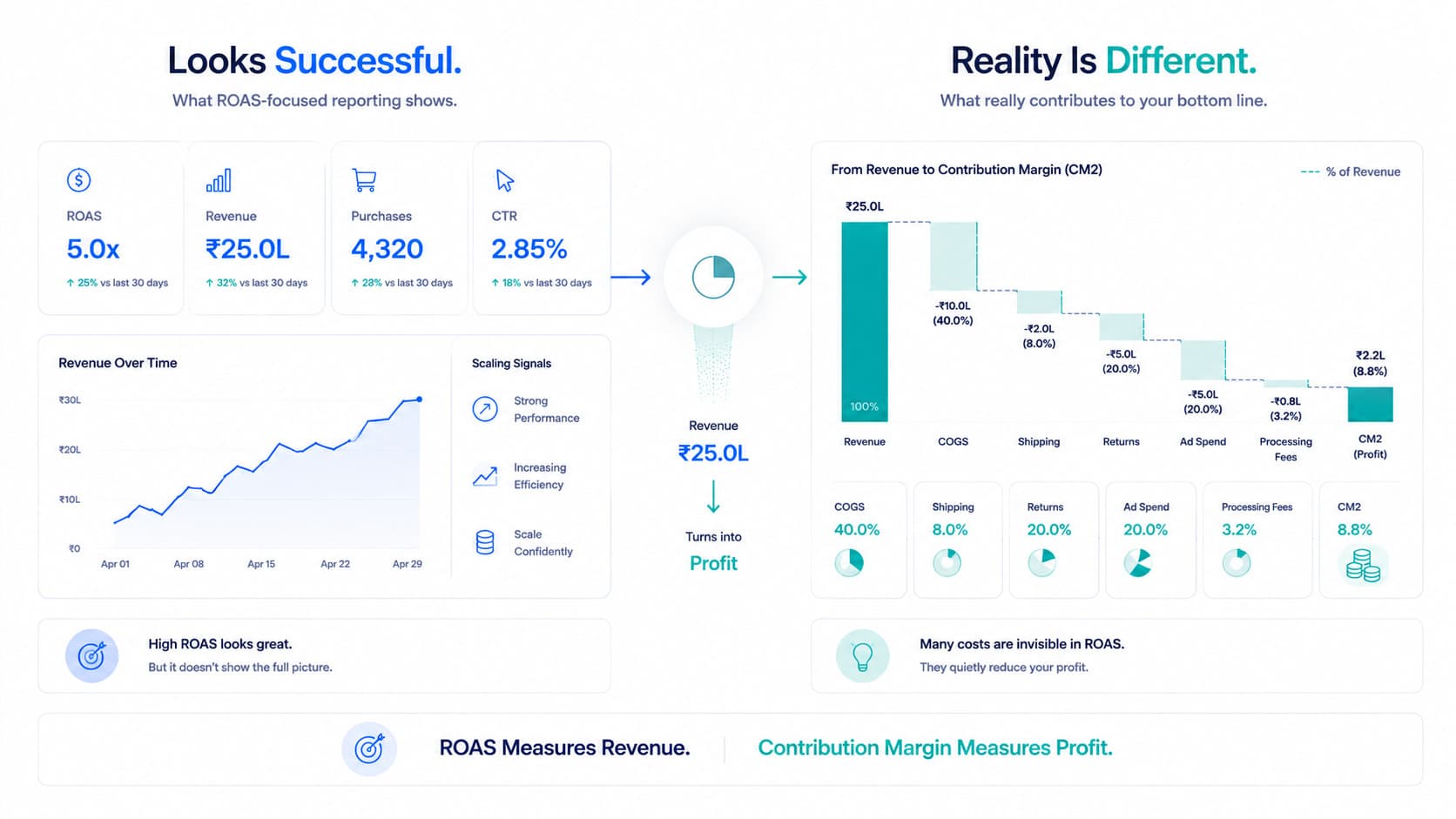
ROAS measures revenue against ad spend. It says nothing about what you actually earned on that revenue. A 4x ROAS on a product with 60% gross margin is a very profitable campaign. A 4x ROAS on a product with 18% gross margin after COGS, packaging, and fulfilment may barely break even.
Ad platforms track front-end events — purchases, form fills, checkouts. They cannot see what happens downstream like chargebacks, subscription cancellations, or actual average order value variation.
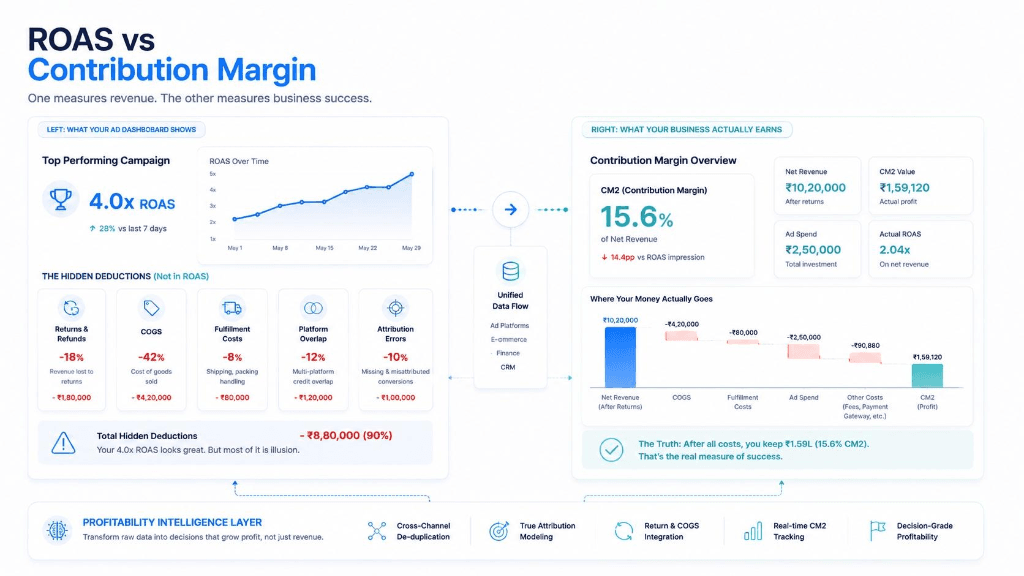
Let's make this concrete. Your reported blended ROAS across Meta and Google is 4x. You've been scaling confidently for three months. Now run the adjustments:
You've been scaling a 4x ROAS campaign that's generating 4–5% contribution margin. You're effectively trading ₹96 in costs for ₹4–5 in profit per ₹100 of revenue. That is not growth. That is very efficient margin erosion.
This is what Flable AI is built to give D2C brands. Not another attribution dashboard — but the real CM2 layer that reconciles ad data with actual business outcomes: returns, COGS, fulfilment, and net revenue in one real-time view.
Your ROAS is inaccurate. Not because the platforms are lying — because the platforms can only see what they can see. Build the measurement foundation that accounts for all six flaws. Then make decisions on real contribution margin — not ROAS.
That is how D2C brands stop growing revenue and start growing profit.
Frequently Asked Questions
Because each platform uses self-attribution — they each take credit for conversions based on their own rules. When a customer interacts with both a Meta ad and a Google ad before purchasing, both platforms count the same sale as their conversion. Your combined ROAS across platforms is almost always inflated by this double-counting.
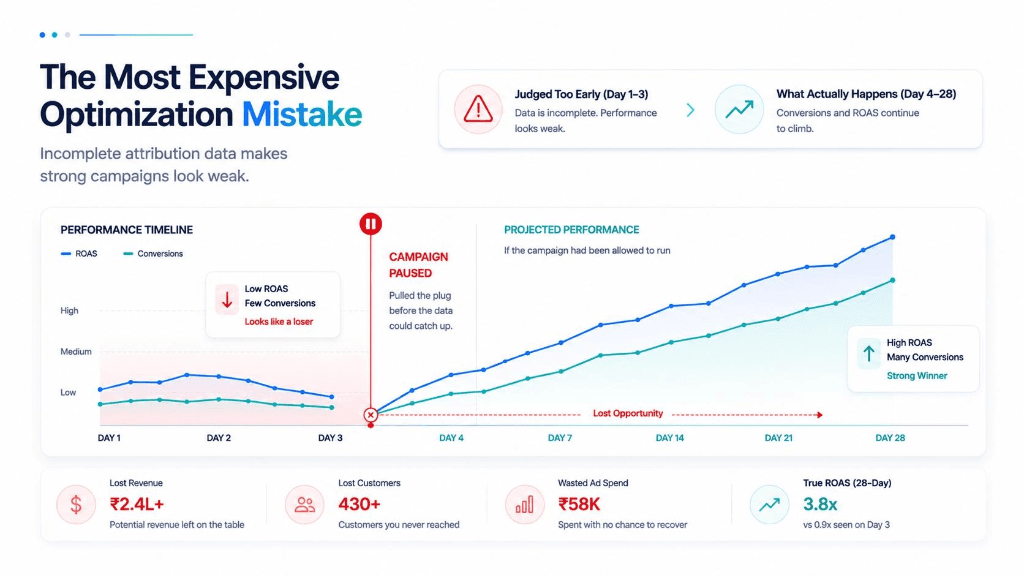
Apple's App Tracking Transparency (ATT) removed device-level tracking for opted-out iOS users, creating significant gaps in Meta's conversion data. The result: your campaigns are likely driving more conversions than Meta reports. Your ROAS appears lower than reality for these campaigns, potentially leading you to underinvest in what's actually working.
View-through attribution gives credit to an ad when a user saw it (but didn't click) and later converted. Meta's default includes 1-day view attribution — if someone saw your ad and converted through any channel within 24 hours, Meta takes credit. Many of these would have converted organically anyway, inflating your reported ROAS without reflecting genuine ad-driven conversions.
Ad platforms track purchase events but not returns. When a customer returns a product, the purchase stays counted as a conversion in your ad account. For D2C brands with 15–25% return rates, this systematically inflates reported ROAS by the same percentage. A reported 4x ROAS with a 20% return rate is actually approximately 3.2x on net revenue.
Flable connects your ad data, revenue, returns, COGS, and fulfilment costs to show real contribution margin per campaign in real time — not platform-reported ROAS. It provides the return-adjusted, margin-adjusted performance metric that platform dashboards cannot calculate. Decisions made on Flable's CM2 data are grounded in actual business outcomes rather than self-reported platform metrics.
Return-adjusted, COGS-adjusted CM2 per campaign — live. The number your business actually earned.
See Your Real Profitability →Setup in 48 hours · No credit card required · Backed by Microsoft & NVIDIA