Deep Dive
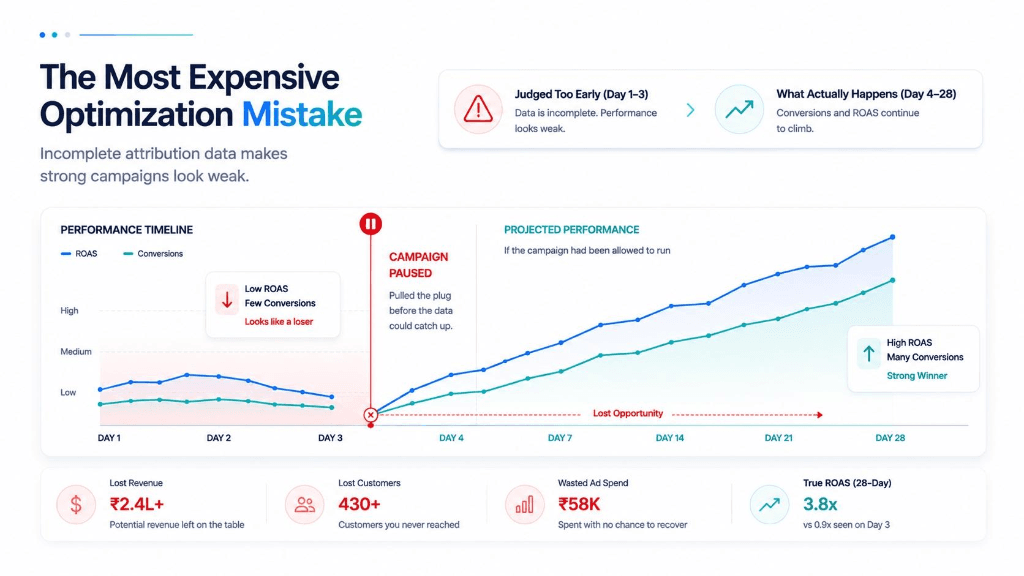
You launch a new Meta campaign. Day 3 CPA looks high. ROAS looks weak. The instinct fires immediately: this isn't working. So you kill it. What you didn't know is that 40% of the conversions from that campaign hadn't been reported yet.
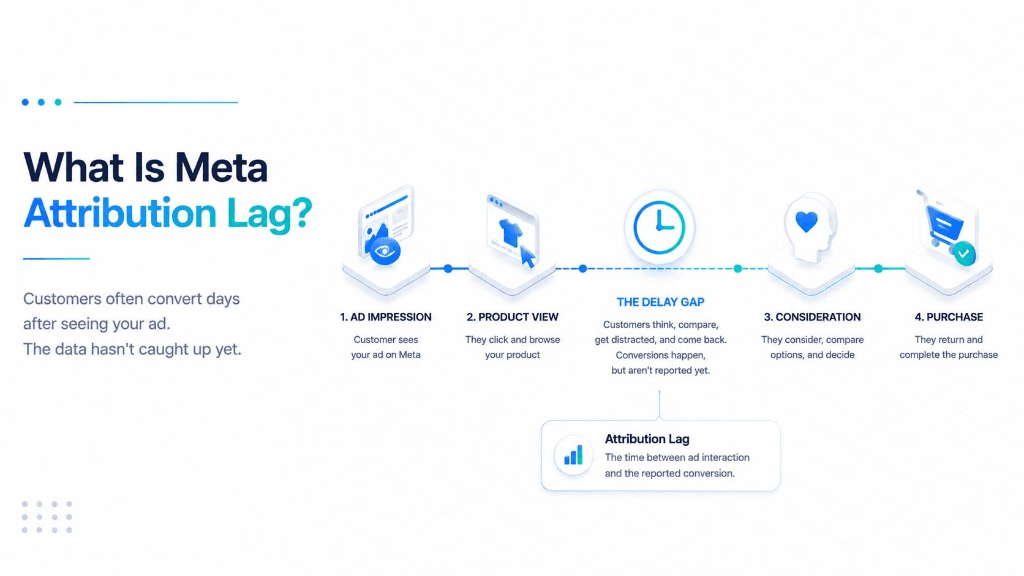
Attribution lag is the delay between when someone engages with your ad and when they actually convert.
Every purchase follows a journey: discovery, consideration, decision. A customer sees your Meta ad on Tuesday. They don't click. They see it again on Thursday, click through, browse your product page, and close the tab. On Saturday, they come back directly and buy.
That purchase happened. It was influenced by your Meta campaign. But if you're looking at your Ads Manager dashboard on Friday — two days after the campaign launched — you see almost nothing. The conversion hasn't happened yet.
This is the core of attribution lag. The ad did its job. The platform just hasn't reported the outcome yet because the customer hasn't finished deciding.
Meta uses the term attribution window to define how long it can link a conversion back to an ad interaction.
For optimization, Meta defaults to a 7-day click, 1-day view window — meaning conversions that happen more than 7 days after a click don't get used to guide delivery optimization.
For reporting, you can view up to 28 days post-click in Ads Manager. This extended view doesn't affect how the algorithm optimizes, but it gives you a much clearer picture of which ads actually influenced sales — especially for higher-consideration products.
Why this matters: If you judge a new campaign after 3 days using the 1-day click window, you're seeing only a fraction of the conversions that campaign will ultimately generate. You're making a scaling or killing decision based on incomplete data.
The most direct consequence. A campaign is launched, judged on 2–3 days of data, looks underperforming, gets paused. Three weeks later, a competitor launches what looks like a very similar campaign and it performs well. What happened? They let it run long enough for the attribution window to fill. You didn't.
The flip side is equally dangerous. A campaign with low-consideration products and high impulse-buy rates shows great 1-day ROAS immediately. You scale aggressively. But those are the easy wins — the customers who were already in buying mode. Early strong data created a false signal.
Meta's Learning Phase requires approximately 50 optimization events within 7 days to exit. If you pause or significantly adjust a campaign during the Learning Phase because early ROAS looks weak, you reset the learning and the algorithm has to start over.
Attribution lag makes Learning Phase performance look even worse than it is. Pausing during this period because the ROAS looks bad is one of the most common and most costly mistakes in D2C Meta advertising.
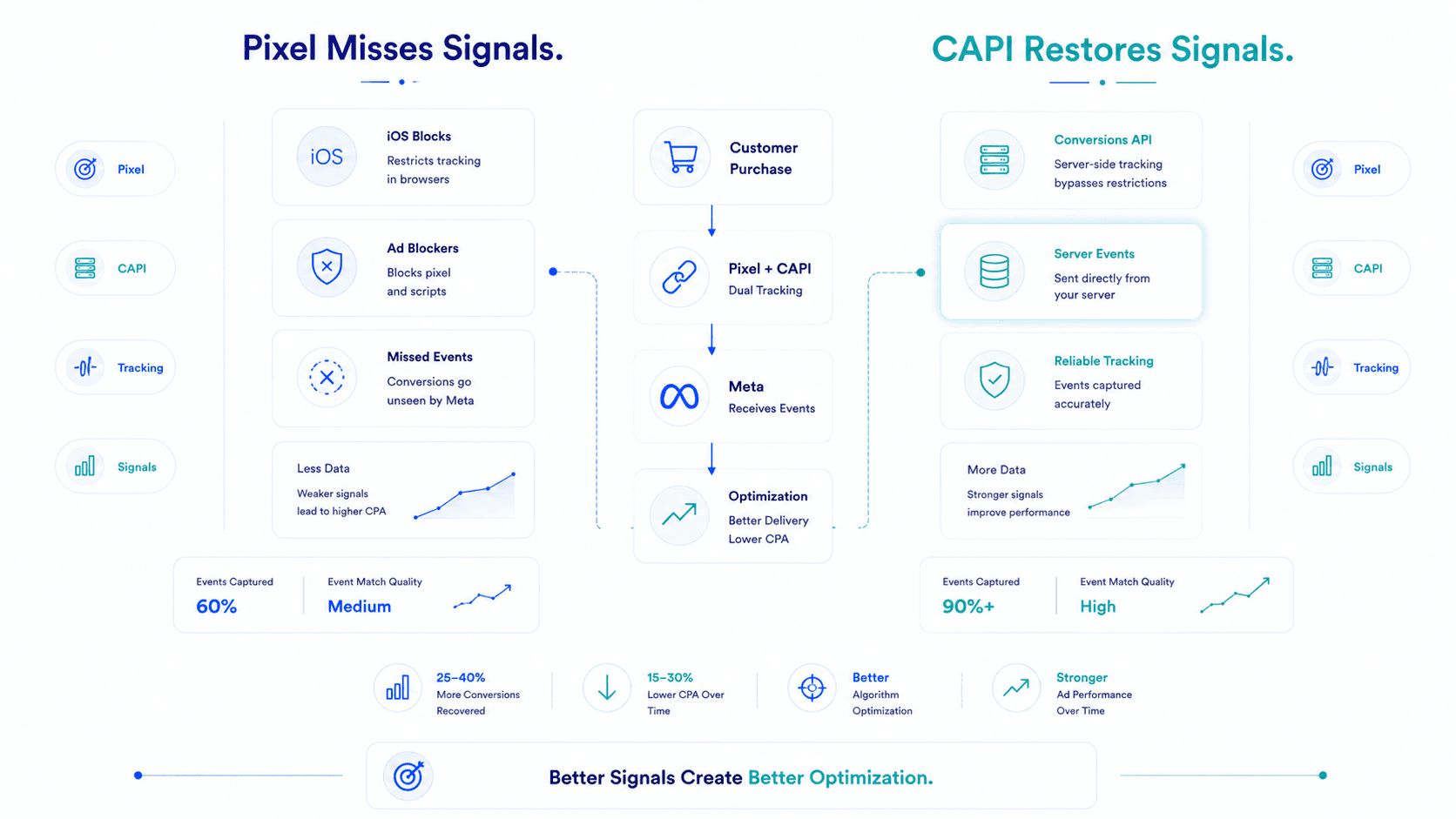
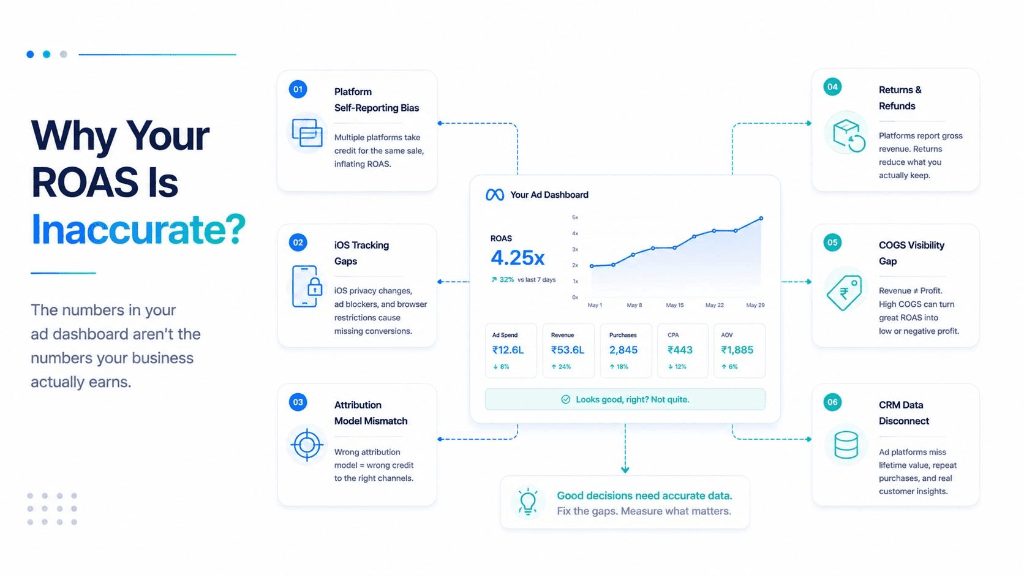
For D2C brands, there's a layer of complexity that attribution lag discussions almost always skip. Your Meta Ads Manager shows conversions filling in over 28 days. It does not show returns.
A customer who converted on day 4 might return the product on day 10. That conversion disappears from your real revenue — but it stays in your Ads Manager as a conversion. Your ROAS is inflated.
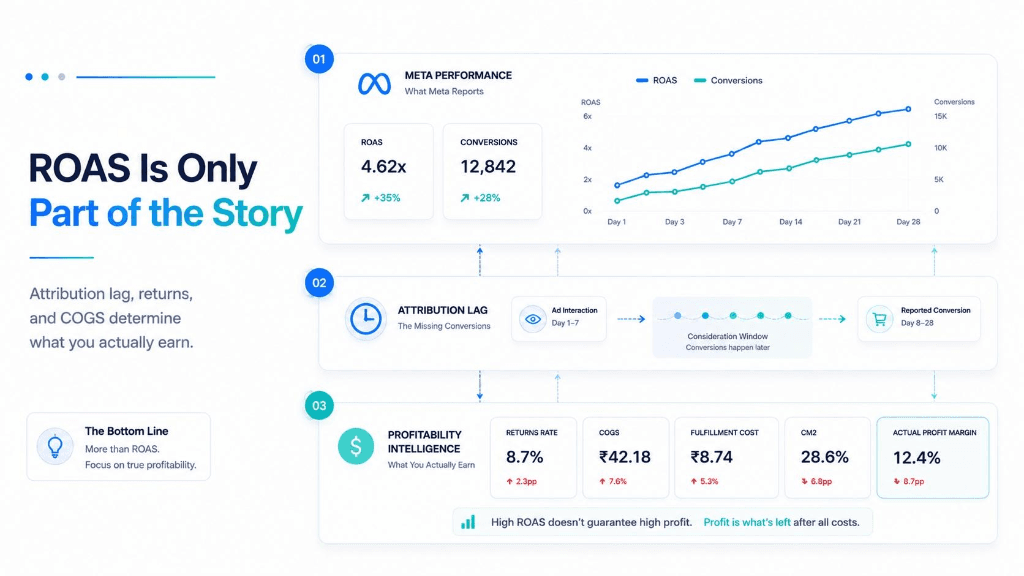
This is exactly what Flable AI provides: contribution margin per campaign in real time, adjusted for returns and COGS, so your performance data reflects what your business actually earned — not what Meta reported.
Never make significant optimization decisions (pause, scale, kill) on a campaign under 7 days old or under your measured average lag, whichever is longer.
Always compare 1-day, 7-day, and 28-day attribution when evaluating campaign performance.
Do not adjust or pause a campaign in the Learning Phase because early ROAS looks weak.
Set retargeting window lengths based on your measured attribution lag, not on default settings.
Use return-adjusted performance data as your primary metric. Platform ROAS does not account for returns.
Attribution lag is not a Meta quirk you can ignore. It is a systematic distortion that affects every campaign decision you make. The brands that get this right stop killing campaigns that were about to work. That alone is worth a significant amount of money.
Measure your lag. Build it into your optimization rules. And pair your lag-adjusted performance data with return-adjusted, margin-adjusted CM2 to get the complete picture.
Frequently Asked Questions
Attribution lag is the delay between when a user engages with your Meta ad and when they actually convert. Because customers need time to consider purchases, many conversions happen days or even weeks after the initial ad interaction — and Meta's reporting shows them gradually filling in over the attribution window.
Go to Ads Manager → Columns → Attribution Settings → Compare Attribution Settings. Select 1-day click, 7-day click, and 28-day click. Apply. You'll see conversions broken out by each window across your campaigns.
Because a significant portion of conversions — often 30–50% for D2C brands — happen after day 3. Judging on early data means making scale or kill decisions based on incomplete performance. You may kill a campaign that was about to become your strongest performer.
Meta needs approximately 50 optimization events within 7 days to exit Learning Phase. If you pause a campaign during Learning Phase because early ROAS looks weak (partly due to attribution lag), you reset the learning clock and the algorithm starts over. Let campaigns run through Learning Phase before making significant changes.
Flable provides contribution margin per campaign adjusted for returns and COGS — not just platform-reported ROAS. This means even as attribution fills in over 28 days, you're seeing the real financial outcome of each campaign (return-adjusted, margin-adjusted) rather than the inflated platform metric.
Real CM2 per campaign, per channel — live, adjusted for returns. Not what Meta reports. What you actually earned.
See Your Real Profitability →Setup in 48 hours · No credit card required · Backed by Microsoft & NVIDIA