Metrics Guide
Why AI Should Optimize for Profit, Not Revenue
AI-driven ad optimization has become the default operating mode for performance marketing. Meta's Advantage+ campaigns, Google's Performance Max, and a growing list of third-party tools all promise to let machine learning handle bidding, budget allocation, and audience targeting better than a human media buyer ever could. In many respects, they deliver on that promise, Advantage+ adoption grew from roughly a third of ecommerce ad spend in 2024 to well over 60% in 2025, and platforms report meaningfully lower cost-per-acquisition for brands using these automated systems.
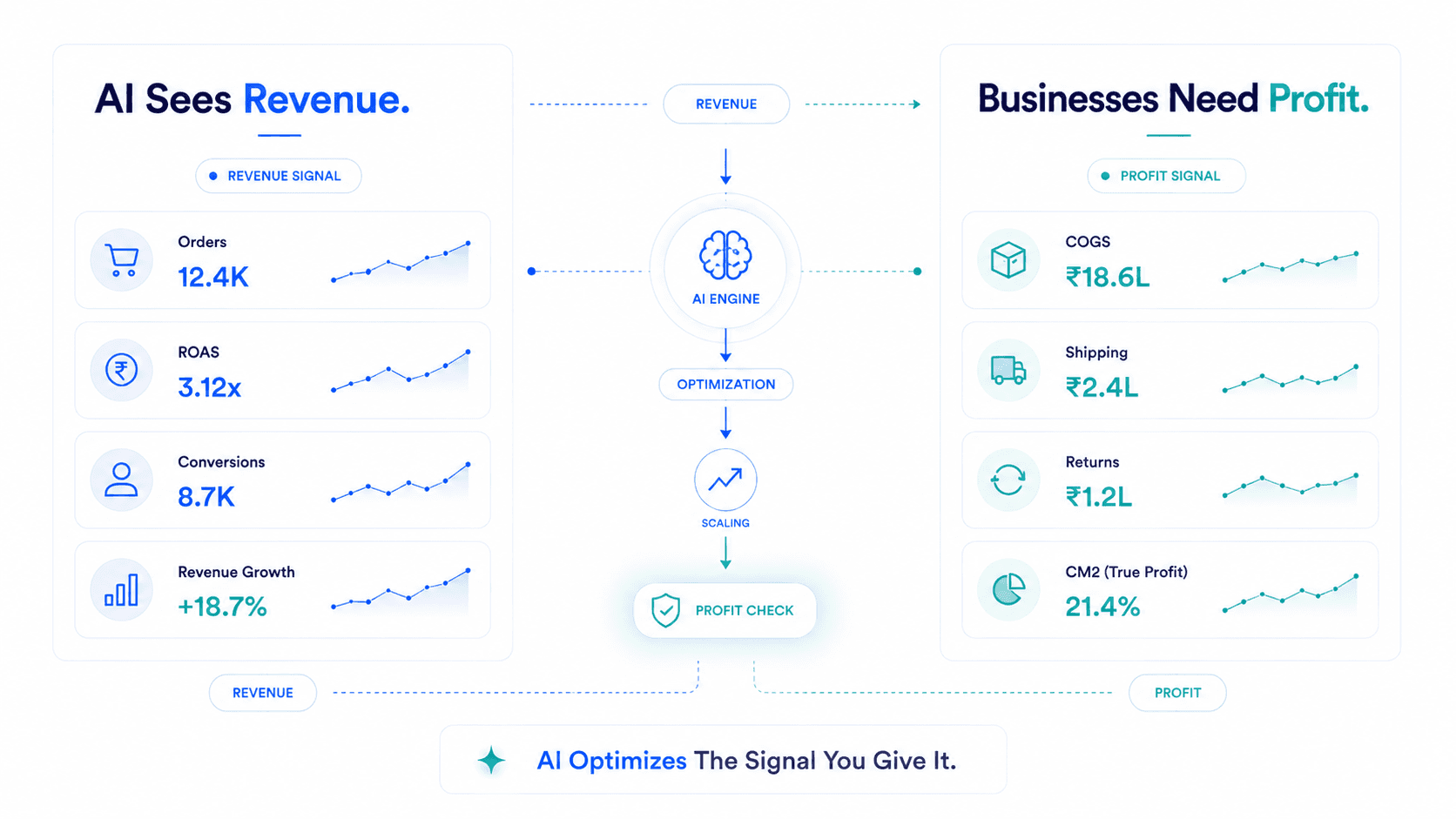
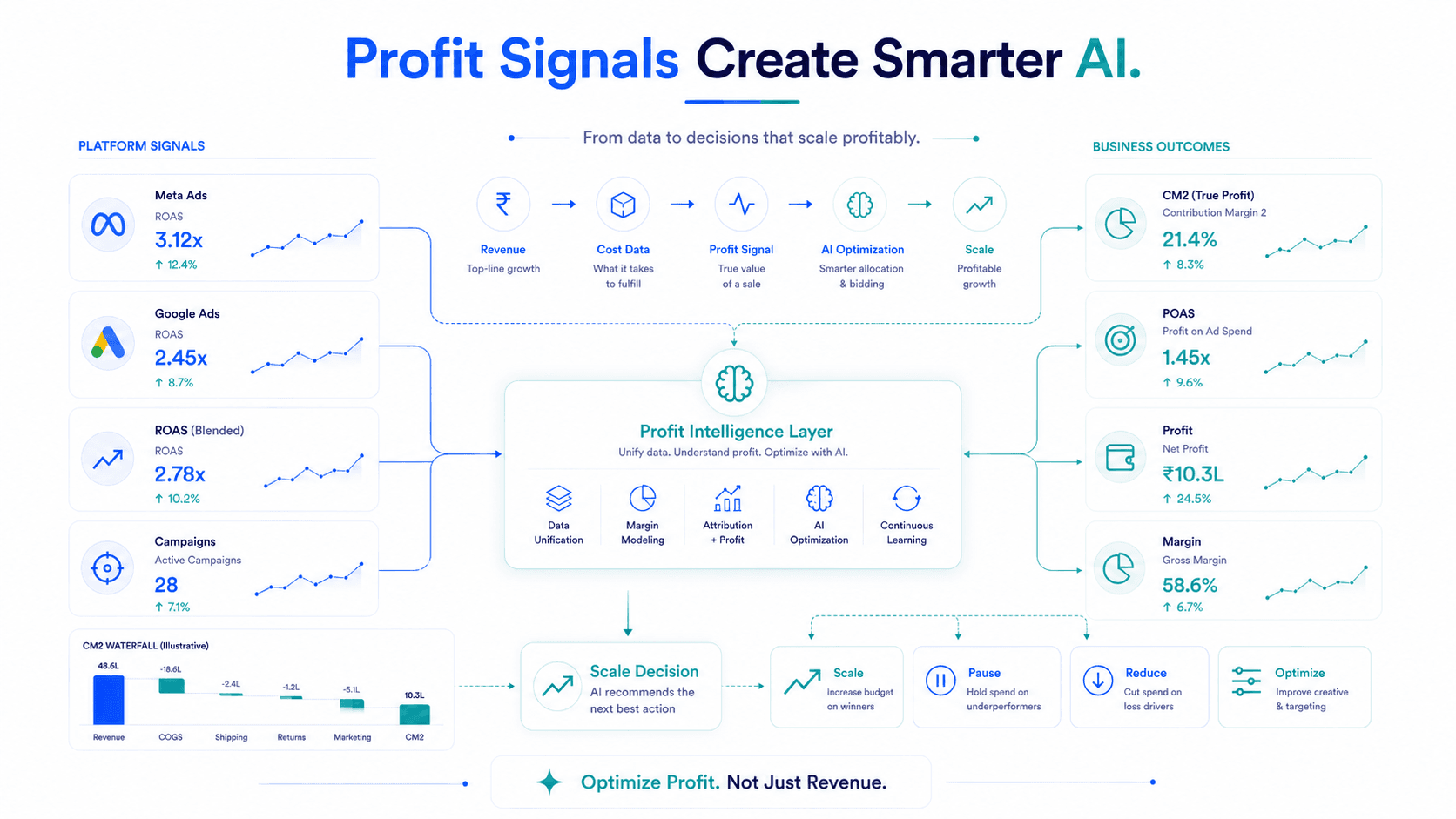
But there's a quiet assumption buried inside almost every one of these tools: they're built to optimize for revenue and conversion volume, because that's the data they can see in real time. Profit, the number that actually matters to the business usually isn't part of the equation unless a brand deliberately puts it there.
This is not a flaw unique to any one platform. It's a structural reality of how algorithmic optimization works: the algorithm optimizes for whatever signal you feed it, and most brands are only feeding it revenue.
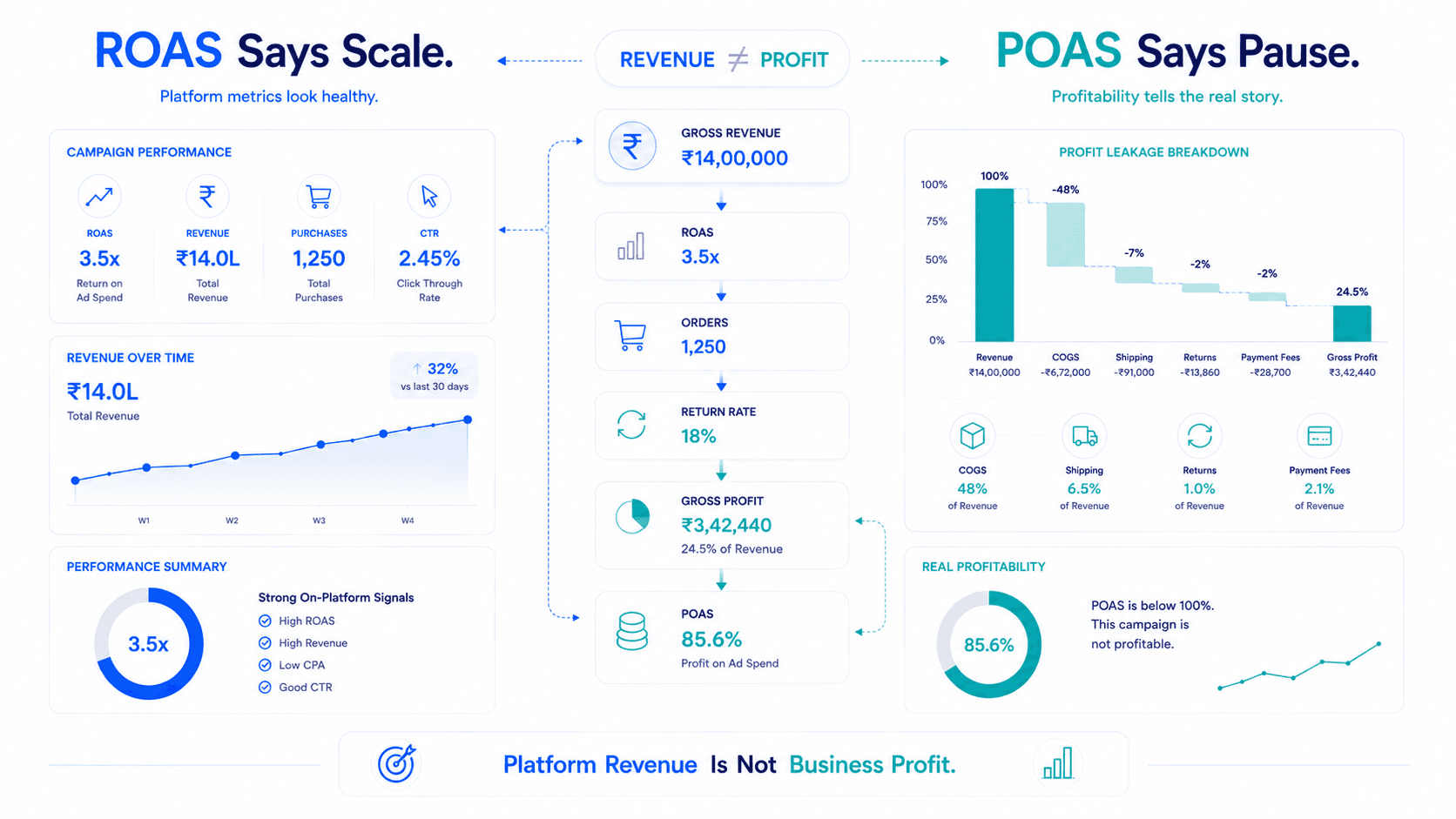
Machine learning bidding systems are optimization engines. Give them a goal and a stream of data, and they will relentlessly pursue that goal. The issue is what goal they're typically given by default: purchases, revenue, or a target ROAS. None of these are wrong signals they're just incomplete ones, in exactly the same way ROAS itself is an incomplete metric (see our full breakdown in ROAS vs POAS vs MER).
An algorithm optimizing purely for revenue has no innate understanding that Product A carries a 60% margin while Product B carries a 15% margin. Left unchecked, it will happily scale whichever product converts best at the lowest cost per acquisition regardless of whether that product is actually profitable to sell.
Modern bidding systems like Meta's Advantage+ and Google's Performance Max use signals such as:
Notice that cost of goods, contribution margin, and true profitability are absent from this list unless a brand manually engineers them in for example, by setting value-based bidding using profit-adjusted "revenue" figures rather than raw order value. Very few brands do this, largely because it requires clean, real-time COGS data feeding into the ad platform, which most ecommerce operations simply don't have wired up.
This is the uncomfortable part: an algorithm doesn't distinguish between "efficient growth" and "efficient loss." If a low-margin, heavily discounted SKU converts well, a revenue-optimized system will allocate more budget toward it not because it's good for the business, but because it satisfies the optimization target it was given.
This is precisely why some brands report scaling ad spend, watching ROAS hold steady or even improve, and still seeing overall profitability decline. The AI did exactly what it was told to do. It just wasn't told the right thing.
A home goods brand runs Advantage+ Shopping campaigns across its full catalog.
SKU A (a hero ceramic mug set): 58% margin, $32 average order value, moderate conversion rate.
SKU B (a discounted bundle promoted heavily): 19% margin, $45 average order value, high conversion rate due to steep promotional pricing.
Because SKU B converts more efficiently in raw revenue terms, the algorithm allocates an increasing share of budget toward it over several weeks. ROAS for the account overall even improves slightly, since SKU B's higher average order value pushes up the blended number.
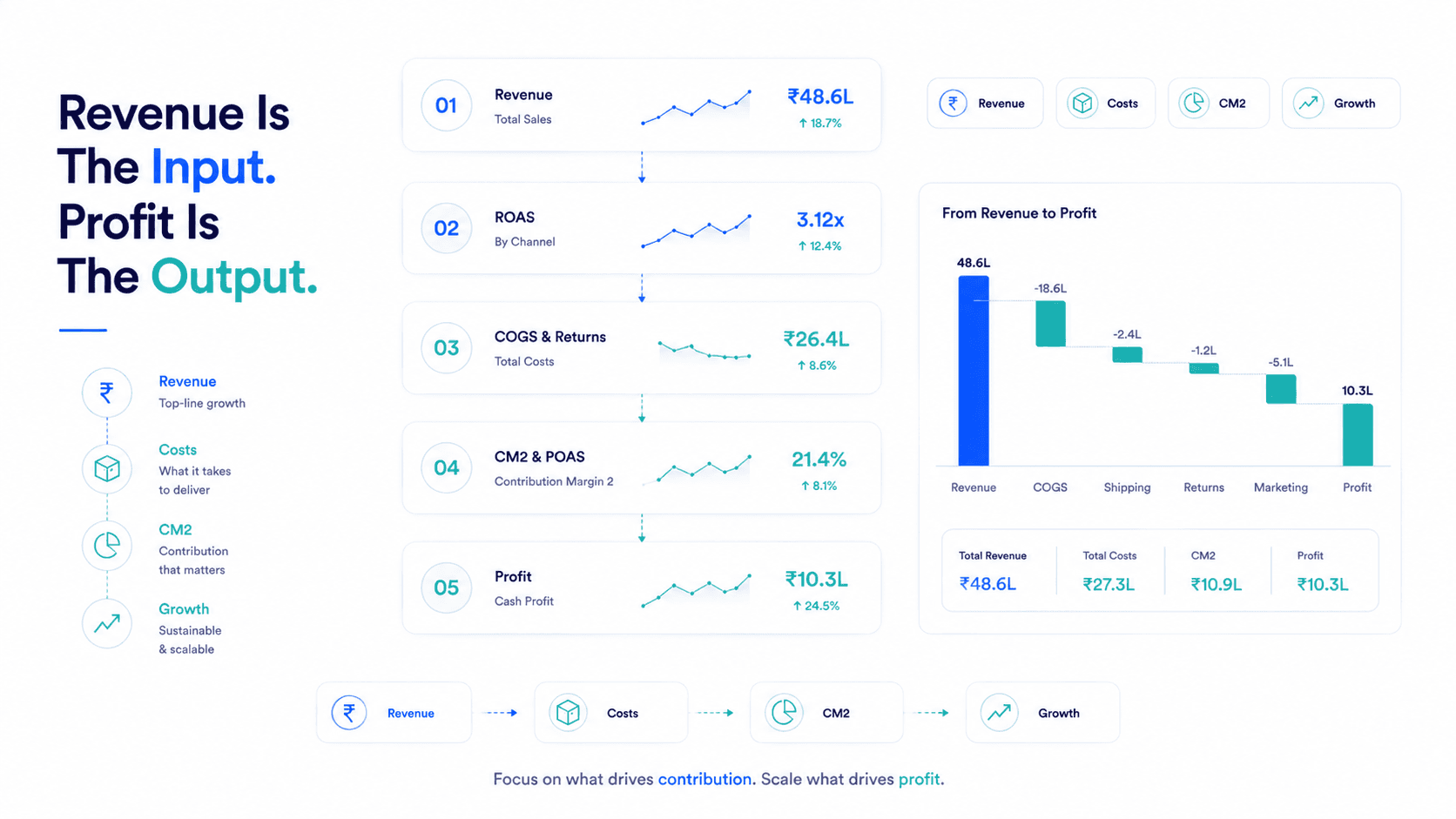
The result: overall ad spend efficiency looks better by the revenue metric, while blended contribution margin across the account actually declines, because a larger share of orders now come from the lower-margin bundle. Nothing in the platform's own reporting flags this — it requires overlaying margin data outside the ad platform to see it.
There are three practical reasons profit rarely reaches the algorithm:
Data fragmentation. COGS lives in Shopify or an inventory system; ad platforms only see order value.
Real-time requirements. Bidding algorithms need signals within seconds or minutes; margin data is often updated weekly or monthly at best in most operations.
Technical complexity. Feeding profit-adjusted conversion values into Meta's Conversion API or Google's value-based bidding requires engineering work most small and mid-sized D2C teams haven't prioritized.
The result is a structural gap: the tools are capable of profit-aware optimization, but most brands never configure them that way.
Profit-first optimization means the signal fed into the bidding algorithm reflects contribution margin or POAS-adjusted value, not raw order value. In practice, this involves:
Calculating a margin-adjusted "value" per SKU or order (revenue minus COGS and key variable costs).
Passing that adjusted value into the ad platform's conversion API instead of gross order value.
Setting bidding targets (like target ROAS) against the margin-adjusted number rather than gross revenue.
Continuously updating COGS and cost data so the signal stays accurate as costs shift.
This is exactly the kind of data infrastructure that AI-powered marketing intelligence platforms have been built to provide pulling COGS, fees, and margin data into a form that can either inform human decisions directly or feed back into ad platform optimization signals.
| Dimension | Revenue-Optimized AI | Profit-Optimized AI |
|---|---|---|
| Primary Signal | Order value / conversion volume | Margin-adjusted value (POAS/CM-based) |
| Risk | Can scale low-margin or unprofitable SKUs | Naturally favors high-margin, sustainable growth |
| Data Requirement | Order value only (native to ad platform) | Requires COGS, fees, and cost data integration |
| Reporting Alignment | Often disconnects from actual P&L | Aligns closely with contribution margin and bank cash flow |
| Setup Complexity | Low, works out of the box | Higher, requires connecting cost data to bidding signals |
| Best Fit | Early-stage brands with simple, single-margin catalogs | Multi-SKU brands with varying margins across products |
Assuming "AI-optimized" automatically means "profit-optimized." Most tools optimize exactly what they're told to, which is usually revenue by default.
Letting Advantage+ or Performance Max run unmonitored across a full catalog with wildly different margins per SKU.
Setting target ROAS based on gross revenue instead of a margin-adjusted equivalent.
Not updating COGS data regularly, which causes even a well-configured profit signal to drift out of accuracy over time.
Treating algorithmic optimization as a "set and forget" system rather than reviewing margin-level outcomes periodically.
Establish accurate, regularly updated COGS at the SKU level.
Calculate a margin-adjusted value for each order (revenue minus COGS and key variable costs).
Use platform tools like Meta's Conversion API to pass this adjusted value instead of raw order value where supported.
Set target ROAS or POAS thresholds against the adjusted value, not gross revenue.
Monitor blended contribution margin regularly not just account-level ROAS, to catch cases where the algorithm is quietly favoring lower-margin products.
Consider a marketing intelligence layer that automates this data pipeline, since manually maintaining accurate, real-time margin data across a growing SKU catalog is difficult without dedicated tooling.
Segment campaigns by margin tier where possible, rather than running one algorithm across products with very different profitability profiles.
Review contribution margin by SKU monthly, even if ad platforms are running largely autonomously.
Treat AI optimization as a tool that amplifies whatever goal you give it, garbage or incomplete signal in, unprofitable scale out.
Pair automated bidding with a human review cadence focused specifically on margin drift, not just ROAS trend lines.
Start with your highest-volume SKUs when building margin-adjusted bidding signals, since that's where profit leakage tends to be largest in absolute terms.
Key Takeaways
Frequently Asked Questions
No — by default it optimizes for conversions or revenue based on the signals it's given, unless a brand explicitly feeds it margin-adjusted values.
Yes. If a low-margin product converts efficiently in revenue terms, revenue-optimized algorithms will scale it just as readily as a high-margin product.
It's the practice of feeding margin-adjusted value (rather than gross revenue) into ad platform bidding algorithms, so optimization decisions reflect actual profitability.
It requires accurate, regularly updated COGS data and some technical setup (such as using Meta's Conversion API), which is more involved than default revenue-based bidding.
Because they don't have access to your cost of goods, fees, or margin data, that information lives in your own systems, not the ad platform.
Ad spend can appear increasingly efficient by ROAS while blended contribution margin quietly declines, especially in multi-SKU catalogs with varying margins.
Ideally continuously, or at minimum monthly, since supplier costs, freight, and discounts all shift and can quickly make a profit signal stale.
Less so, the risk is highest for brands with multiple SKUs at different margin levels, where the algorithm has room to favor lower-margin products.
AI-powered marketing intelligence platforms are increasingly built specifically to pull COGS, fees, and margin data together and connect it to ad performance and optimization decisions.
No, the tools themselves are effective. The fix is ensuring they're optimizing against a profit-aware signal rather than raw revenue. If you're still optimizing for ROAS alone, you're only seeing part of the picture. Platforms like Flable AI help D2C brands connect real margin and cost data to their marketing decisions, so AI optimization works toward actual profit, not just revenue that looks good on a dashboard.
Real contribution margin per campaign and channel. The number that tells you whether to scale.
Start Measuring Profitability →Setup in 48 hours · No credit card required · Backed by Microsoft & NVIDIA