Attribution
The question every D2C founder asks at some point: “Should we scale ad spend?”
And the answer they usually get from their agency: “Your ROAS is strong, yes.”
That answer is incomplete. ROAS tells you whether you’re generating revenue efficiently. It tells you nothing about whether you’re ready to scale.
Here’s the framework that does.
Scaling ad spend when your unit economics aren’t ready doesn’t just waste money.
It accelerates every problem you have.
Returns
If your return rate is 22% at ₹5L/month in ad spend, it’ll still be 22% at ₹20L/month. Except now you’re processing 4x the returns at 4x the logistics cost.
POAS
If your POAS is 0.9x, below break-even, at ₹5L spend, scaling to ₹20L means you’re losing money 4x faster.
LTV : CAC
If your new customer CAC is ₹900 and your LTV is ₹1,800, that 2:1 ratio might be sustainable at small scale and fatal at large scale when working capital dries up.
Premature scaling turns small problems into large crises. The framework below is how you know the difference between “ready to scale” and “ready to implode.”
The framework
Signal 1
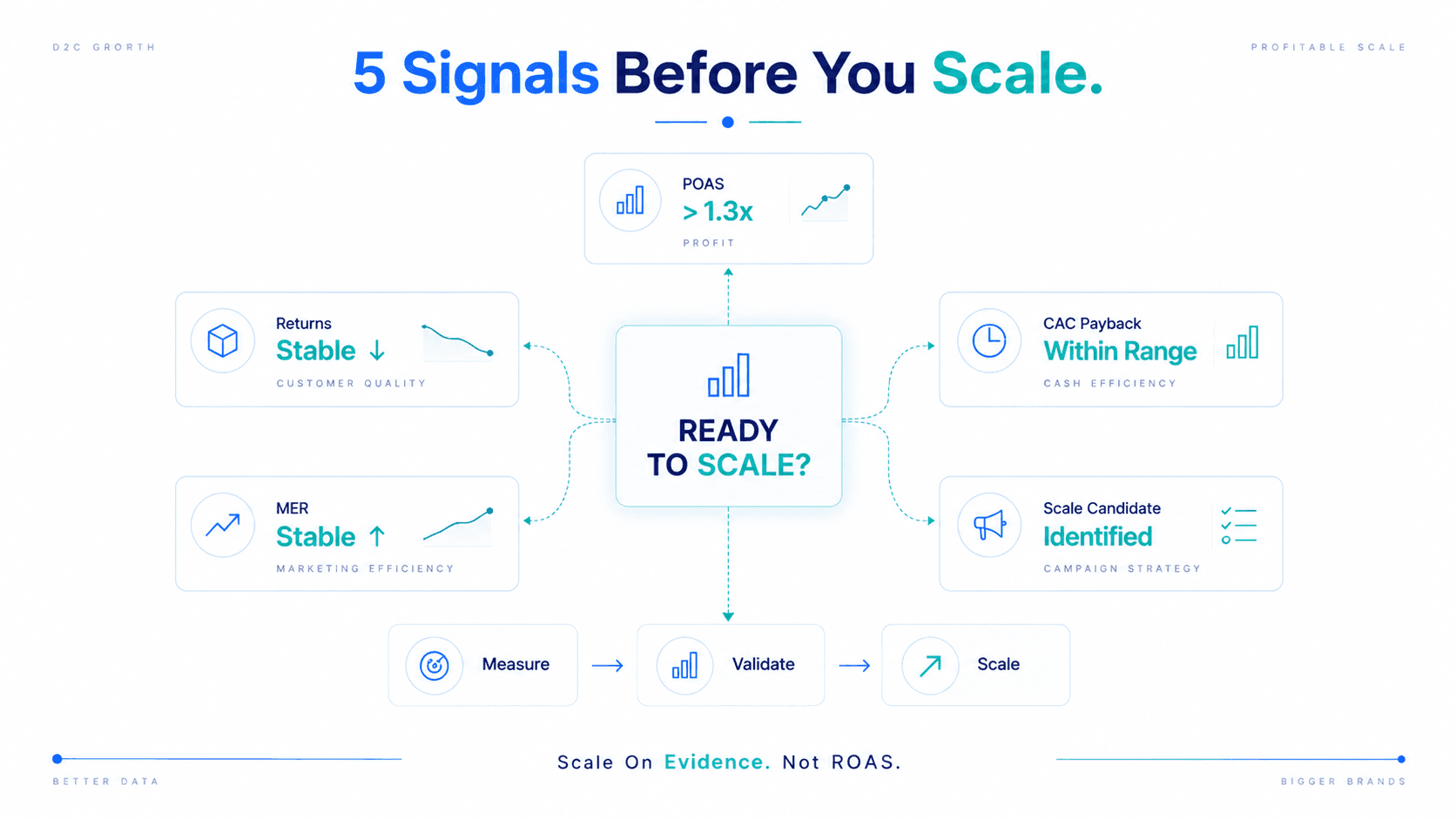
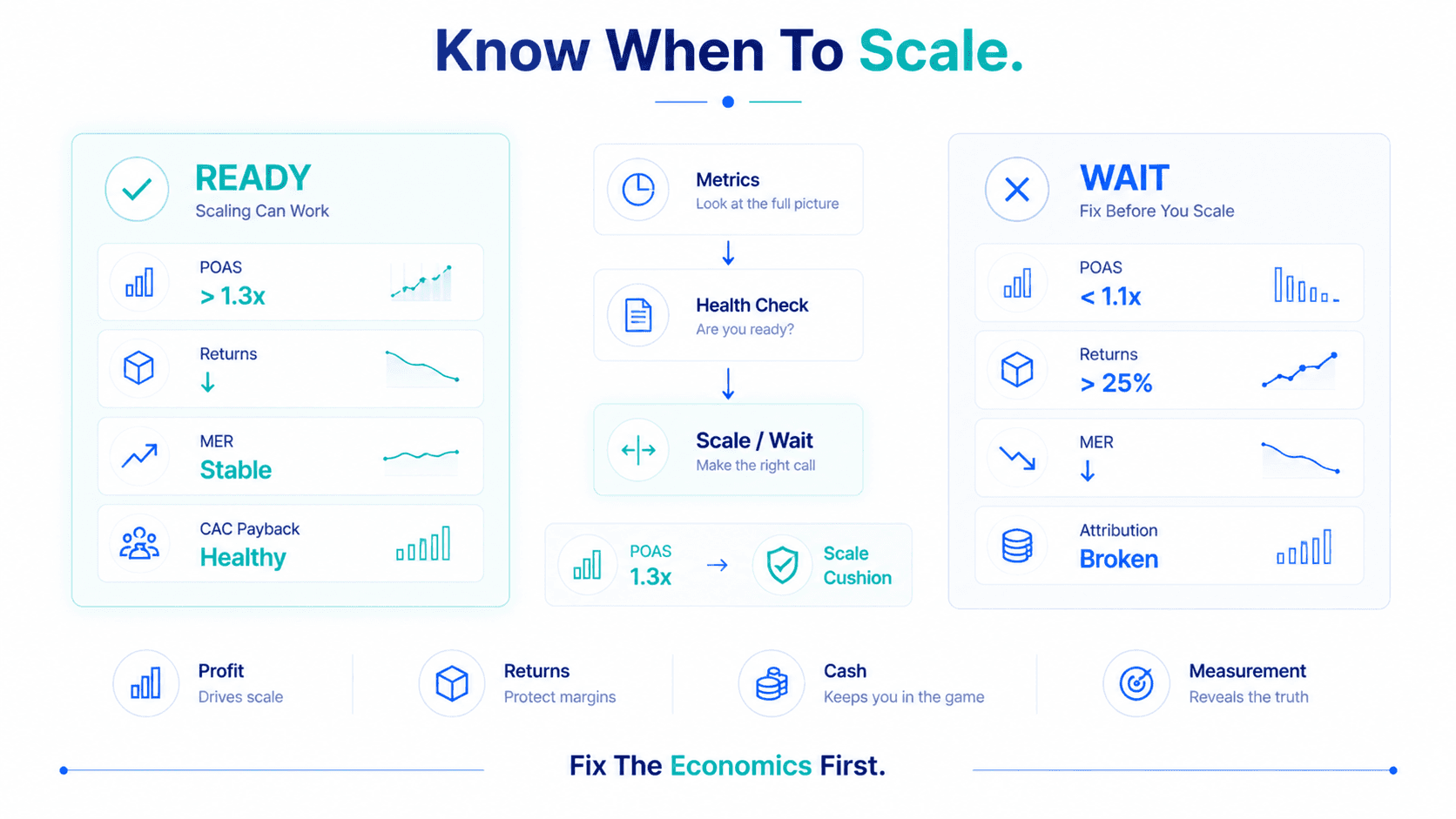
Not one good week. Not “it was 1.4x this week, 0.8x last week.” Consistently above 1.3x for 3 consecutive weeks on your core prospecting campaigns.
1.3x POAS means for every ₹1 of ad spend, ₹1.30 in gross profit is coming back, after COGS, shipping, returns, and payment fees. That 30-paise margin above break-even is your scaling cushion. As you scale, POAS typically compresses slightly as audiences widen. Starting at 1.3x gives you room.
Starting at 1.05x and scaling? You’ll be below break-even within 3 weeks.
Signal 2
Before scaling, pull your return rate trend for the last 8 weeks. Is it: rising, flat, or falling?
Rising return rate before scaling means you’re about to amplify an economics problem. The campaigns you scale will bring in progressively worse customers as audiences widen, higher return rates, lower LTV.
Flat or falling return rate means the campaign is maturing well. The audience is settling into its natural quality. You can scale with confidence.
Signal 3
Payback period
True New Customer CAC ÷ Monthly Gross Profit per Customer
This is your payback period, how many months until the business recovers what it spent acquiring the customer. For most Indian D2C categories:
| Category | Target payback |
|---|---|
| Supplements / food | Under 4 months |
| Beauty / skincare | Under 6 months |
| Fashion / apparel | Under 8 months |
| Home / lifestyle | Under 12 months |
If your payback period is within these ranges, scaling is manageable. Your capital cycles back before you need it again.
If it’s above these ranges, scaling means carrying enormous working capital in unreturned acquisition costs. That’s a cash flow bomb that gets bigger as you scale.
Signal 4
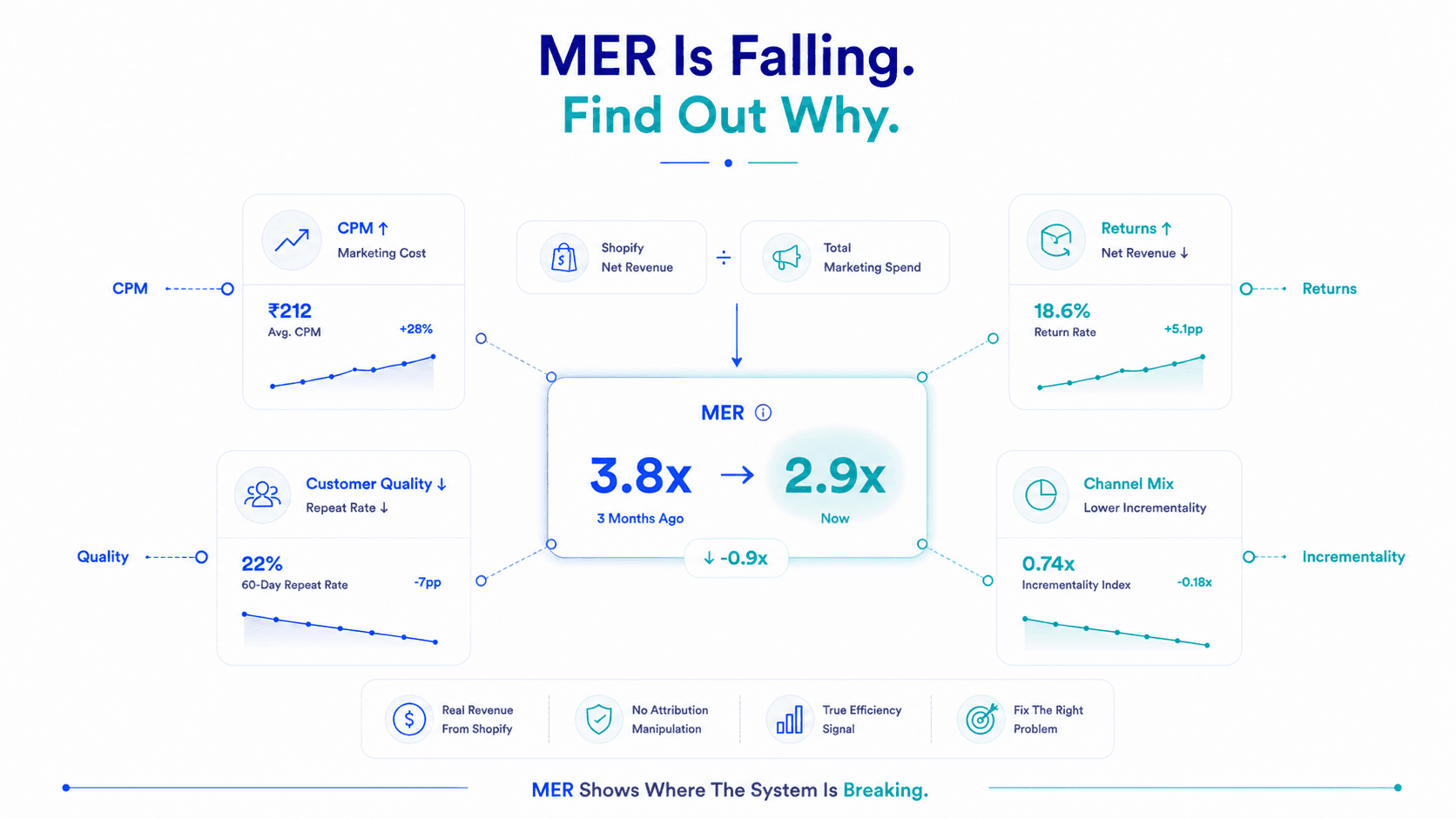
Marketing Efficiency Ratio = Shopify Net Revenue ÷ Total Marketing Spend
If your MER has been declining over the last 4–6 weeks, something in your marketing system is deteriorating. CPMs rising. Return rates climbing. Customer quality falling. Channel mix shifting to lower-incrementality spend.
Don’t scale into a declining MER. Fix what’s causing the decline first.
If MER is stable or improving, your marketing is becoming more efficient as it matures. That’s the signal that scaling will compound the efficiency, not compound the problem.
Signal 5
“We should scale” is not a plan.
“We should scale Campaign A, which has POAS of 1.6x, return rate of 9%, and is acquiring customers with 90-day repeat purchase rates of 38%, by 30% budget over the next 3 weeks while monitoring POAS weekly” is a plan.
Before scaling, you should know exactly which campaigns are your scaling candidates. Not all campaigns, the specific ones with the strongest POAS, the lowest return rates, and the most evidence that the acquired customers are high-LTV.
If you can’t name them, you’re not ready to scale. You’re ready to guess.
Instead of “should we scale?”, ask this:
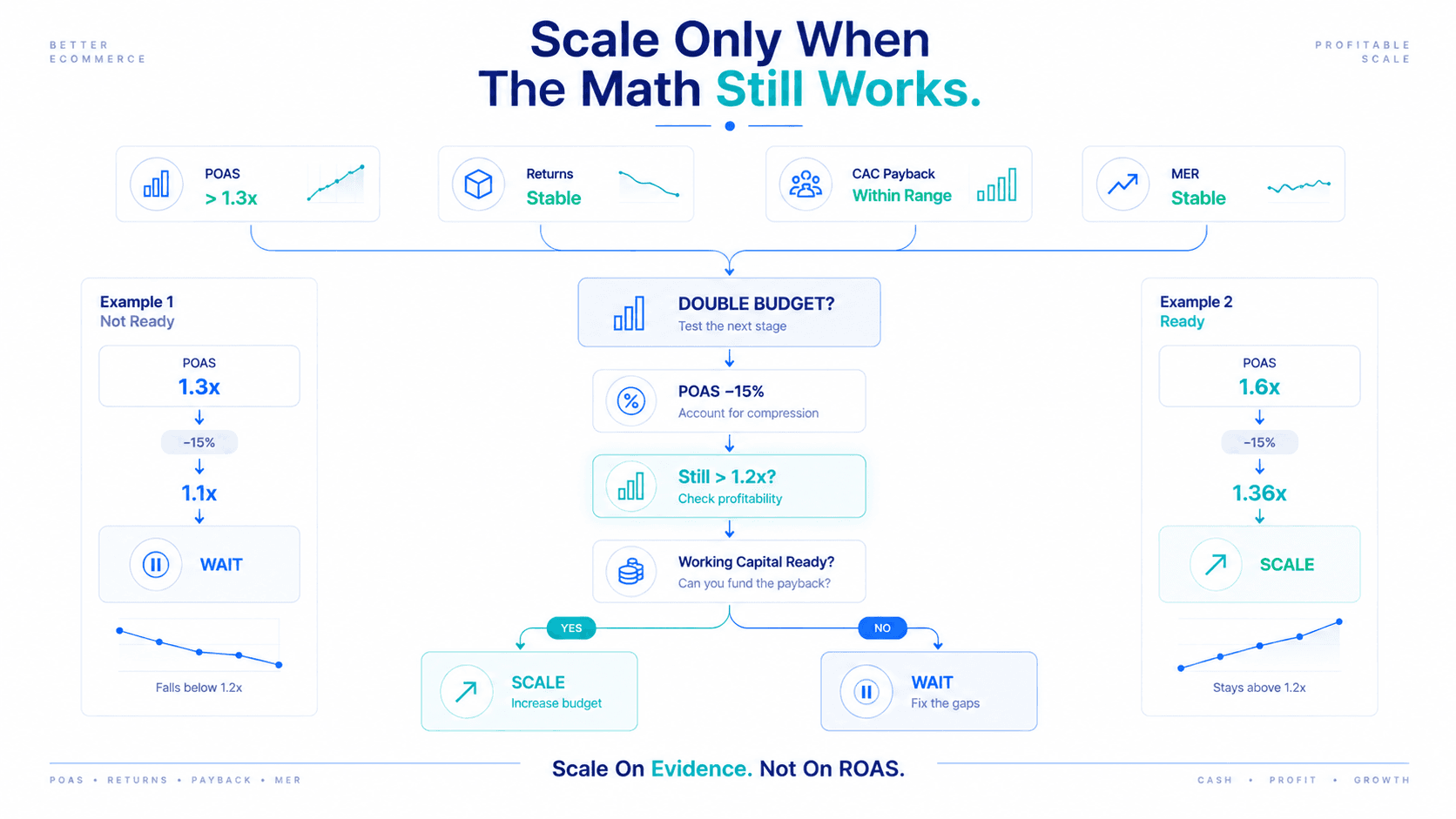
“If I double this campaign’s budget and POAS compresses by 15%, is it still above 1.2x? And do I have the working capital to carry the additional acquisition cost for the payback period?”
Yes to both
The economics hold even after compression, and the cash is there to carry payback.
No to either
Fix the gap first: margin cushion or working capital.
One question. Anchored in the metrics that actually matter.
Because ROAS says they’re ready.
And ROAS is easy to find. POAS requires connecting your ad data with your COGS, your returns, and your Shopify revenue.
When the easy metric says go, founders go.
The damage shows up 6–8 weeks later when the returns from scaled campaigns land, POAS collapses, and MER declines. By then, the budget has already been spent.
The brands that scale correctly build the measurement infrastructure first. They see POAS, return rates, true CAC, and MER clearly, and they scale when every signal says go, not just the one that’s easiest to read.
Scale on evidence. Not on ROAS.
Look for five signals: POAS consistently above 1.3x for three weeks, a stable or falling return rate, a CAC payback period inside your category range, a stable or improving MER, and specific named campaigns you can scale. ROAS alone cannot tell you this.
Consistently above 1.3x for 3 consecutive weeks on core prospecting campaigns. POAS typically compresses as audiences widen, so 1.3x gives you a cushion. Scaling from 1.05x usually puts you below break-even within about 3 weeks.
As a guide: supplements and food under 4 months, beauty and skincare under 6 months, fashion and apparel under 8 months, home and lifestyle under 12 months. Payback is True New Customer CAC divided by monthly gross profit per customer.
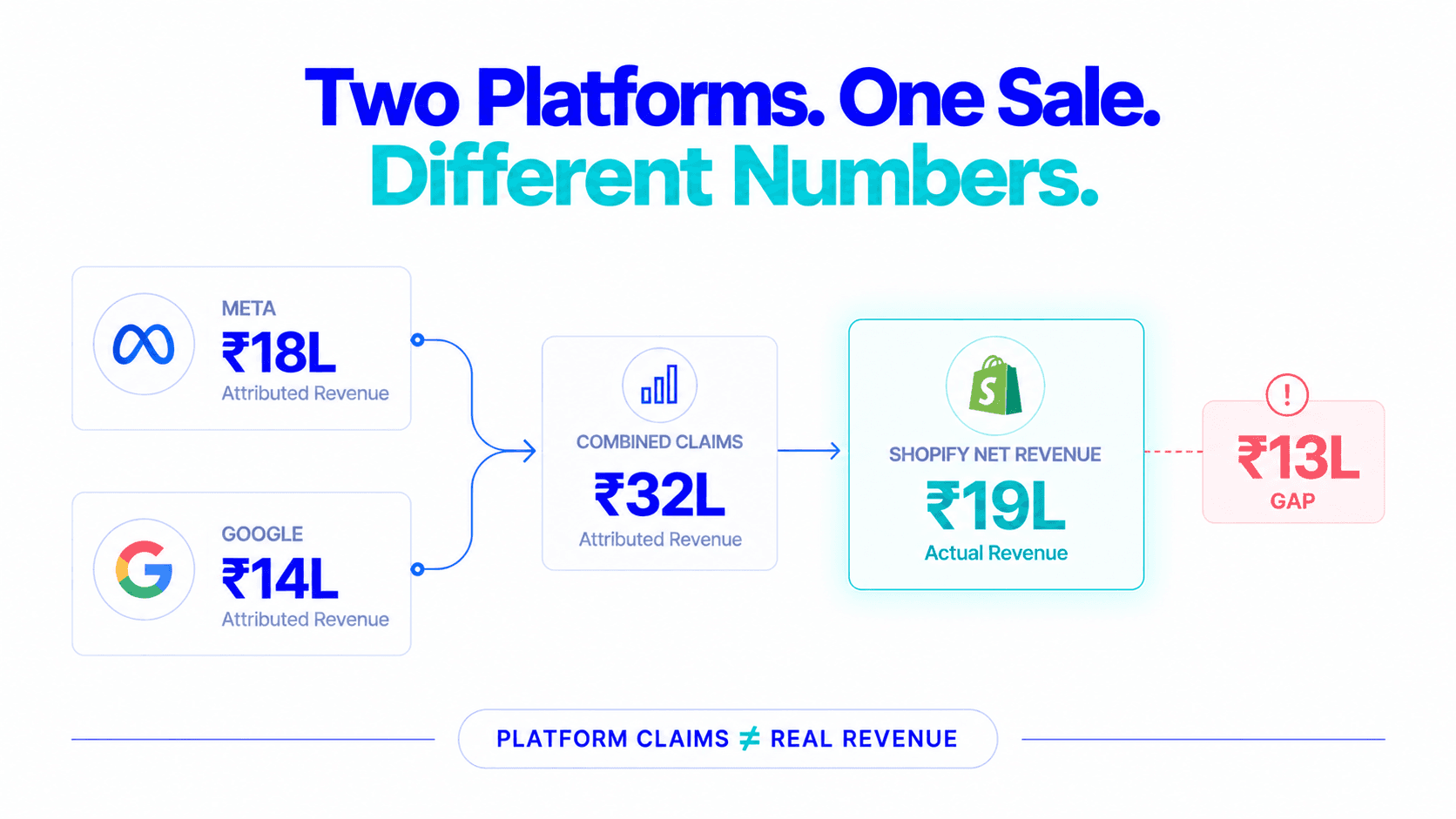
When POAS is below 1.1x, when core campaigns have return rates above 25%, or when combined platform-attributed revenue is more than 50% higher than Shopify net revenue, because attribution is then too broken for reliable scaling decisions.
If I double this campaign's budget and POAS compresses by 15%, is it still above 1.2x? And do I have the working capital to carry the additional acquisition cost for the payback period? Yes to both means scale; no to either means wait.
Flable AI gives D2C brands real-time POAS, return rate, true CAC and MER per campaign: the signals that tell you whether you’re ready to scale.