Meta Ads
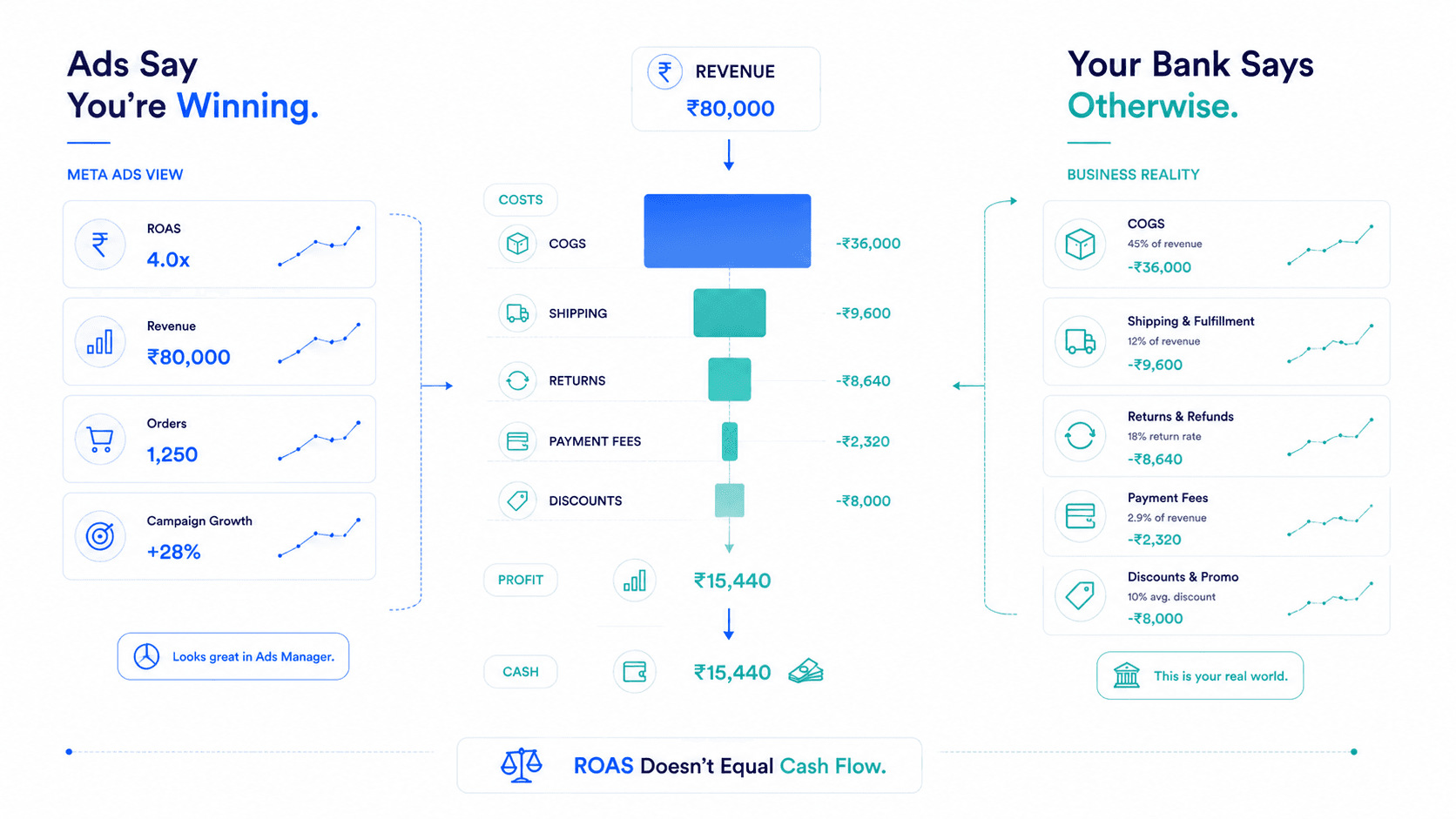
Your Meta ROAS is 3.1x. Your Google ROAS is 4.4x. Your total attributed revenue across both platforms is ₹42L. Your actual Shopify revenue was ₹27L. Where did ₹15L go?
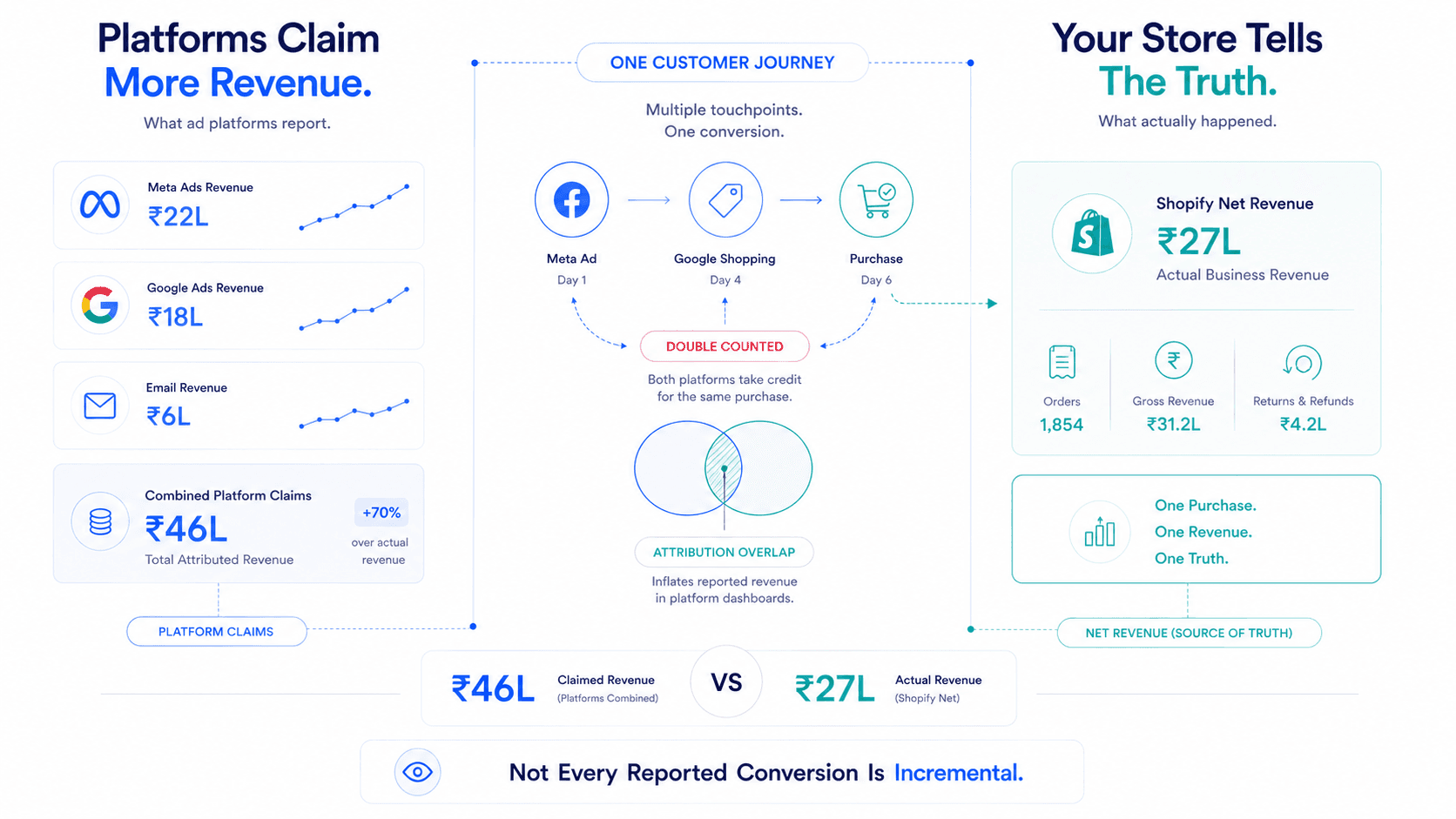
It didn't go anywhere. It was never real. Both Meta and Google claimed credit for the same conversions — and your combined attributed revenue exceeds what your business actually earned. This is the attribution overlap problem, and it's costing D2C brands real money in misallocated budget every single month.
A customer sees your Meta ad on Monday, clicks a Google Shopping ad on Wednesday, and buys on Thursday. Meta claims the conversion (view-through attribution within 1 day). Google claims the same conversion (click-through attribution within 7 days). One sale. Two platforms claiming credit. Your total attributed revenue is now double the actual revenue from that customer.
For most multi-channel D2C brands, this overlap inflates total attributed revenue by 30–60% above actual Shopify revenue.
Export the last 30 days of conversion value from Meta Ads Manager and Google Ads. Sum them. This is your total attributed revenue — the number both platforms want you to believe.
For the same 30-day period, pull your actual revenue from Shopify (or your ecommerce platform). This is the ground truth — what your business actually earned.
Attribution Gap = Total Attributed Revenue − Actual Shopify Revenue
Express it as a percentage: Gap% = (Attribution Gap ÷ Actual Revenue) × 100
If your attribution gap is 40%, it means 40% of the revenue your platforms are claiming doesn't actually exist. Your real ROAS on each channel is significantly lower than reported.
Use incrementality signals, UTM-based last-click data from GA4, and post-purchase surveys to estimate what percentage of real revenue each channel genuinely influenced. This gives you a channel-level CM2 — the real profitability of each channel after accounting for overlap.
Once you know each channel's real contribution, shift budget from channels with high overlap inflation to channels with higher verified CM2. This is the single most impactful budget decision most D2C brands can make.
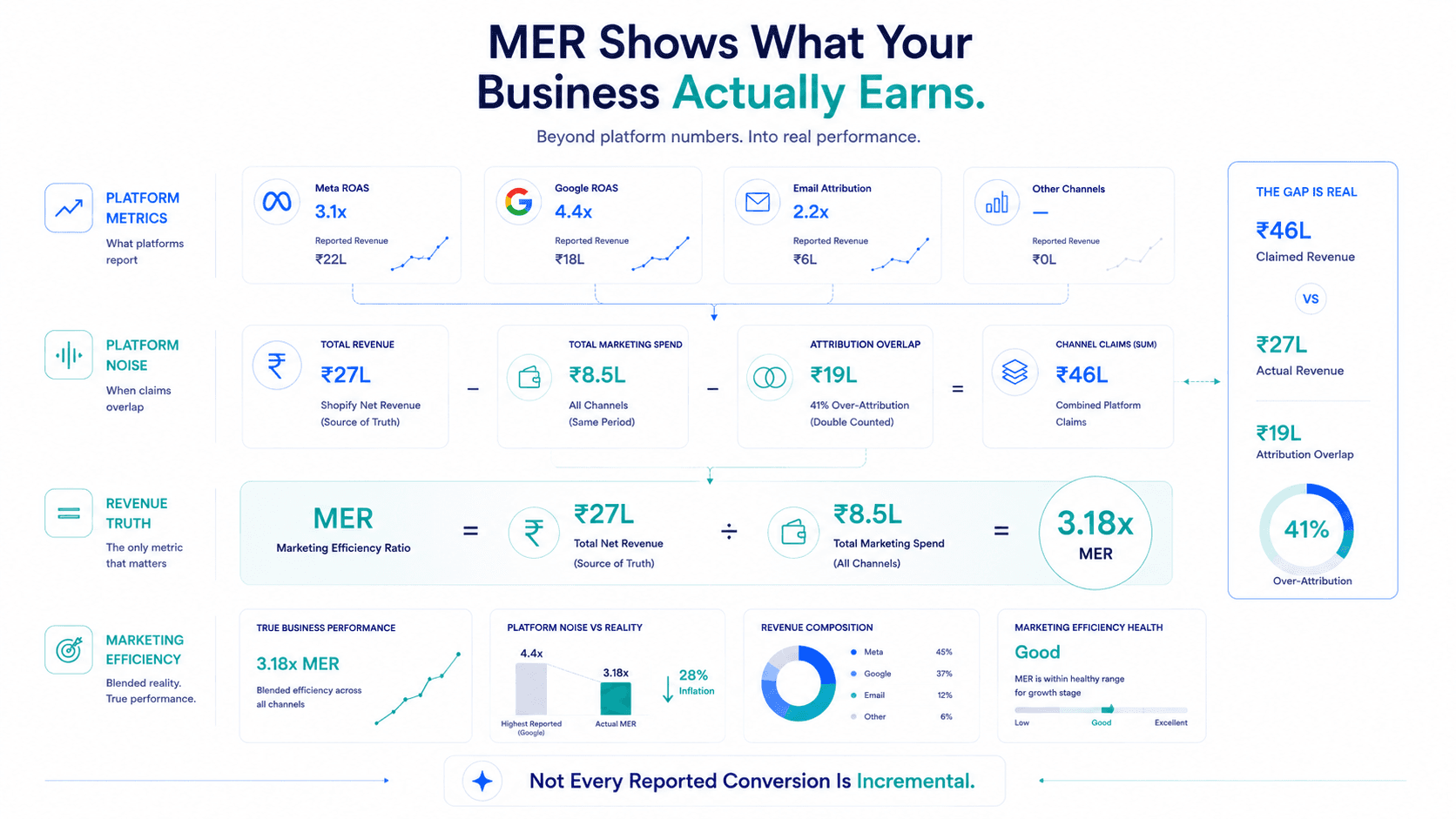
Done manually, attribution audits take hours of spreadsheet work and go stale immediately. Flable AI reconciles Meta and Google attributed revenue against your actual Shopify data continuously — showing real CM2 per channel, adjusted for overlap, returns, and COGS. No spreadsheets. No guesswork.
Every D2C brand running ads on multiple platforms has an attribution overlap problem. The question is whether you're measuring it or ignoring it. An attribution audit doesn't require new tools — it requires the discipline to compare what platforms claim against what your business actually earned. Do it monthly. Reallocate based on real CM2. That's how you stop funding the overlap and start funding profitable growth.
Frequently Asked Questions
It is a structured process of comparing each ad platform’s self-reported conversions against your actual ecommerce revenue to identify attribution overlap, inflated ROAS, and misallocated budget across Meta, Google, and other channels.
Both Meta and Google claim credit for the same conversion when a customer interacts with ads on both platforms. This double-counting inflates total attributed revenue by 30–60% above actual Shopify revenue for most multi-channel D2C brands.
Monthly is ideal. At minimum, quarterly. Attribution overlap patterns shift with campaign changes, seasonal behaviour, and budget reallocation — so a one-time audit goes stale quickly.
Flable reconciles Meta and Google attributed revenue against your actual Shopify data, identifies overlap, and shows real CM2 per channel — giving you an independent attribution layer that no single platform can provide.
Stop trusting platform-reported ROAS. Flable reconciles your real revenue automatically.
Start Your Attribution Audit →