Attribution
Last-Click Attribution Is Dead: What Smart D2C Brands Use Instead
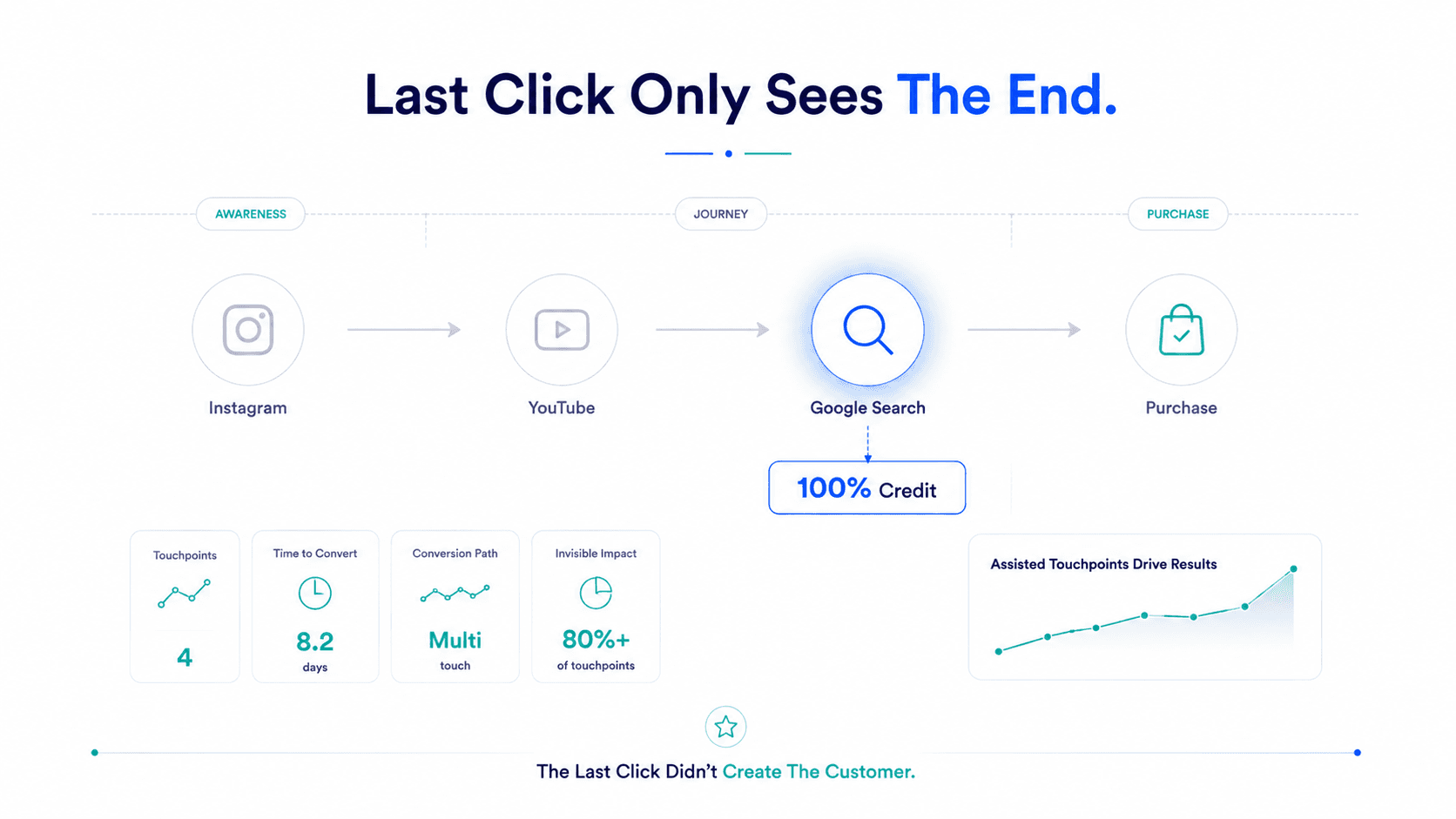
For most of the last decade, "attribution" and "last-click attribution" were treated as the same thing. It was simple: whichever channel got the final click before a purchase got 100% of the credit. Easy to explain, easy to build a dashboard around, easy to defend in a budget meeting.
It was also, as measurement researchers have increasingly documented, thoroughly wrong. Analysis from multiple attribution research firms has found that last-click models can overstate the true contribution of paid search by 40–65%, while simultaneously understating channels like display and content marketing by 150–400%. In a 2026 landscape shaped by iOS privacy changes, Google's confirmation that Chrome will retain third-party cookies (which paradoxically hasn't solved the underlying tracking gaps), and the rise of walled-garden platforms, the cracks in last-click have become impossible to ignore.
This piece walks through why last-click finally broke, and what D2C brands are actually replacing it with in 2026, not in theory, but in practice.
Last-click attribution was never a perfect model, it was a convenient one, built when cross-device and cross-channel tracking was simpler and less obstructed by privacy protections. It survived as long as it did because it was cheap to implement and easy for every stakeholder to understand.
But convenience and accuracy have been diverging for years, and the gap has now become a genuine measurement crisis. According to the IAB and BWG Global State of Data 2026 report, roughly three in four marketers say their current measurement systems lack the speed, accuracy, or trust needed to make confident decisions.
Last-click gives 100% of conversion credit to the final touchpoint before purchase, typically a paid search ad, a retargeting ad, or a direct visit. It completely ignores every earlier touchpoint in the customer journey: the YouTube video that built awareness, the influencer post that created initial interest, the display ad that kept the brand top of mind.
Research on marketing attribution has found that a large share of paid social conversion paths require three or more touchpoints before closing, and that display and content channels contribute meaningfully to assist value even when they rarely register the final click. Last-click structurally cannot see any of this it only ever rewards whichever channel happened to be last in line.
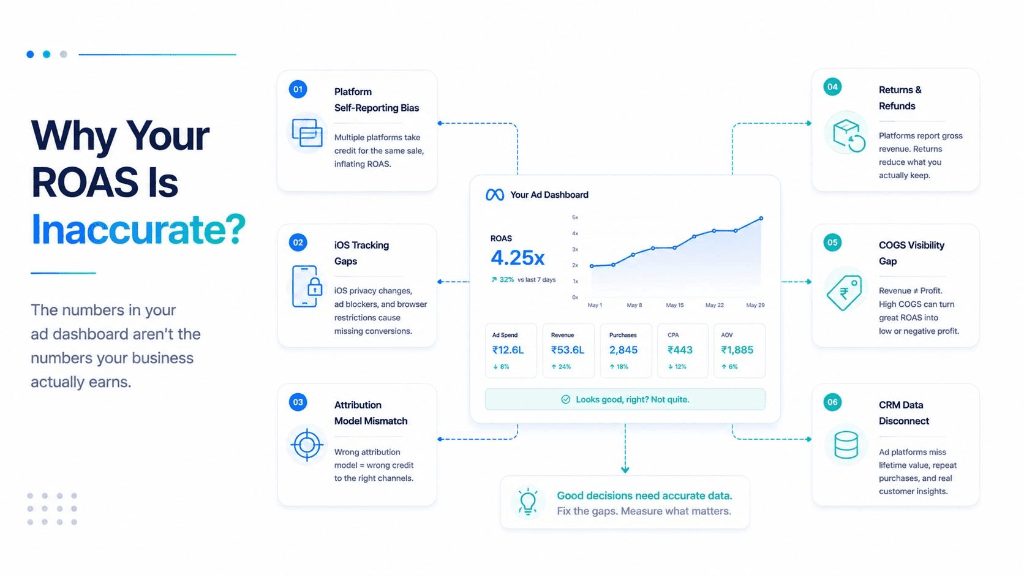
Privacy regulation and platform restrictions. Apple's App Tracking Transparency and browser-level tracking blocks have erased a meaningful share of previously trackable conversions, some analyses estimate 30–40% of conversions are now lost without server-side tracking like Meta's Conversion API in place.
Cross-device and cross-channel complexity. B2B buyers average dozens of touchpoints before converting, and even D2C purchase journeys increasingly span multiple devices and sessions that last-click can't stitch together.
Growing awareness of measurement bias. As more brands adopt multi-touch attribution and incrementality testing, the gap between what last-click reports and what these more rigorous methods find has become too large, and too costly, to keep ignoring.
There isn't a single replacement for last-click, there's a combination of three complementary methods, each answering a different part of the measurement question:
Multi-touch attribution (MTA) for granular, touchpoint-level optimization
Marketing mix modeling (MMM) for strategic, channel-level budget allocation
Incrementality testing for ground-truth validation of whether spend is truly causing sales
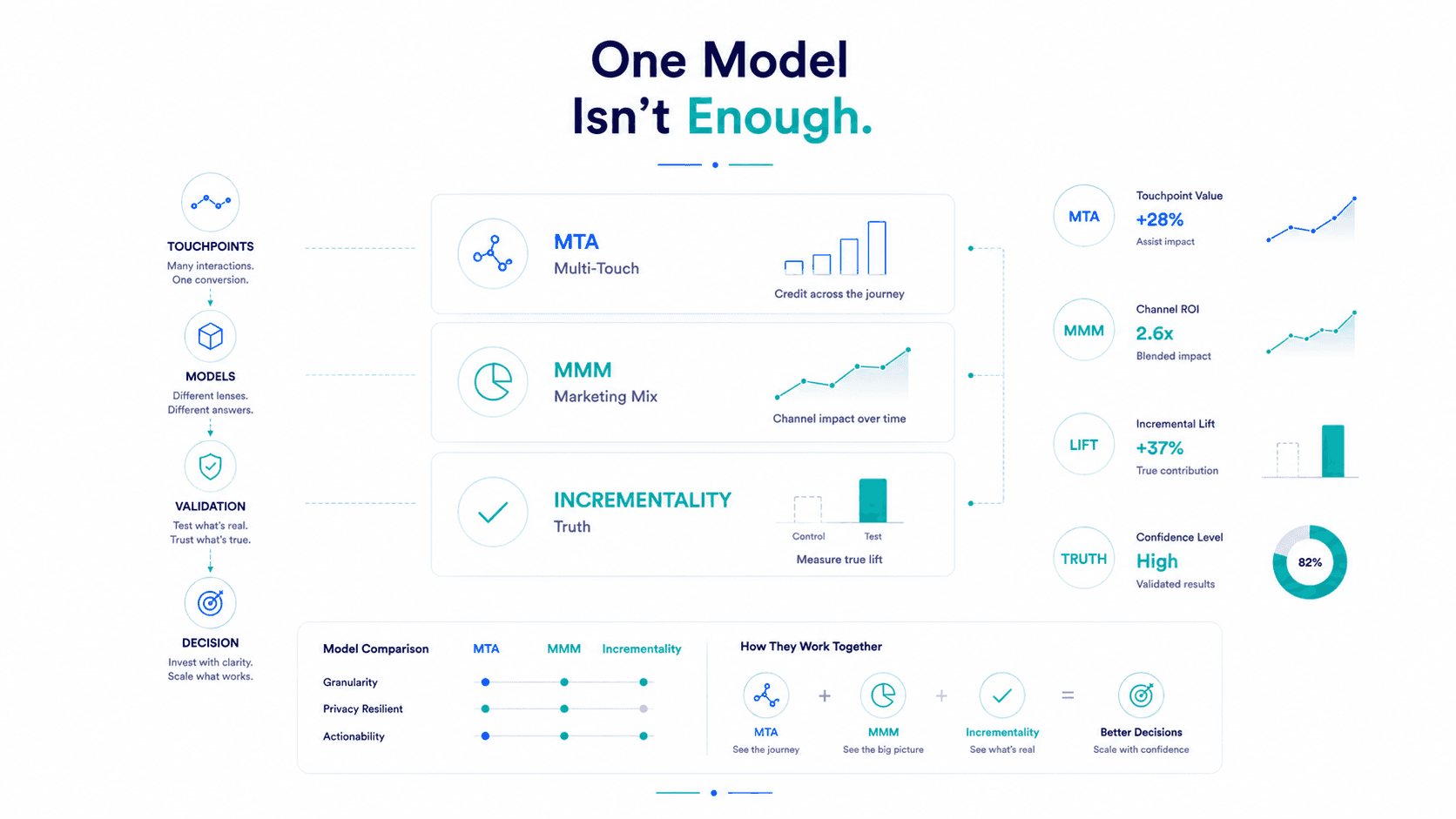
Brands treating attribution seriously in 2026 are increasingly running at least two of these three approaches in parallel, using incrementality testing specifically to keep the other models calibrated and honest.
MTA distributes conversion credit across every touchpoint in a customer's journey, rather than giving 100% to the last one. It requires a connected, first-party data foundation — every touchpoint needs to be tied to the same user identity, which has become harder (and more important) since third-party cookies became unreliable.
Strength: Granular enough to inform day-to-day campaign and creative decisions. Weakness: Enterprise adoption has roughly doubled since 2023, but only a minority of implementations are rated as highly accurate by the marketing teams using them, largely due to cross-device fragmentation and walled-garden data restrictions.
MMM takes a statistical, top-down approach, analyzing aggregate spend and revenue data over time to estimate each channel's contribution, without relying on individual user-level tracking at all. This makes it inherently more resilient to privacy changes than click-based models.
Strength: Doesn't depend on cookies, pixels, or device-level tracking, making it durable against ongoing privacy shifts. Weakness: Best suited to strategic, longer-horizon budget decisions rather than daily campaign optimization, and it requires a reasonable amount of historical data to produce reliable estimates.
Incrementality testing uses controlled experiments, holding out a portion of an audience from a campaign and comparing outcomes, to measure the true causal lift of ad spend, rather than inferring it from correlation. This is the only one of the three methods built on causation rather than correlation, which is exactly why it's used to calibrate the other two.
Recent analysis of well-designed geo and holdout experiments found a median incremental return on ad spend of roughly 2.3x, with the large majority of tests reaching statistical significance, figures that frequently diverge meaningfully from what last-click or even MTA models report for the same campaigns.
Strength: The most accurate method for answering "did this spend actually cause incremental sales?" Weakness: Requires deliberate test design, sufficient scale, and patience, it's not a real-time dashboard metric.
| Model | How It Works | Best For | Biggest Weakness |
|---|---|---|---|
| Last-Click | 100% credit to final touchpoint | Simplicity, legacy reporting | Systematically over- and under-credits channels |
| Multi-Touch Attribution (MTA) | Distributes credit across touchpoints | Granular, near-real-time optimization | Accuracy degraded by privacy restrictions and walled gardens |
| Marketing Mix Modeling (MMM) | Statistical modeling of aggregate spend and revenue | Strategic budget allocation, privacy-resilient | Less useful for daily, tactical decisions |
| Incrementality Testing | Controlled experiments (holdouts, geo tests) | Ground-truth validation of true causal lift | Slower, requires scale and careful test design |
A supplements brand relying solely on last-click attribution sees paid search as its top-performing channel, receiving the majority of last-touch credit, while its YouTube and influencer content appears to contribute almost nothing.
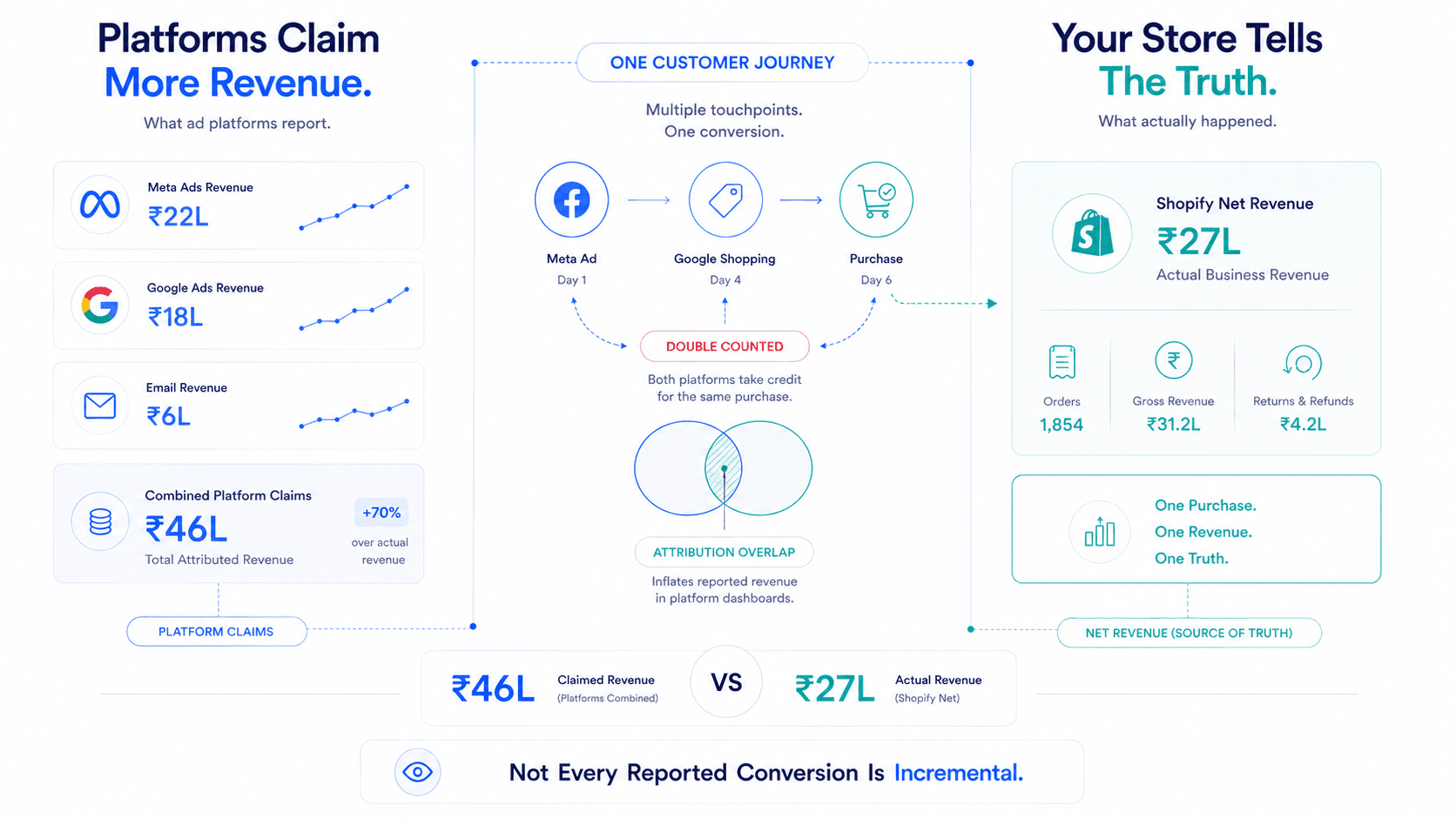
After running a six-week geo-based incrementality test and layering in an MMM view of the past twelve months, the brand finds that a meaningful share of its "paid search" conversions were actually branded search terms, customers who had already decided to buy because of earlier YouTube and influencer exposure, then simply searched the brand name before purchasing. The incrementality test shows branded search carrying a notably lower true incremental return than last-click suggested, while upper-funnel content channels show real, previously invisible causal lift.
The result: the brand reallocates a portion of budget from branded search defense toward the content channels actually driving new demand, a decision last-click attribution alone would never have surfaced.
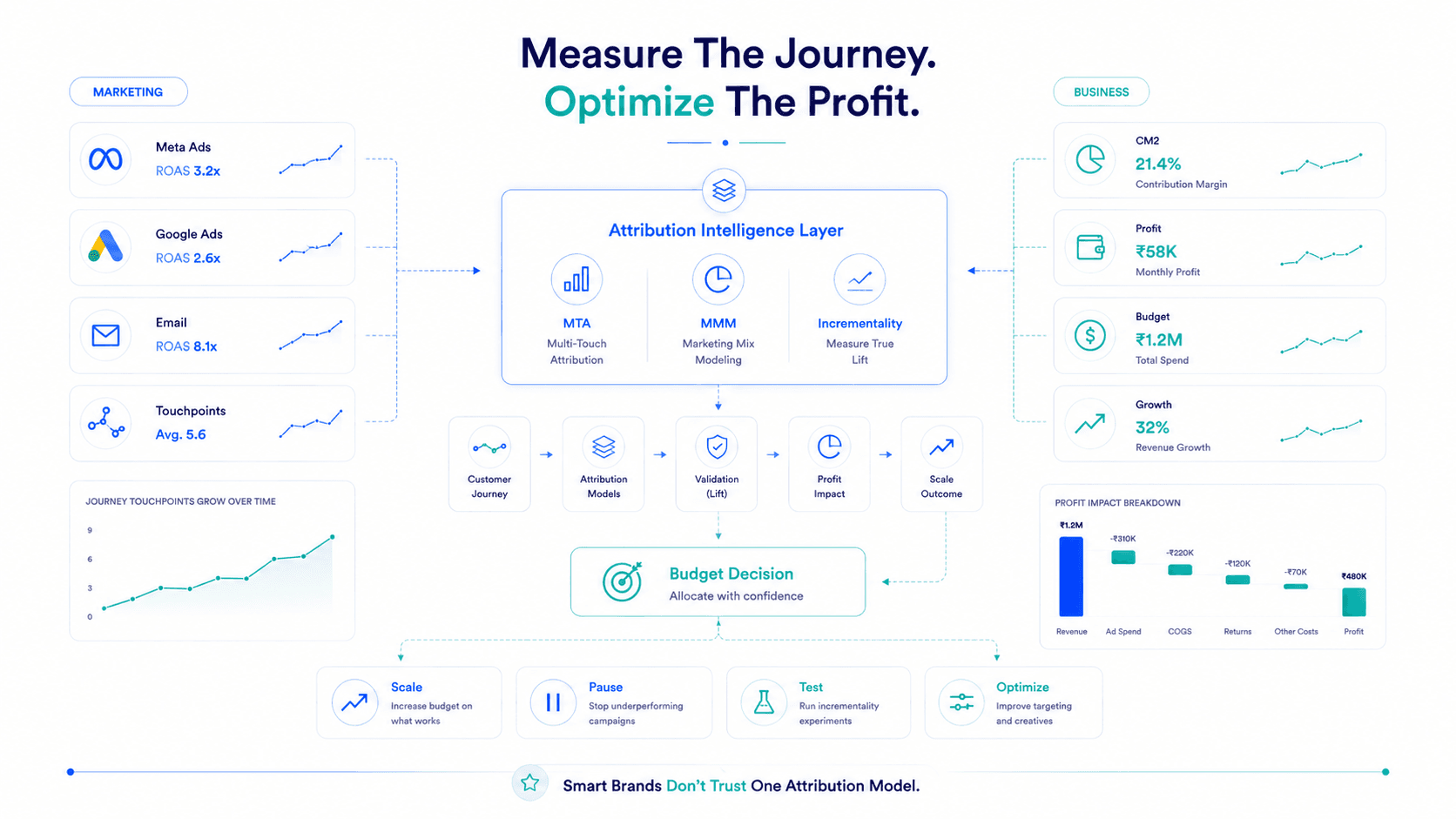
Replacing last-click with a single new model and treating it as equally infallible, rather than using multiple methods together.
Running incrementality tests too small or too short to reach statistical significance.
Ignoring server-side tracking (like Meta's Conversion API), which leaves even MTA models missing a large share of conversions.
Using MMM for daily campaign decisions it wasn't designed for, rather than strategic budget planning.
Failing to recalibrate models periodically, letting MTA and MMM estimates drift out of sync with incrementality test results over time.
Implement server-side tracking (such as Meta's Conversion API) to reduce the conversion data lost to privacy restrictions.
Adopt MTA for granular, campaign-level optimization, built on a first-party data foundation.
Layer in MMM for quarterly or annual strategic budget allocation decisions.
Run periodic incrementality tests, geo holdouts or audience holdouts, to validate and recalibrate both MTA and MMM outputs.
Pay particular attention to branded search and retargeting, the two channels most consistently overstated by last-click and even by some MTA implementations.
Treat incrementality testing as the calibration layer, not a replacement for daily reporting use it periodically to check and correct your other models.
Don't discard last-click entirely; use it as one input among several, understanding its known biases rather than trusting it in isolation.
Prioritize first-party data infrastructure (server-side tracking, connected user identity) since every modern attribution method depends on it to some degree.
Revisit attribution model outputs quarterly, since privacy rules, platform behavior, and consumer habits all continue shifting.
Involve finance, not just marketing, in reviewing attribution outputs, since budget allocation decisions ultimately affect the P&L.
Key Takeaways
Frequently Asked Questions
Because it systematically misattributes conversion credit, research shows it can overstate paid search by 40–65% while understating channels like display and content significantly, and privacy changes have made it even less reliable.
A combination of multi-touch attribution (MTA), marketing mix modeling (MMM), and incrementality testing, used together rather than relying on any single model.
It's more accurate than last-click, but cross-device fragmentation and walled-garden restrictions mean even mature MTA implementations often aren't rated as highly accurate by the teams using them.
It's a controlled experiment (such as a geo or audience holdout test) that measures the true causal lift of ad spend, rather than relying on correlation-based tracking.
No, MMM uses aggregate spend and revenue data statistically, which makes it more resilient to privacy changes than click-based attribution models.
Significantly, some estimates suggest 30–40% of previously trackable conversions have been lost due to platform and browser privacy changes.
Even simple holdout tests can be valuable at smaller scale, though the statistical rigor typically improves with more traffic and spend.
It's search activity using a brand's own name; last-click attribution often overcredits it, since much of that demand was actually generated by other channels earlier in the journey.
It's more manageable with dedicated resources or an AI-driven measurement platform, though a basic combination (server-side tracking plus occasional holdout tests) is achievable at smaller scale.
Quarterly at minimum, and ideally supported by periodic incrementality tests, since platform behavior and consumer habits shift continuously. If you're still relying on last-click to guide budget decisions, you're only seeing part of the picture. Platforms like Flable AI help D2C brands connect real profitability data to marketing performance, so measurement reflects what's actually driving growth — not just the last click before checkout.
Real contribution margin per campaign and channel. The number that tells you whether to scale.
Start Measuring Profitability →Setup in 48 hours · No credit card required · Backed by Microsoft & NVIDIA