Deep Dive
The average Meta Ads ROAS across ecommerce in 2026 is 2.79x. Write that number down. Now forget it. Not because it's wrong — but because that number tells you almost nothing about whether your Meta campaigns are making you money.
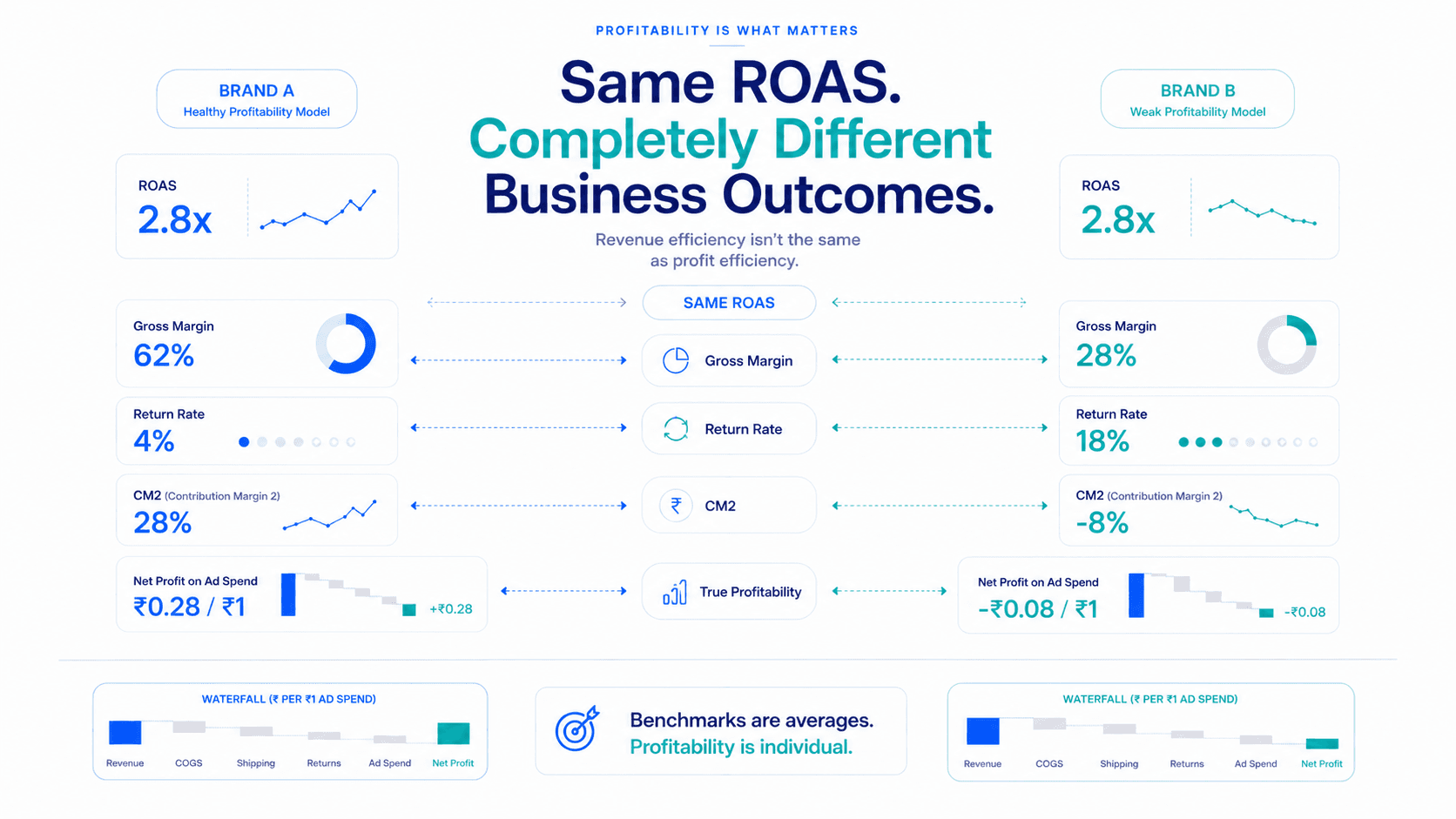
A 2.79x ROAS on a 60% margin product with a 3% return rate is a healthy, profitable campaign. The same ROAS on a 25% margin product with a 20% return rate is a loss. Same benchmark. Opposite business outcomes.
That's the problem with Meta Ads benchmarks as they're typically presented — they measure revenue efficiency, not profitability. And for D2C brands in 2026, that gap has never been more expensive to ignore. This is the benchmark report that accounts for what the others don't.
Most Meta Ads benchmark reports give you ROAS by industry. Some give you CPA and CPM. A few give you CTR and hook rate. All of these are useful as diagnostics signals of delivery health, creative quality, audience efficiency. What none of them tell you is whether your campaigns are profitable after all costs.
A 2025 analysis of nearly 35,000 ecommerce brands found that the median Meta Ads ROAS was 1.86. A 1.86 ROAS means something completely different for a brand with 70% gross margins and a 40% repeat purchase rate than for a brand with 30% margins and no repeat buyers. The first brand is probably profitable. The second is almost certainly losing money. Same ROAS, opposite outcomes.
The benchmark is not the problem. The problem is treating a revenue metric as a profitability signal.
Meta Ads in 2026 deliver an average ROAS of 2.79x to 3.61x, but results vary significantly by industry. Here's the breakdown across the categories most relevant to D2C brands:
| Industry | Median ROAS (Meta, 2026) | Typical Gross Margin | Break-Even ROAS |
|---|---|---|---|
| Apparel / Fashion | 3.5–4.1x | 45–65% | 1.5–2.2x |
| Beauty & Personal Care | 1.6–2.1x | 55–70% | 1.4–1.8x |
| Health & Supplements | 2.2–3.0x | 60–75% | 1.3–1.7x |
| Home & Garden | 2.1–2.5x | 35–50% | 2.0–2.9x |
| Food & Beverage | 1.5–2.0x | 30–45% | 2.2–3.3x |
| Baby Products | 3.8–4.4x | 40–55% | 1.8–2.5x |
| Electronics / Gadgets | 1.8–2.4x | 20–35% | 2.9–5.0x |
| Pet Supplies | 2.3–3.1x | 35–50% | 2.0–2.9x |
Key insight from the table: Beauty & Personal Care has a low ROAS benchmark (1.6–2.1x) but a high gross margin (55–70%), meaning brands in this category can be highly profitable at what looks like "underperforming" ROAS. Electronics has a higher ROAS benchmark but razor-thin margins — meaning that "stronger" ROAS may still be unprofitable.
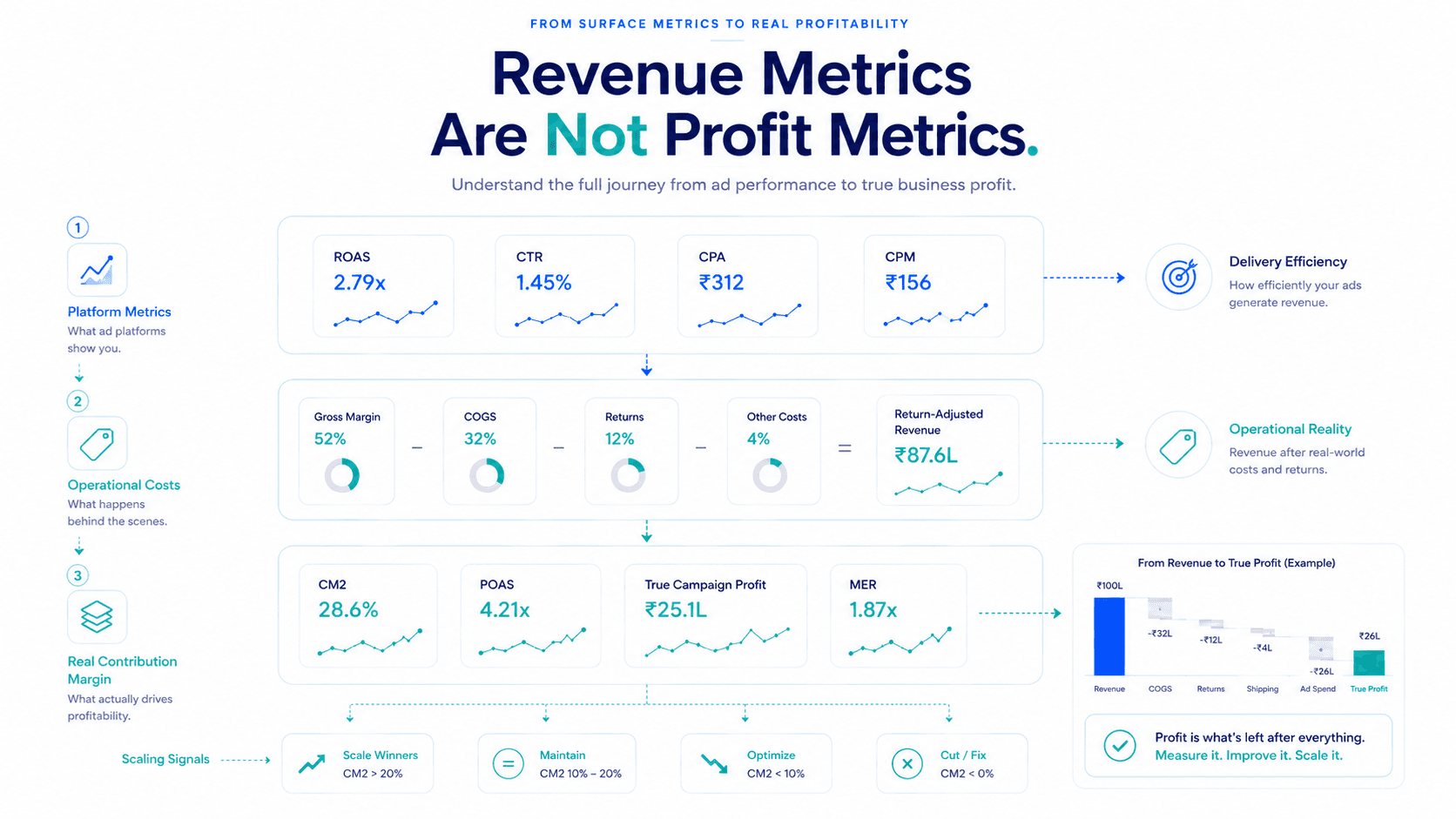
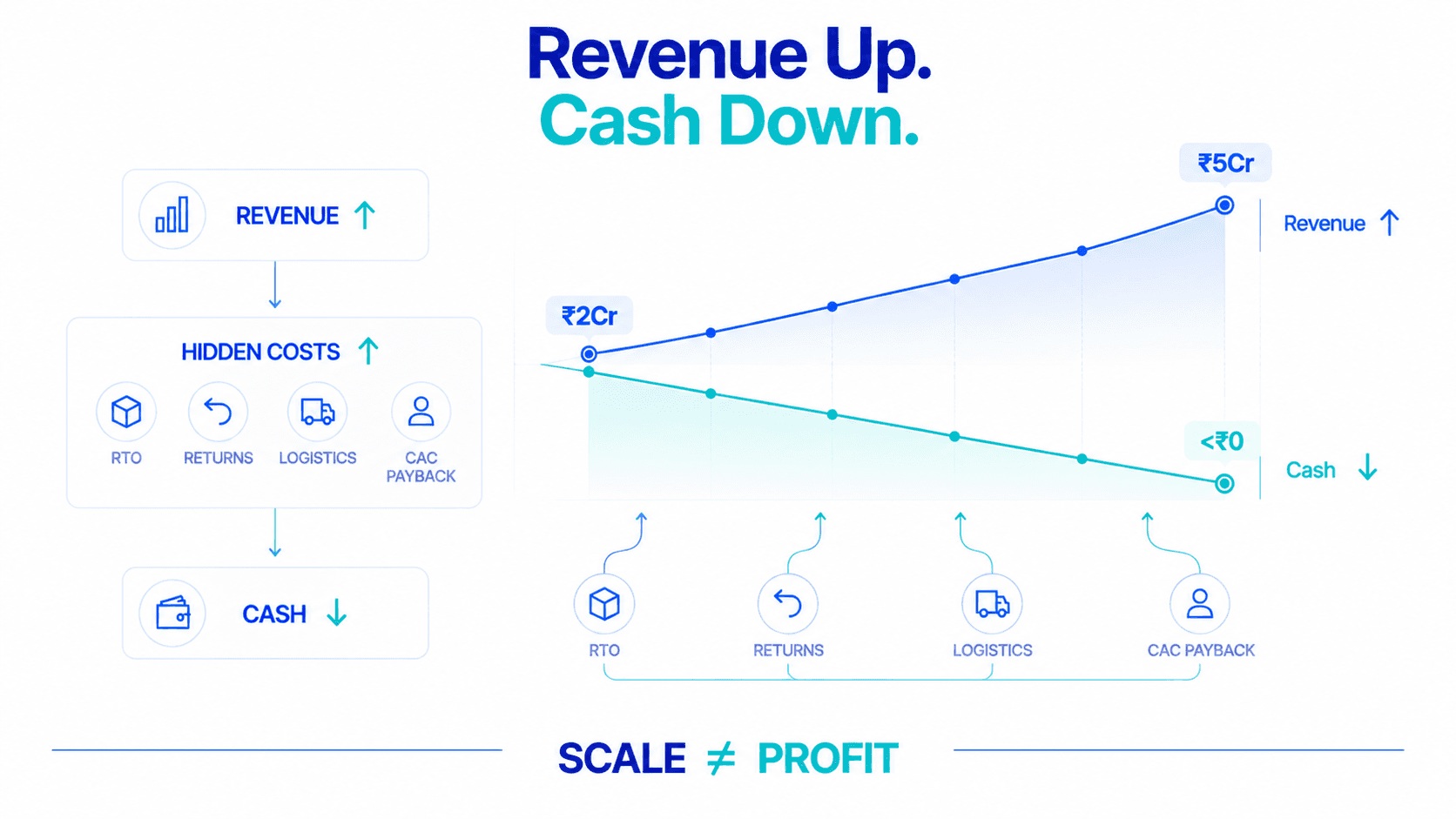
Every Meta Ads benchmark report shows you revenue generated per ad rupee. None of them show you what happens to that revenue after it lands.
RTOs accounted for nearly 25–30% of failed orders across mid-size Indian D2C brands in 2024. Each returned COD order costs brands ₹180–240 in forward shipping, reverse logistics, and processing.
Free shipping is the standard expectation for D2C in 2026. On low-AOV products (under ₹600), shipping costs alone can consume 15–25% of revenue.
Razorpay, Stripe, Shopify Payments payment processing fees of 2–3% apply to every order. Add Shopify's transaction fees where applicable. These are invisible in ROAS but very visible in your margin.
The most common margin trap: blended ROAS hides the fact that different SKUs have dramatically different margins. Your hero SKU might have 65% margin, while your upsell is at 18%.
This is your product-level profitability before any marketing costs. It tells you whether the product itself has enough margin to support advertising. If your CM1 is 20% or below, most paid channels will struggle to be profitable regardless of ROAS.
| Category | Strong CM1 | Adequate CM1 | At Risk CM1 |
|---|---|---|---|
| Apparel | >60% | 40–60% | <40% |
| Beauty / Skincare | >65% | 45–65% | <45% |
| Health / Supplements | >50% | 35–50% | <35% |
| Food / Beverage | >40% | 25–40% | <25% |
| Home / Lifestyle | >45% | 30–45% | <30% |
| Electronics | >35% | 20–35% | <20% |
This is campaign-level profitability — what actually remains for your business after you've paid to acquire the customer. This is the exact metric every Meta Ads campaign should be evaluated against.
| Category | Target CM2 |
|---|---|
| Beauty / Supplements | 25–40% |
| Apparel | 15–28% |
| Food / Beverage | 12–22% |
| Home / Lifestyle | 18–28% |
| Electronics | 5–15% |
If your CM2 is consistently below 10% at scale, you're paying to grow revenue without building a profitable business.
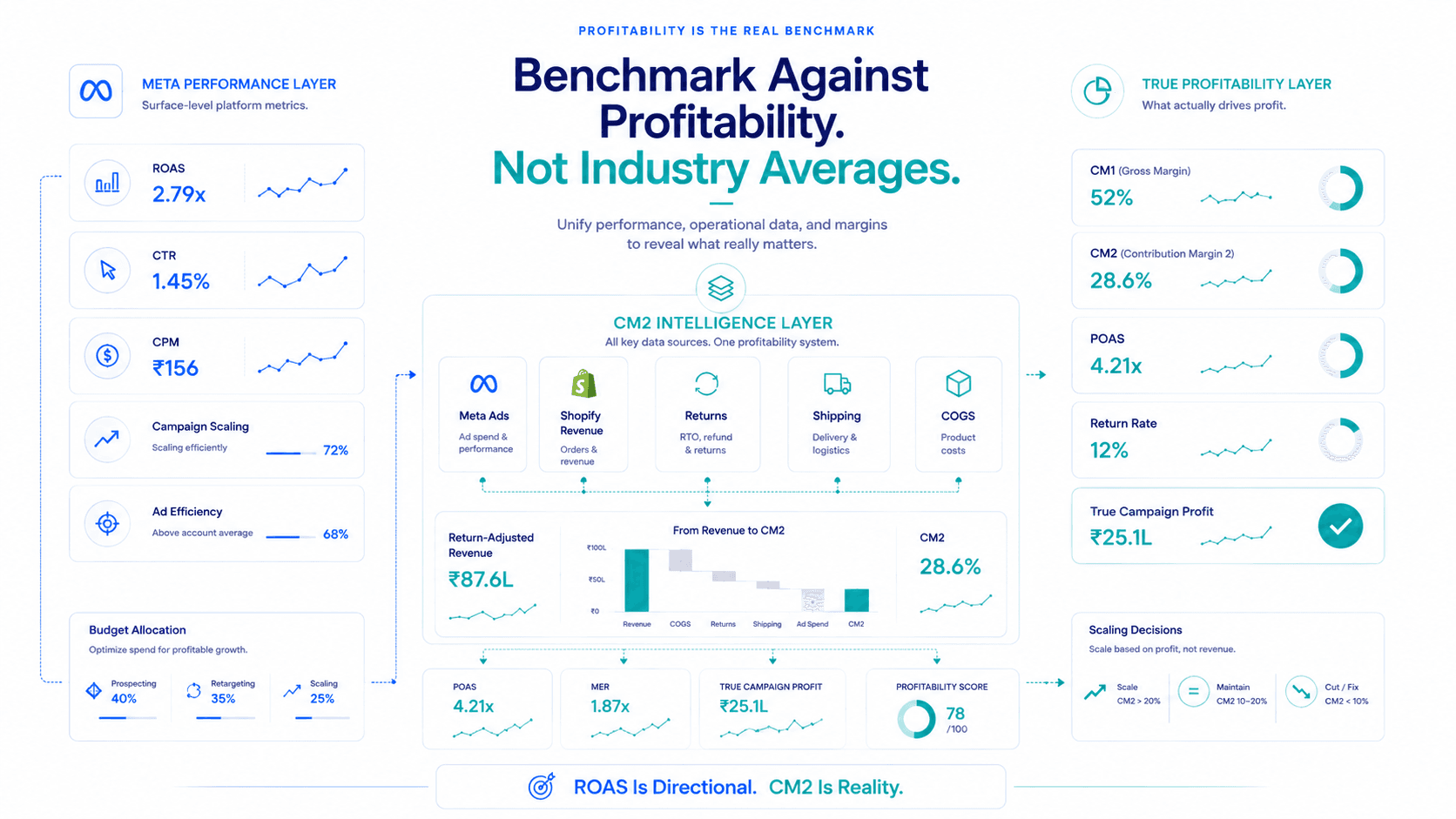
While ROAS measures how much revenue was generated as a result of an ad campaign, POAS (Profit on Ad Spend) measures the gross profit gained from every ad dollar spent. To calculate POAS, marketers need to consider other costs and profit margins.
The formula: (revenue minus all operational costs) divided by advertising costs. Your break-even point sits at POAS = 100%. Everything below that means you are advertising at a loss. In e-commerce optimisation projects, it's common to see businesses that think they are profitable based on ROAS, but score below 100% POAS.
| POAS Level | What It Means |
|---|---|
| Below 100% | Advertising at a loss, every ad rupee is destroying margin |
| 100–120% | Breakeven to marginal, viable only if strong LTV exists |
| 120–150% | Profitable, suitable for scaling with discipline |
| 150%+ | Strong, accelerate spend aggressively |
For D2C brands in India, a POAS above 1.0 means you are profitable after variable costs. Most early-stage D2C brands should target a POAS of 1.1–1.5 before scaling spend. Anything below 1.0 means every rupee of ad spend is destroying margin, regardless of ROAS.
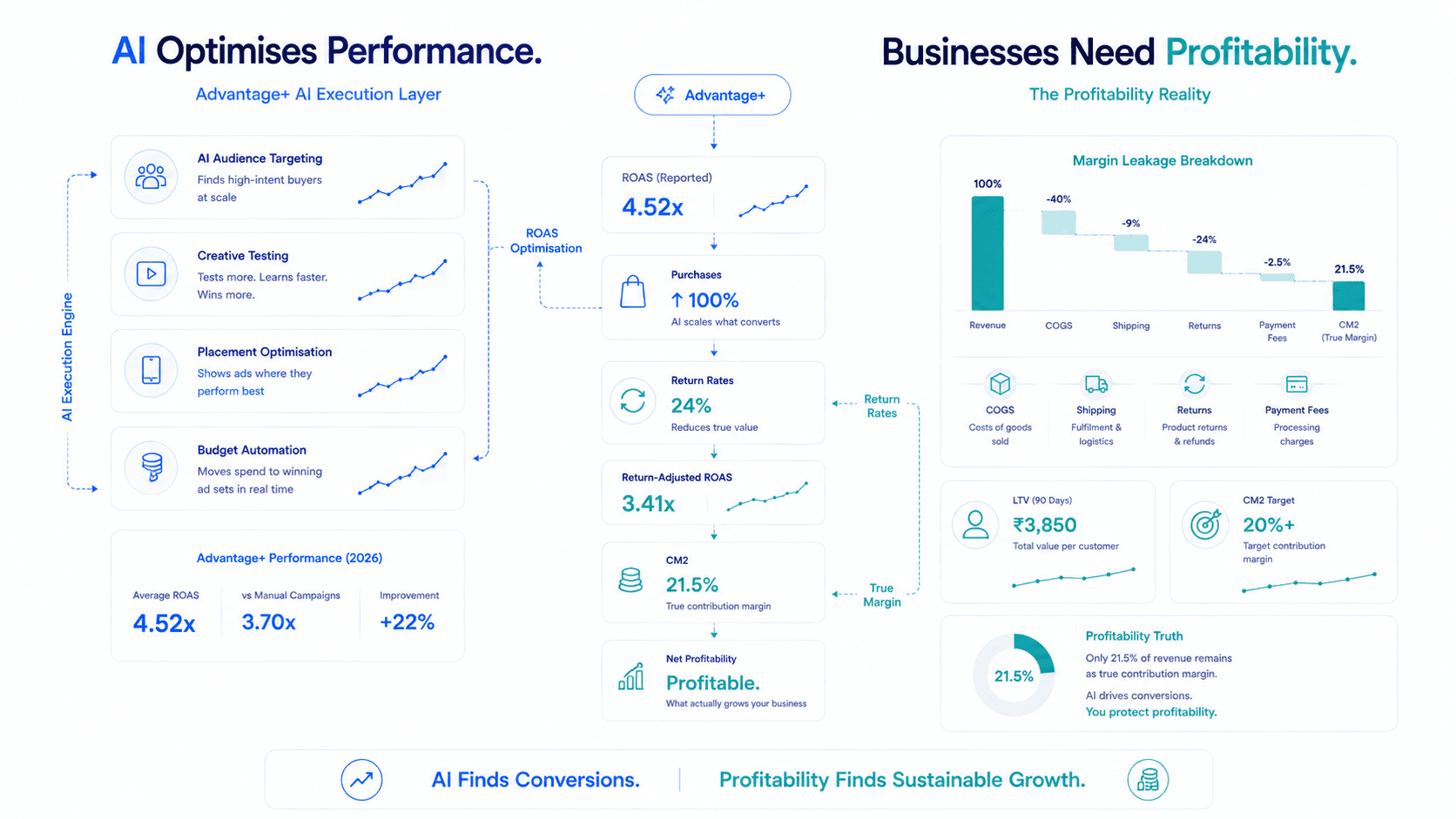
Even when you get your Meta ROAS right, the platform number is almost always optimistic. Meta's reported ROAS underestimates true performance by 20–40% for advertisers without CAPI (Conversion API), due to browser-based pixel limitations. But here's the inverse for advertisers relying entirely on platform attribution, double-counting across Meta and Google regularly inflates combined reported ROAS.
The fix: calculate your Marketing Efficiency Ratio (MER) independently. MER = Total Revenue ÷ Total Marketing Spend (all channels). MER doesn't care about platform attribution. It measures what your business actually earned against everything you spent on marketing. When your MER and your Meta ROAS are significantly misaligned, you have an attribution problem and your scaling decisions are being made on bad data.
Industry ROAS benchmarks are useful for one thing: identifying if your delivery mechanics are broken. If your Meta ROAS is dramatically below category median, something is wrong with your targeting, creative, or landing page.
They are not useful for measuring whether your campaigns are making you money. That requires CM2 and CM2 requires data that no ad platform will ever give you.
Contribution margin per campaign = Revenue − COGS − Returns − Shipping − Ad Spend
This is what Flable AI calculates automatically connecting your Meta ad data with your Shopify revenue, your returns portal, and your COGS to give you real CM2 per campaign in real time. Not industry benchmarks. Your numbers. Live. Every time a campaign is running. That is the benchmark that actually tells you whether to scale.
The Meta Ads ROAS benchmarks for 2026 are directional guides. They tell you whether your in-platform efficiency is within the normal range for your category. They do not tell you whether you're profitable.
The brands that are building durable D2C businesses in 2026 have moved past ROAS benchmarks as decision tools. They know their CM2 targets. They know their POAS. They know their return-adjusted revenue per campaign. And they make scaling decisions against those numbers — not against what the industry median says.
Frequently Asked Questions
Industry benchmarks for Meta ROAS range from 1.6x (Beauty) to 4.1x (Apparel) in 2026, with a cross-category median of approximately 2.79x–3.61x. However, 'good' ROAS depends entirely on your gross margin and return rate. A 2x ROAS can be highly profitable for a 70% margin brand; a 4x ROAS can be unprofitable for a 20% margin brand with high returns.
POAS (Profit on Ad Spend) measures the gross profit generated for every rupee of ad spend after COGS, shipping, returns, and other variable costs. ROAS measures revenue against ad spend. POAS break-even is 100%; anything above means you're generating real profit. Brands showing strong ROAS frequently score below 100% POAS once all costs are factored in.
CM2 is revenue minus COGS, shipping, returns, and ad spend the actual contribution each campaign makes to your business before fixed costs. It's the most accurate measure of whether a specific Meta campaign is profitable. Industry benchmarks don't show CM2; it can only be calculated by combining your ad data with your operational cost data.
Returns reduce net revenue without reducing ad spend, directly compressing ROAS and CM2. A campaign with a 20% return rate is approximately 20% less profitable than platform ROAS suggests. For high-return categories like fashion and electronics, this gap can make the difference between positive and negative contribution margin.
Flable connects your Meta ad data with Shopify revenue, COGS, and return data to calculate real CM2 per campaign in real time not just platform-reported ROAS. This gives you the actual profitability picture that benchmark reports can't provide, so every scaling decision is grounded in real business outcomes.
Real CM2 per campaign — live, automatic, adjusted for returns and COGS.
See Your Real Profitability →Setup in 48 hours · No credit card required