Industry Report
Meta's Advantage+ campaigns now deliver $4.52 for every $1 spent approximately 22% higher than manually managed campaigns. That's from Meta's Q1 2025 earnings report.
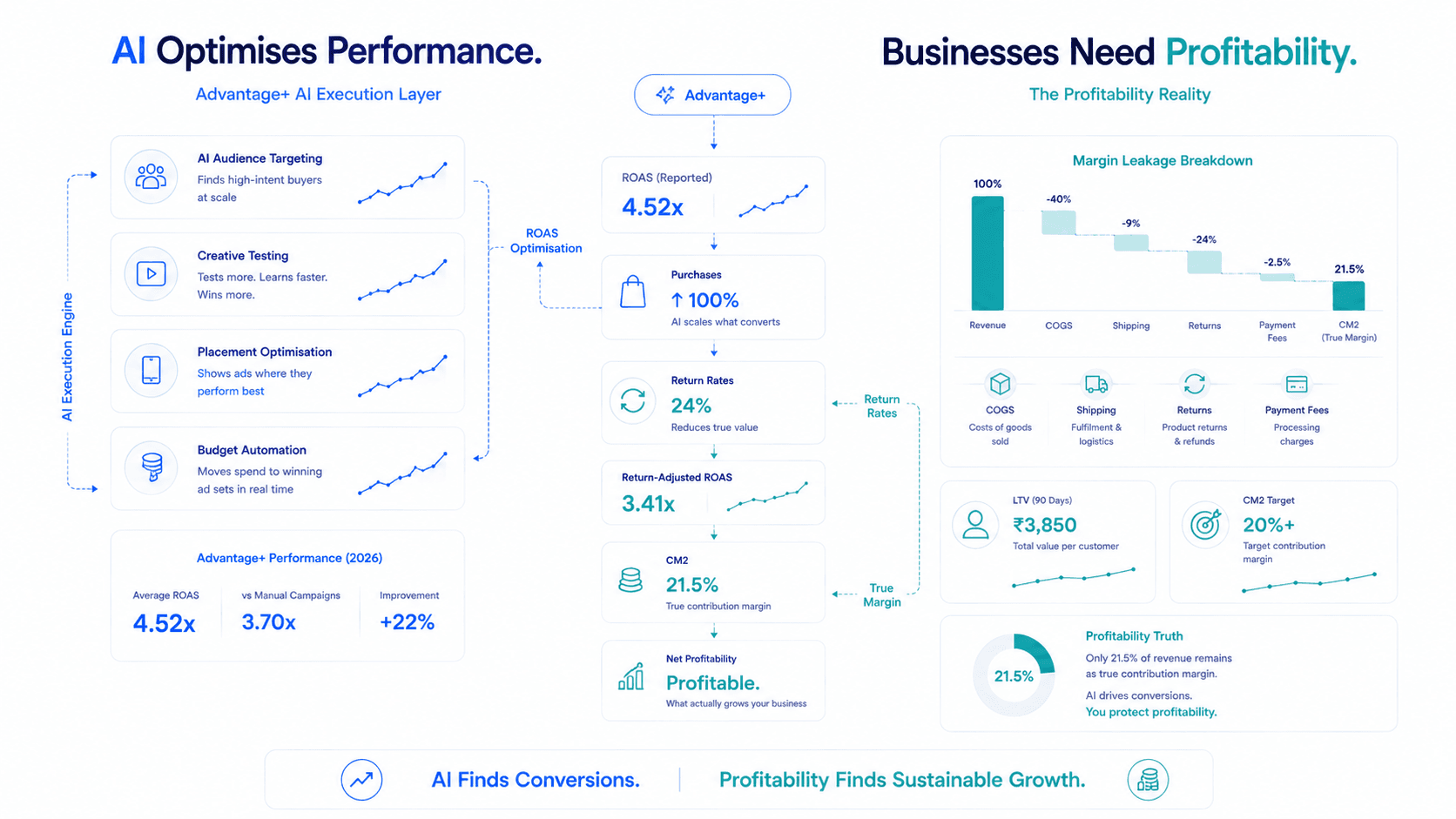
The shift to AI-powered Meta advertising in 2026 is not a trend to watch. It's already the default operating model for brands scaling on the platform. The question is no longer whether AI campaigns outperform manual ones the data is clear that they often do. The question is what the data doesn't show you, and whether the number you're optimising for is the right one.
Advantage+ automates the decisions performance marketers previously made manually:
| Campaign Type | Average ROAS | Notes |
|---|---|---|
| Advantage+ Shopping (ASC) | 4.52x | Meta Q1 2025 earnings data |
| Manual campaign | 3.70x | Same period comparison |
| AI improvement | +22% | Consistent across most verticals |
In 2026, creative quality accounts for over 50–70% of Meta Ads performance. The AI handles targeting and placement; the human input that matters most is creative quality and volume. Brands testing 20+ new ads monthly achieve 65% higher ROAS than those testing fewer than 10.
Where Advantage+ consistently outperforms manual:
Where manual campaigns can outperform or complement:
The practical recommendation from experienced D2C advertisers in 2026: run both. Allocate 25–50% of budget to Advantage+ and maintain manual campaigns alongside.
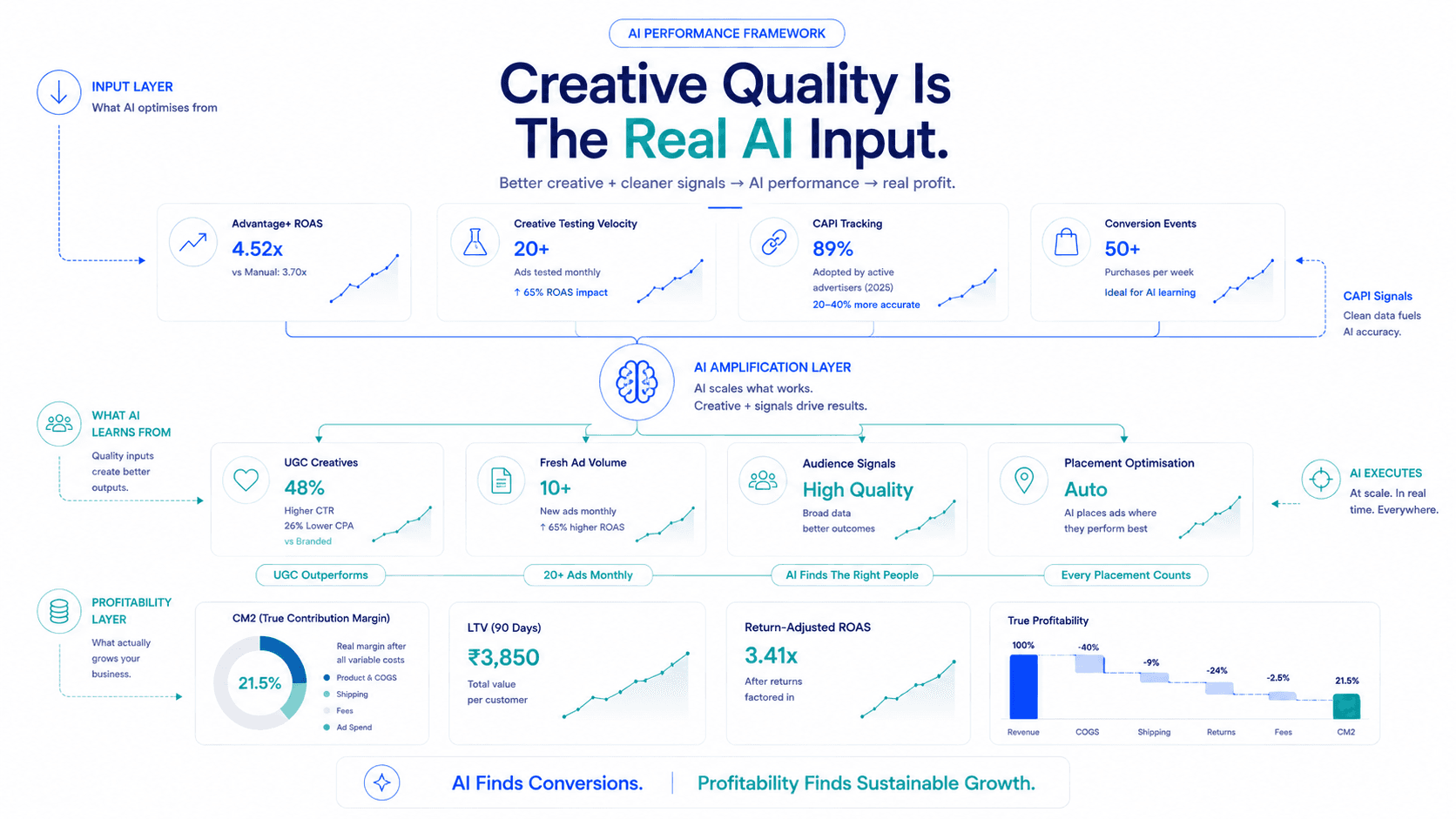
Advantage+ optimises toward purchases. It is very good at finding people who will click and convert. It is not able to evaluate whether those purchases are profitable.
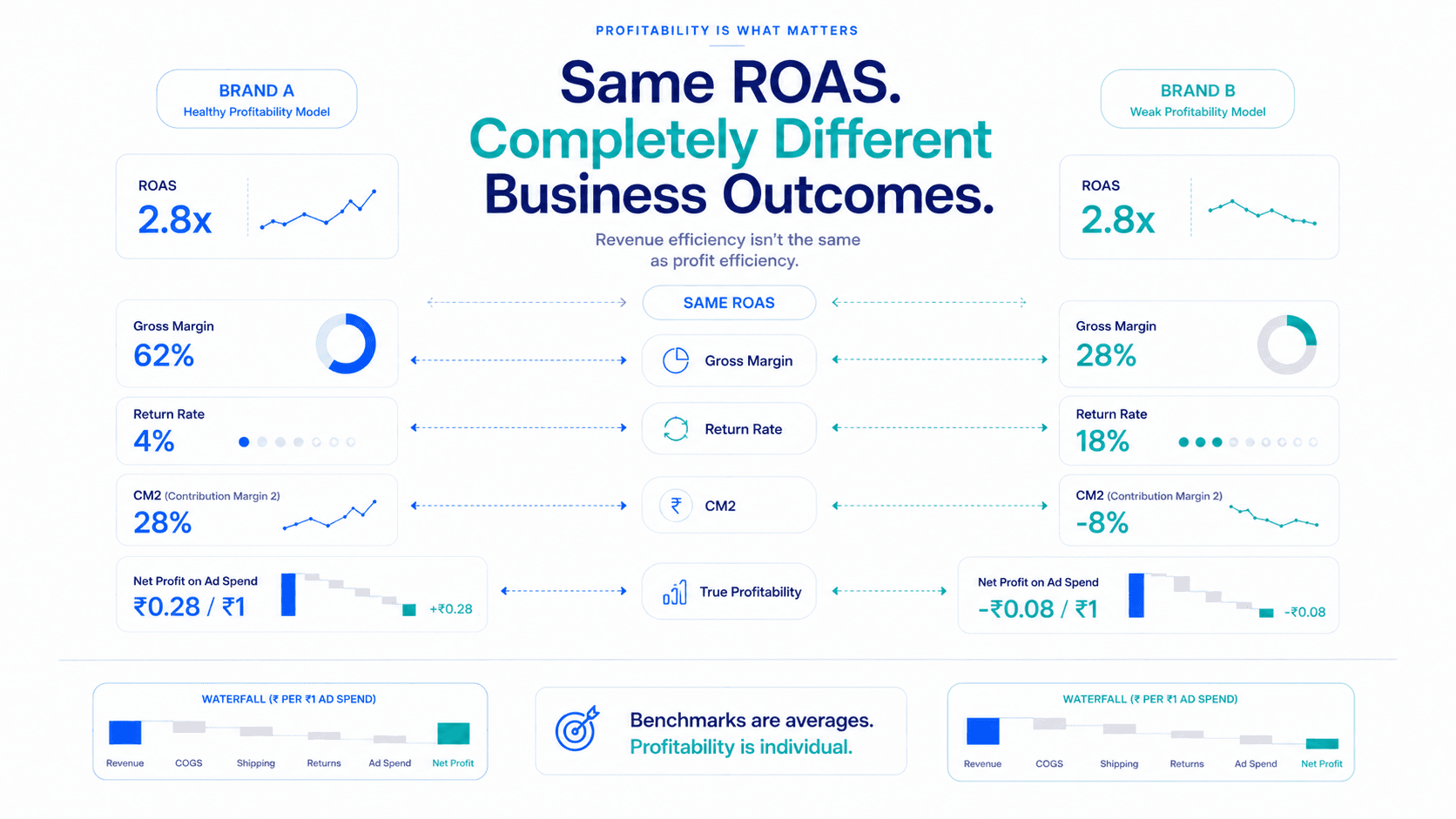
It doesn't know your COGS. It doesn't know your return rate. An ASC campaign might find a high-converting audience of price-sensitive buyers during a promotional period, showing a 5.1x ROAS. But if that audience has a 28% return rate, your real contribution margin might be lower than a 3.2x ROAS campaign targeting considered buyers with a 5% return rate.
A real scenario: An ASC campaign finds a high-converting audience of price-sensitive buyers. Reported ROAS: 5.1x. Return rate on that audience: 28%. Gross margin: 40%. Real contribution margin: 21.5%. Another campaign with 3.2x ROAS targeting considered buyers with a 5% return rate: Real contribution margin: 15.5%. Wait — this one's less profitable? Yes. But these customers have a 3x purchase frequency vs the promotional buyers. Over 12 months, their LTV makes them dramatically more valuable.
The algorithm sees ROAS. It does not see LTV. It does not see return rates. It scales the conversion signal, not the margin signal.
The brands getting the most from Advantage+ use AI campaigns for execution (targeting, placement, creative testing) and an independent profitability layer to evaluate what the AI is actually producing.
This is what Flable AI enables. Not replacing Advantage+, but giving D2C brands the profitability layer that Advantage+ doesn't have. Real CM2 per campaign, adjusted for returns and COGS, in real time so the AI optimises execution while you optimise for real business outcomes.
Frequently Asked Questions
Advantage+ Shopping Campaigns (ASC) are Meta's AI-powered campaign type for ecommerce. Instead of manually setting audiences, the algorithm draws from Meta's full user base and uses machine learning to find converters automatically. It manages targeting, placement, and budget allocation in real time. According to Meta's Q1 2025 earnings report, ASC delivers an average ROAS of 4.52x approximately 22% higher than manually managed campaigns.
On average, yes, 22% higher ROAS according to Meta's own data. But averages hide variation. For niche audiences, regulated categories, or campaigns needing tight demographic control, a hybrid approach often performs better. The key is testing both and comparing CM2 results against your specific benchmarks.
Creative quality and testing velocity. MHI Media's 2026 benchmark data shows brands testing 20+ new ads monthly achieve 65% higher ROAS than those testing fewer than 10. The algorithm optimises distribution; it cannot fix weak creative.
The 2026 Advantage+ update lowered the conversion threshold to 25 weekly purchase events. Below this threshold, the algorithm has insufficient data to optimise effectively. You also need CAPI (Conversions API) installed for clean tracking signals.
Advantage+ optimises toward purchases. Flable shows what those purchases actually earned real CM2 per campaign, adjusted for COGS, returns, and shipping. This gives D2C brands the profitability signal the algorithm can't see, enabling scaling decisions based on actual business outcomes.
Real CM2 per campaign, live, adjusted for returns and COGS. What the AI can't see.
Start Measuring Profitability →