Automation Guide
This is the question every D2C founder eventually asks: should I put more money in Meta or Google?
The short answer is: it depends. The useful answer requires understanding exactly what each platform is doing for your business and why the ROAS number alone gives you an incomplete and often misleading picture of where your money should go.
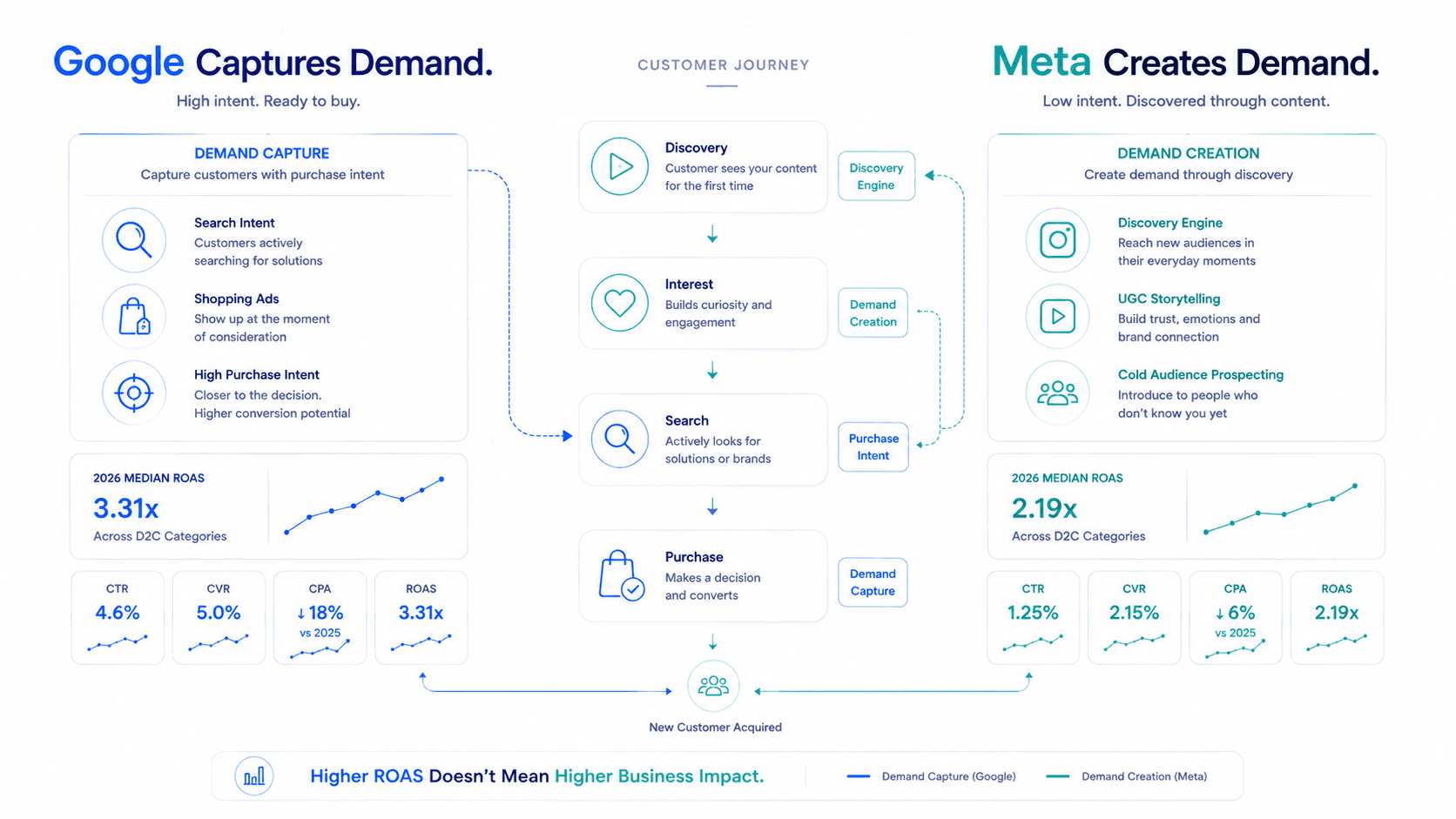
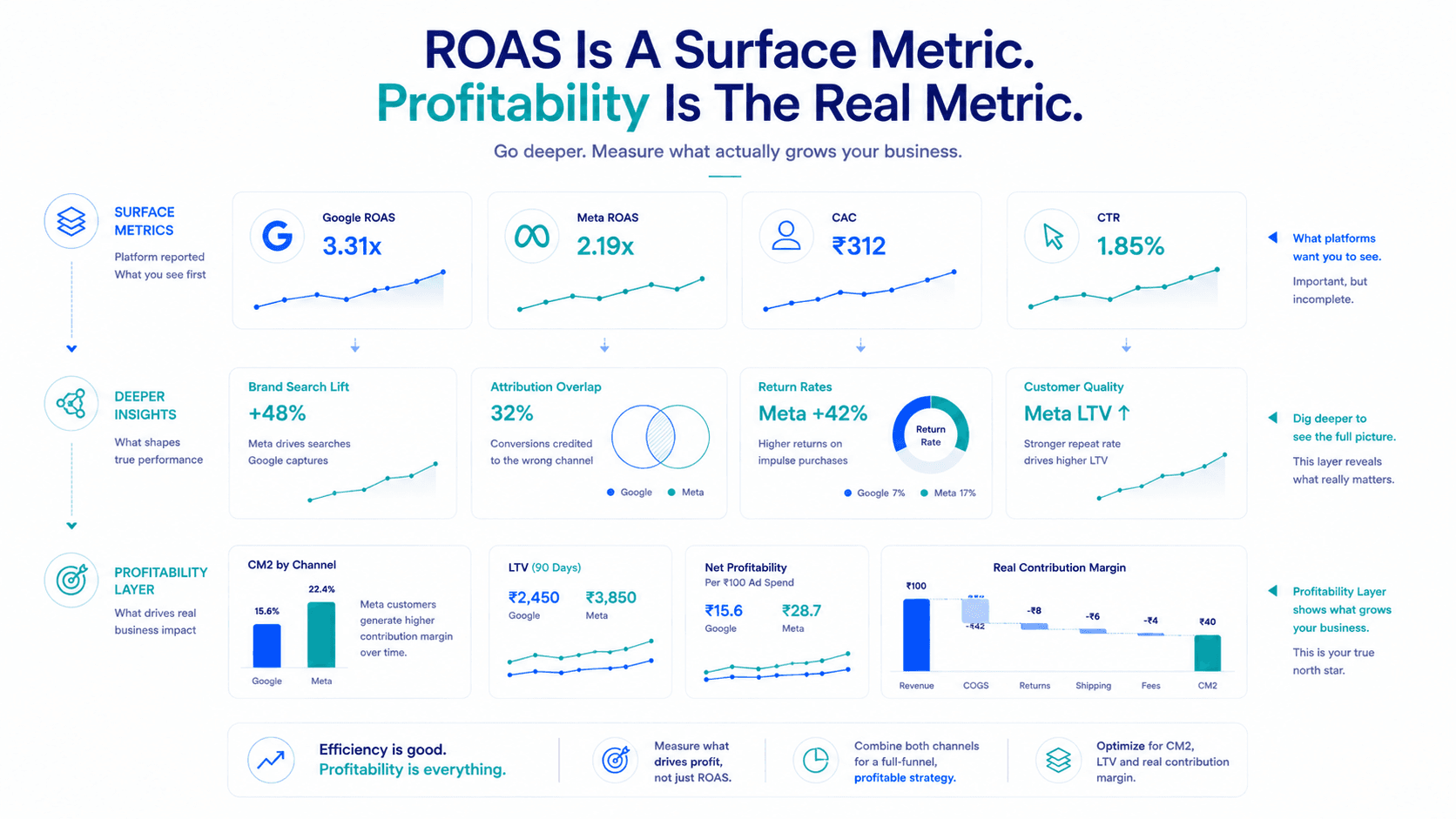
In 2026, Google Ads delivers a median ROAS of 3.31x across industries. Meta delivers 2.19x. On the surface, Google wins. But that comparison misses almost everything that matters.
Google Ads captures existing demand. When someone searches "buy whey protein", they've already decided they want to buy. Google's job is to ensure your product appears in front of that intent at the right moment.
Meta Ads create new demand. When someone scrolls Instagram and sees your ad, they were not thinking about your product. They had no purchase intent. Your ad had to interrupt their scroll, earn their attention, and build desire.
Comparing their ROAS is like comparing the conversion rate of a physical store (where people walked in to buy something) to a cold-call salesperson (who has to create interest from nothing). The store will always win on conversion rate. That doesn't make cold outreach valueless.
| Category | Google ROAS | Meta ROAS | Gap | What It Means |
|---|---|---|---|---|
| Health & Supplements | 4.2–5.5x | 2.2–3.0x | +2x | Strong search intent exists — Google captures ready buyers |
| Beauty / Skincare | 3.5–4.8x | 1.6–2.1x | +2x | Discovery-driven category — Meta builds demand, Google converts it |
| Apparel / Fashion | 3.0–4.2x | 3.5–4.1x | ~Parity | Meta competitive for fashion — visual discovery is strong |
| Food & Beverage | 2.5–3.5x | 1.5–2.0x | +1.5x | Google wins on specific product searches; Meta struggles to convert F&B |
| Home & Garden | 3.5–4.5x | 2.1–2.5x | +1.5x | Consideration purchases perform better on Google's intent-capture model |
| Electronics / Gadgets | 4.5–6.0x | 1.8–2.4x | +2.5x | Research-driven purchases strongly favour Google |
| Baby Products | 4.0–5.0x | 3.8–4.4x | ~Parity | Both channels effective — high intent for essential products |
Cross-category medians: Google ~3.31x overall. Meta ~2.19x. Google's structural ROAS advantage holds across almost every category because it captures buyers who are ready to purchase, not people who need to be persuaded.
Meta: Demand creation and brand equity
- Cold audience prospecting — introduce your product to new people
- Brand storytelling — build emotional connection that reduces future acquisition costs
- Creative testing — discover what messages and formats resonate
- Retargeting warm audiences — bring back those who engaged
Google: Demand capture and purchase conversion
- Brand search — capture people who heard about you through Meta and are now searching
- Category search — appear when people have purchase intent for your product category
- Shopping — capture visual browsing from buyers in product research mode
The sequence that works: Meta creates awareness and desire. Google captures the conversion that Meta created. When you attribute the final purchase to Google and cut Meta spend, you reduce the top of funnel that was feeding Google.
| Category | Google CAC | Meta CAC | Notes |
|---|---|---|---|
| Beauty / Skincare | ₹350–650 | ₹250–500 | Meta often cheaper for beauty prospecting |
| Health / Supplements | ₹400–750 | ₹350–600 | Comparable — both effective |
| Apparel / Fashion | ₹450–800 | ₹300–600 | Meta lower CAC but higher returns |
| Home & Garden | ₹500–1,000 | ₹600–1,100 | Google slightly more efficient |
| Electronics | ₹800–1,500 | ₹1,000–2,000 | Google significantly more efficient |
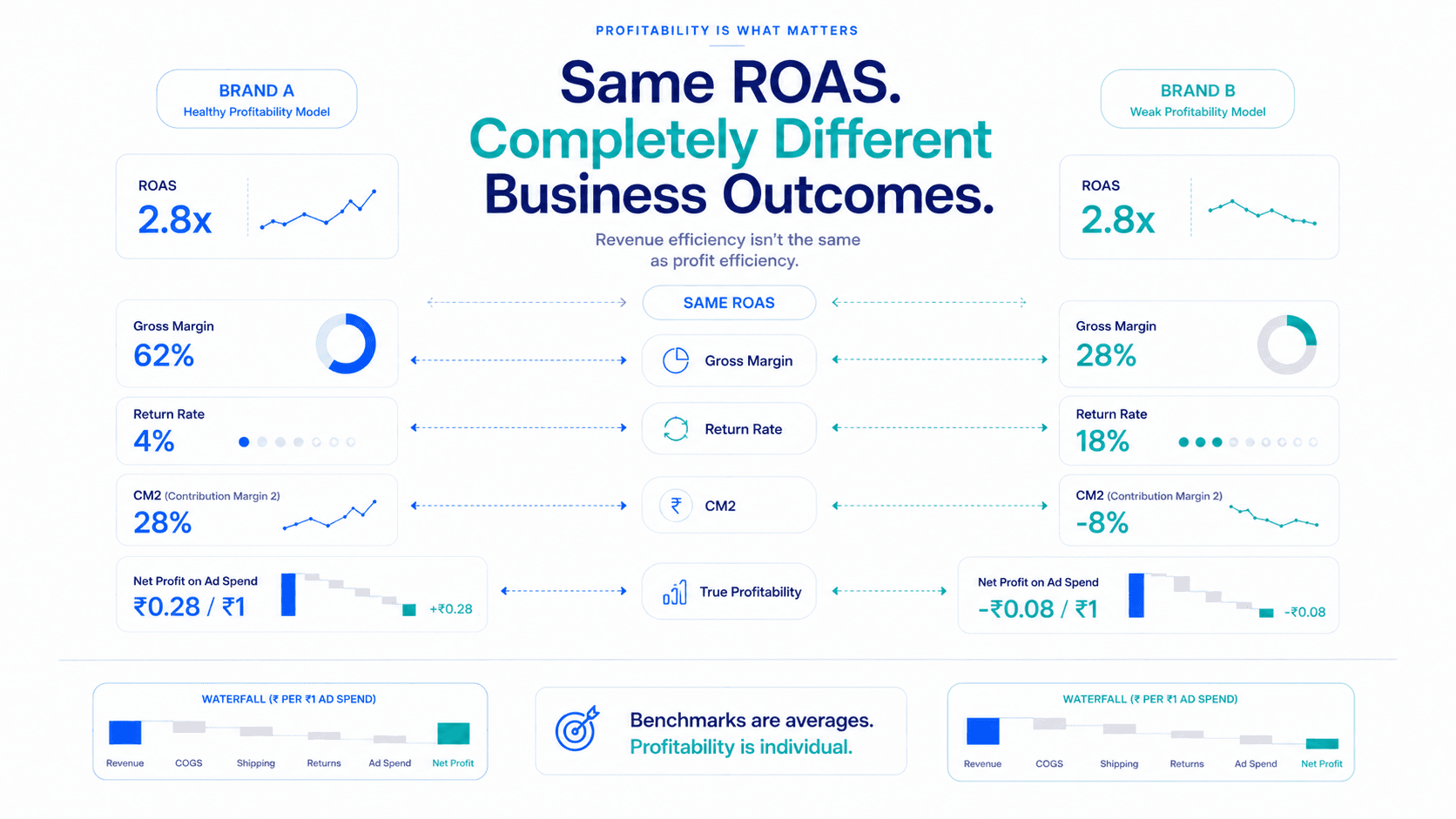
Stop asking: which platform has a better ROAS? Start asking: which platform generates a better CM2 per customer acquired?
CM2 per channel = (Net Revenue from Channel − COGS − Shipping − Returns) ÷ Ad Spend on Channel
When you have this number for both Google and Meta calculated against the same real cost data, the allocation decision becomes clear. This is what Flable AI gives D2C brands in real time. Not Meta ROAS vs Google ROAS. Real CM2 per channel, per campaign, per day so budget allocation decisions are made on actual business outcomes.
Frequently Asked Questions
Google Ads captures existing demand people actively searching for your product or category. Meta Ads create new demand interrupting people who were not looking for your product and building desire from scratch. This is why Google typically shows higher ROAS (it's converting ready buyers) while Meta builds the awareness that eventually feeds Google's conversions.
Google consistently delivers higher ROAS approximately 3.31x median vs Meta's 2.19x across industries in 2026. But Google's higher ROAS partly reflects conversions that Meta created upstream. An incrementality test (pausing Google brand campaigns) often shows that a meaningful portion of Google conversions would have happened through direct or organic regardless.
Base the allocation on CM2 per channel, not ROAS. As a starting framework: 60–70% Meta / 30–40% Google at the growth stage, adjusted based on which channel produces better contribution margin per acquired customer. Meta-only brands plateau because they can't capture search intent. Google-only brands struggle to build awareness and brand equity over time.
If Meta acquires customers with lower return rates and stronger repeat purchase behaviour than Google, its true CM2 (contribution margin per customer) may be higher despite lower ROAS. Return-adjusted CAC and downstream LTV are the right comparison metrics not in-platform ROAS, which doesn't account for post-purchase behaviour.
Flable shows real CM2 per channel connecting ad spend on both platforms with actual revenue, returns, and COGS from your Shopify store. This gives you an apples-to-apples comparison of what Google and Meta are actually contributing to your business, adjusted for all costs, so budget allocation decisions are grounded in real profitability.
Google vs Meta real CM2, live, per campaign. Make allocation decisions on actual profit.
Connect Your Ad Accounts →