Attribution
Why Your Meta Ads Are Getting Purchases But Not Profits
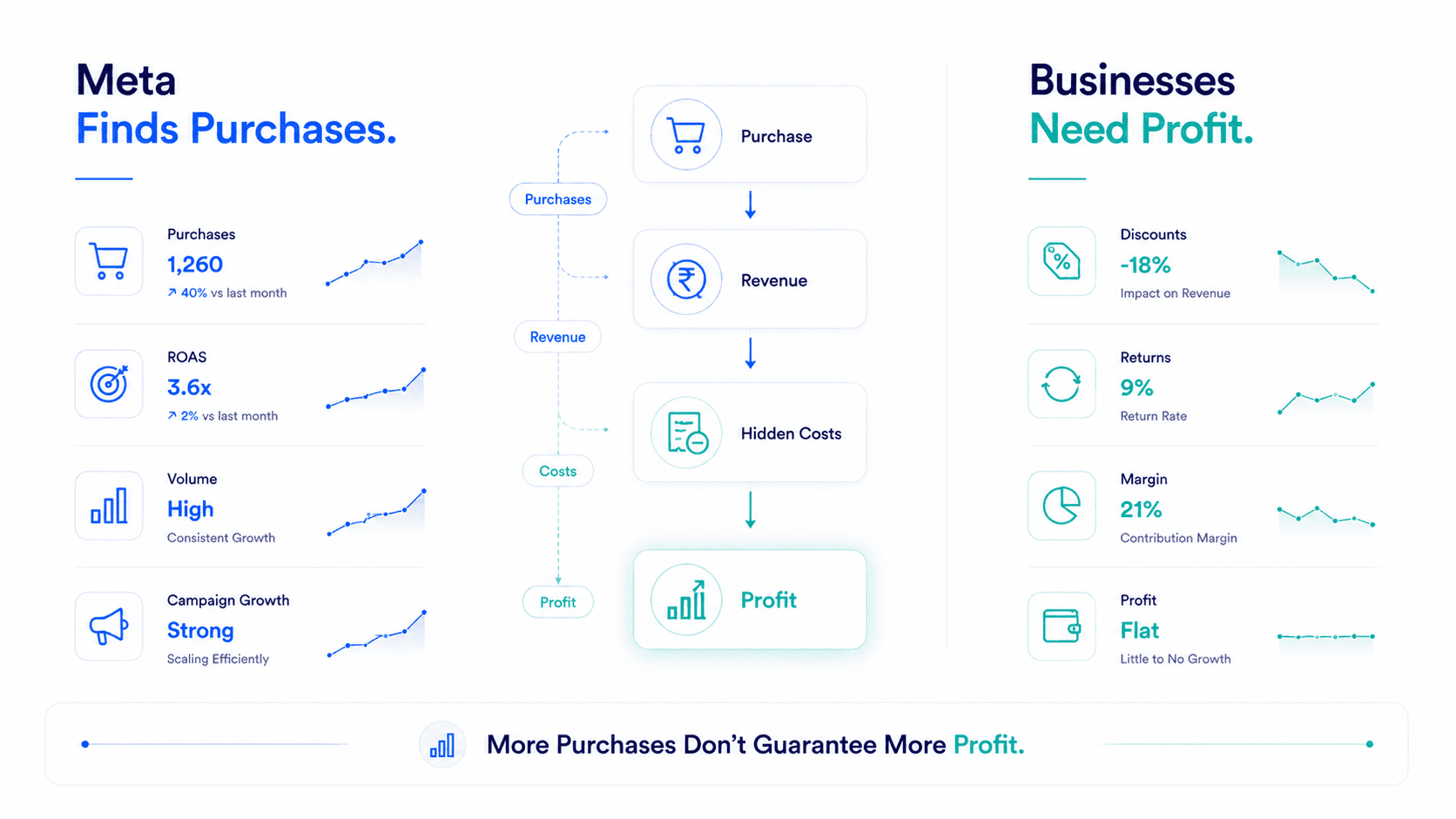
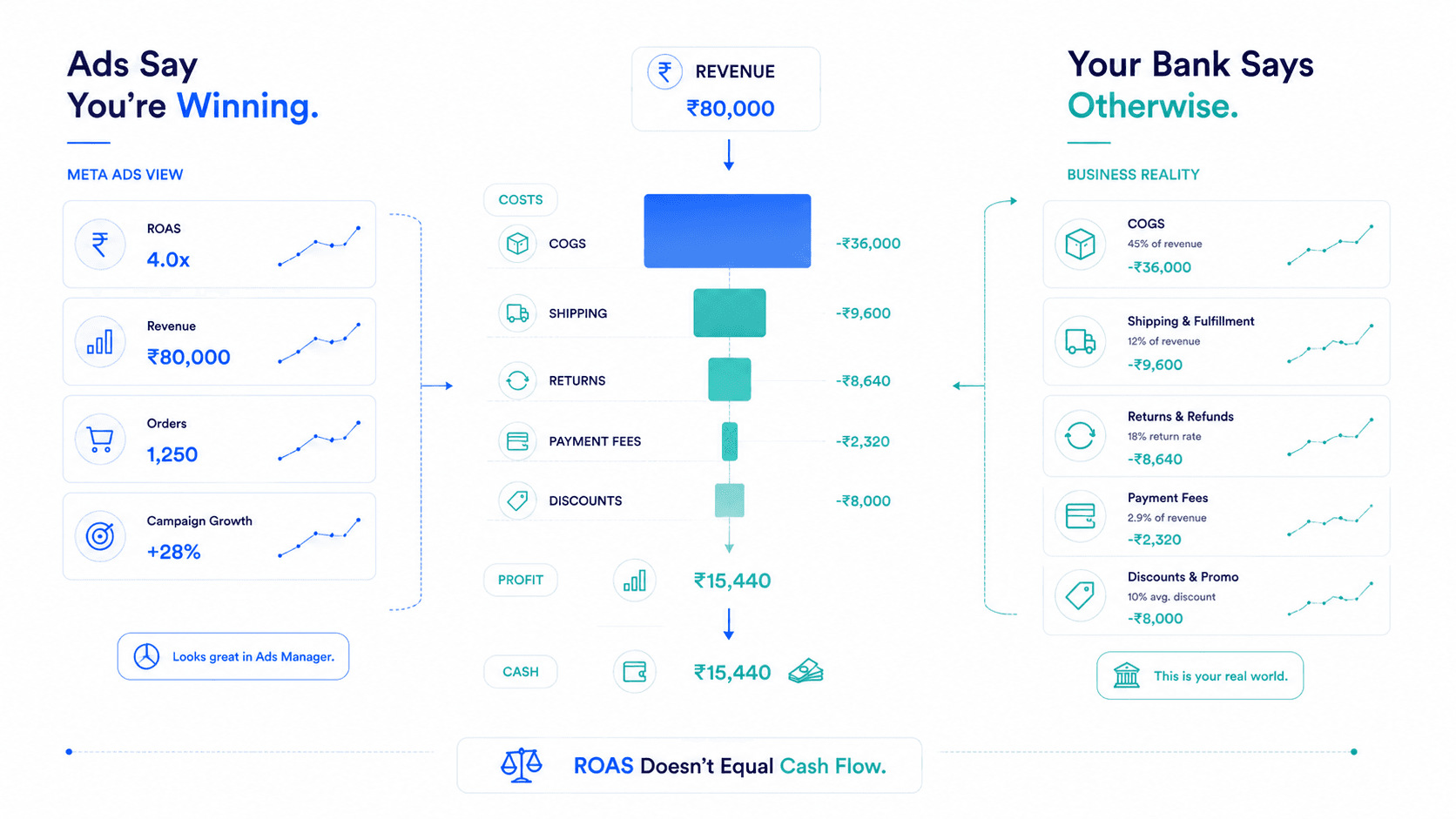
There's a specific kind of confusion that hits performance marketers around month three or four of scaling a Meta Ads account: purchase volume is genuinely climbing, the "Purchases" column in Ads Manager looks great, and yet profit, the number on the P&L, refuses to move in the same direction.
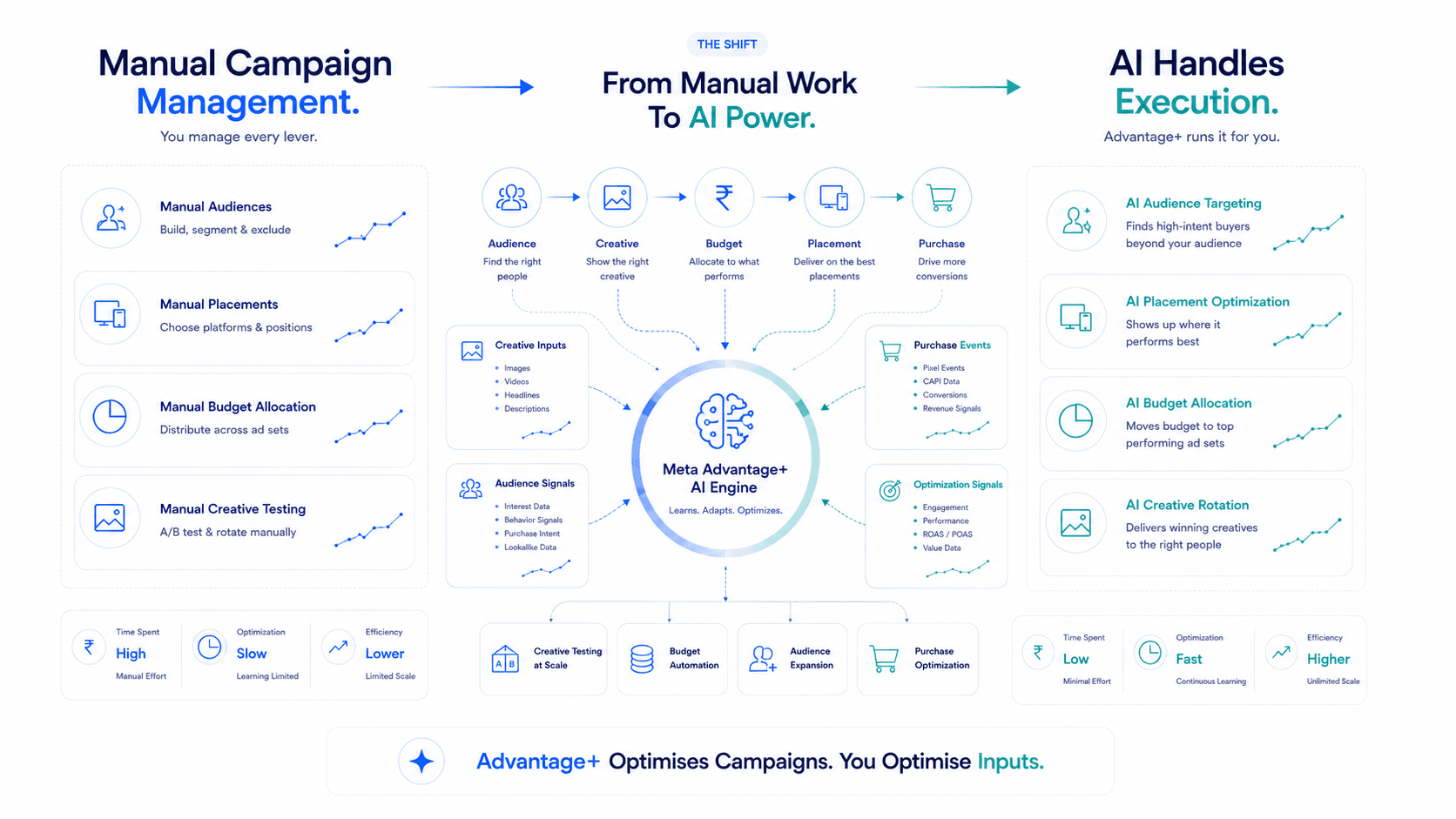
This isn't a tracking bug. It's a natural consequence of how Meta's optimization engine works. Meta's algorithms are built to maximize the event you tell them to maximize, in most ecommerce setups, that event is "Purchase." The algorithm has no concept of margin, discount depth, or whether a purchase came from a customer who would have bought anyway. It simply hunts for the cheapest, most reliable way to generate more of the event you asked for.
With Meta Ads CPMs up roughly 18–20% year over year in 2026 and overall cost-per-acquisition rising alongside it, this gap between purchase volume and profit has become more expensive to ignore than ever. This guide breaks down exactly why it happens and what to do about it.
Ask a founder to describe this pattern and it usually sounds something like: "Our purchases are up 30% quarter over quarter, our ROAS is stable, but our bank balance hasn't moved the way it should." This is one of the clearest signals that a Meta Ads account is optimizing for the wrong outcome, purchase volume instead of profitable purchase volume.
Meta's ad delivery system is a machine learning model trained to find the lowest-cost path to your chosen conversion event. By default, most ecommerce advertisers set this event to "Purchase," using the order's total value as the value signal (if using value-based bidding at all). The algorithm has zero visibility into:
Whether the customer was already a returning buyer who would have converted through another channel
Left to its own devices, the algorithm will happily find the cheapest, most reliable purchases available, and cheap, reliable purchases are frequently the ones driven by heavy discounting or by customers already deep in the consideration funnel, not by genuinely incremental demand.
Discount-driven purchases dominate the mix. Promotional codes convert more easily, so the algorithm naturally leans toward campaigns and audiences using them, inflating purchase count while compressing per-order margin.
Retargeting captures purchases that would have happened anyway. Warm audiences convert cheaply, making retargeting look highly efficient even when much of that "purchase" was not incremental.
Low-margin bundles convert better than hero products. If a bundle is priced to move quickly, the algorithm scales it, even though it contributes less profit per order.
Average order value drops as volume rises. Chasing purchase count can shift the mix toward smaller basket sizes, which increases per-order fixed costs (shipping, payment fees) as a percentage of revenue.
Return rate increases with impulse-driven volume. Purchases driven by urgency messaging or steep discounts often carry higher return rates, which erodes realized profit weeks after the original "win" was recorded.
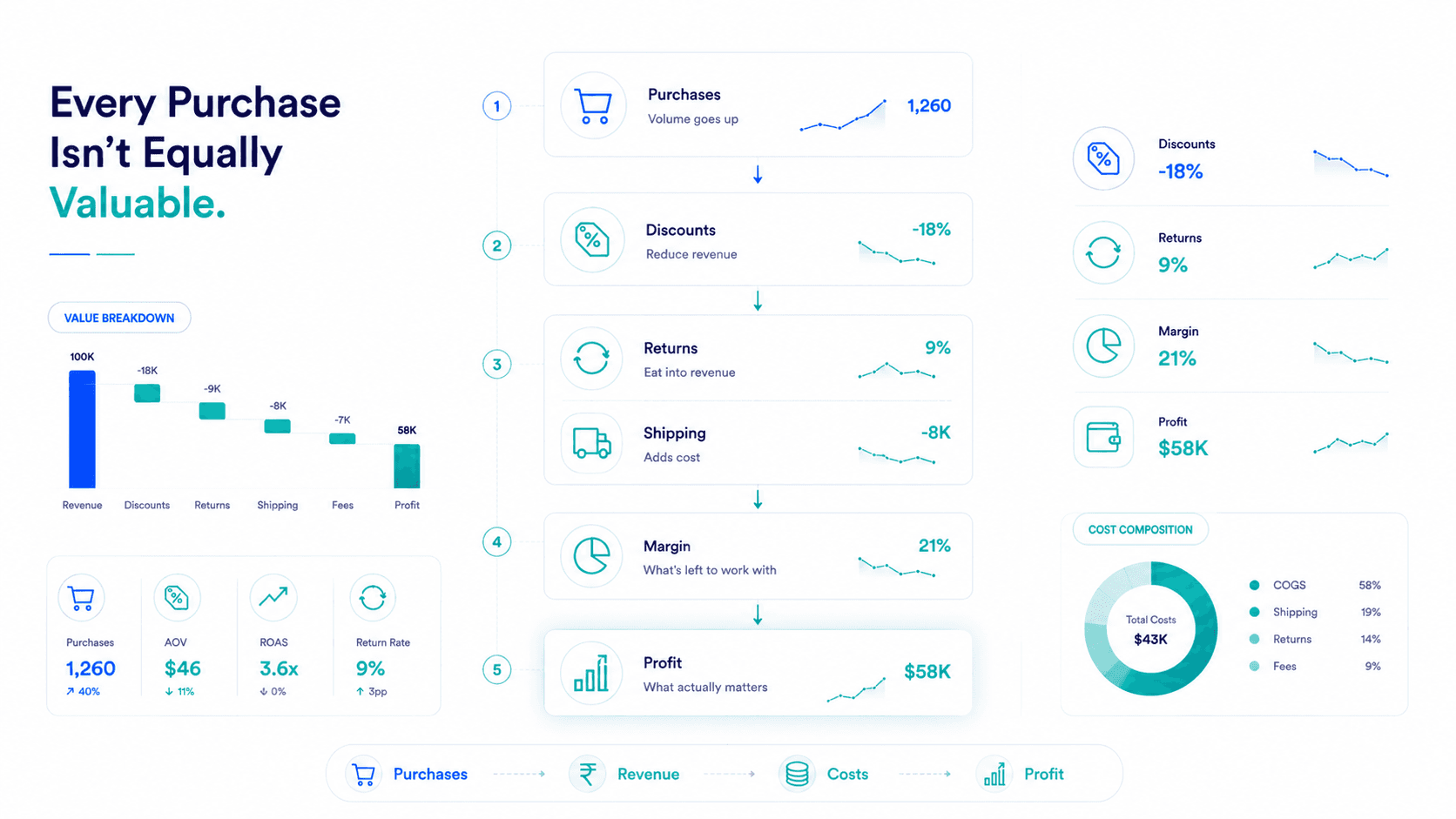
A beauty brand scales its Meta budget from $18,000 to $28,000 per month, targeting the Purchase conversion event.
Average order value drops from $52 to $46, as more orders come from a discounted starter bundle
Return rate ticks up from 6% to 9%, as bundle buyers are less committed than hero-product buyers
The result: contribution profit for the month is nearly identical to the prior month, despite 40% more purchases and 55% more ad spend. The extra spend generated volume, not profit, a pattern invisible in the Purchases metric or even ROAS, and only visible once POAS and contribution margin are calculated by product.
| Dimension | Purchase-Optimized | Profit-Optimized |
|---|---|---|
| Optimization Signal | Raw purchase event / order value | Margin-adjusted value or POAS target |
| Tendency | Favors discounted, low-margin, or already-warm buyers | Favors high-margin, genuinely incremental buyers |
| Reported Metric Trend | Purchases and ROAS both look strong | POAS and contribution margin trend upward |
| Risk | Can scale volume without scaling profit | Requires more setup and cost-data accuracy |
| Best Fit | Early testing phase, brand awareness goals | Scaling phase, budget allocation decisions |
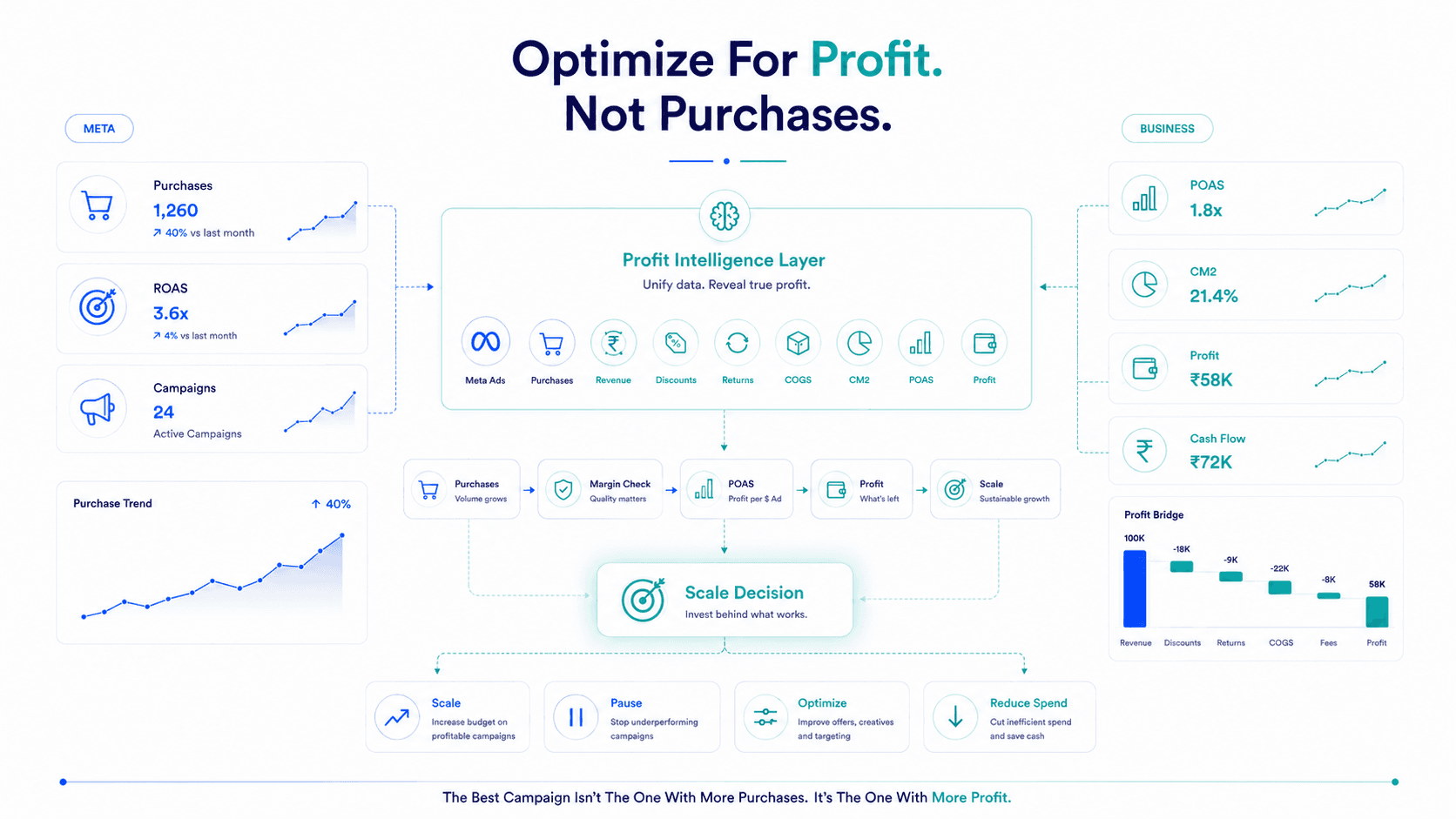
The core issue is that "Purchase" as an event has no concept of quality. A $15 discounted item and a $150 full-price hero product both count as exactly one purchase in Ads Manager. This is why brands need a profitability layer sitting on top of raw conversion counts, segmenting purchases by product and margin, not just totaling them.
Discount codes are one of the most common, and most underestimated, drivers of this gap. A steep promotional offer will almost always convert better than full-price messaging, which means Meta's algorithm will naturally favor serving more impressions to discount-driven creative and audiences, since that's where the cheapest purchases live. Over time, this can shift an account's entire purchase mix toward promotional buyers without anyone deliberately deciding that should happen.
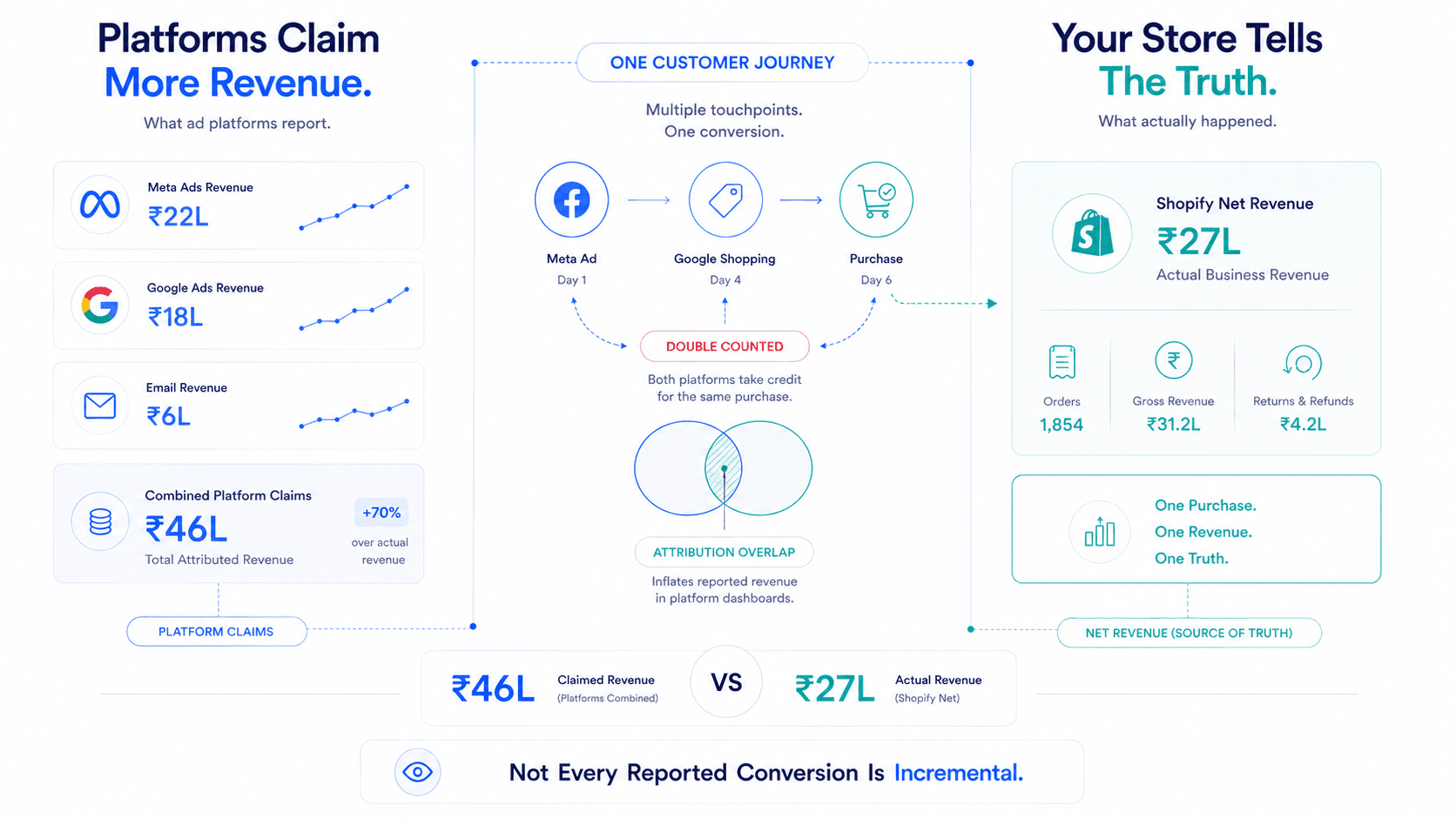
Retargeting campaigns typically show the lowest cost-per-purchase in any account, which makes them look like the best-performing tactic. But a meaningful share of retargeting "wins" are customers who had already decided to buy and would have converted through organic search, direct traffic, or email regardless. Multiple attribution and incrementality studies, including research referenced by digital measurement firms and echoed in the IAB/BWG Global State of Data 2026 report have found that click-based measurement systems, including standard Meta reporting, tend to overstate the incremental impact of remarketing specifically. Paying full price in ad spend for a purchase that would have happened anyway is, by definition, pure cost with no profit benefit.
Celebrating rising purchase counts without checking average order value or return rate trends.
Running steep, always-on discounts through paid social, training the algorithm to favor bargain-hunting buyers.
Not excluding or separately tracking retargeting-driven purchases when evaluating incremental value.
Scaling budget based on ROAS or purchase volume alone, without a POAS or contribution margin gate.
Failing to segment purchase data by product or SKU, missing which specific items are driving the volume-without-profit pattern.
Calculate contribution margin by SKU and identify which products are driving purchase volume at the expense of profit.
Where supported, feed margin-adjusted order value into Meta's Conversion API instead of raw order value.
Separate prospecting and retargeting budgets, and evaluate retargeting against an incrementality benchmark, not just cost-per-purchase.
Cap discount-code exposure within paid social specifically, rather than running blanket sitewide promotions through every channel.
Set a POAS floor before scaling any campaign, regardless of how strong purchase volume or ROAS looks.
Review purchase volume alongside average order value and return rate every time you review Ads Manager, never in isolation.
Treat retargeting cost-per-purchase with healthy skepticism; periodically test holdout groups to estimate true incrementality.
Segment reporting by product margin tier, not just campaign or ad set.
Build (or adopt) a profitability layer that connects COGS and discount data to ad performance automatically, since manually tracking this by SKU becomes unmanageable at scale.
Treat "more purchases" as a question, not automatically as good news, until contribution margin confirms it.
Key Takeaways
Frequently Asked Questions
Usually because the additional purchases are coming from discounted products, low-margin bundles, or retargeting audiences that would have converted anyway none of which show up as a problem in the raw purchase count.
No, by default it optimizes for the conversion event and value signal you provide, which is typically raw order value or purchase count, not margin.
Often, yes, a portion of retargeting "wins" are customers who would have converted anyway, meaning the ad spend on them generates no true incremental profit.
Track average order value and discount-code usage rate alongside purchase count; a rising purchase count with falling average order value is a strong signal.
No, retargeting still has value, but it should be evaluated against incrementality benchmarks rather than cost-per-purchase alone.
It's an order value passed to Meta's optimization engine that reflects margin (revenue minus COGS and key costs) rather than the raw order total.
By connecting SKU-level COGS to your order and ad performance data, ideally through a unified profitability tool rather than manual spreadsheet work.
Yes, if it's driven by low-margin or heavily discounted products at increasing ad cost, it can consume cash without adding meaningful profit.
Compare average order value and return rate trends against purchase count trends over the same period a divergence there is usually the first sign.
POAS (Profit on Ad Spend) or contribution margin by product, since both explicitly account for cost and margin rather than treating every purchase as equal. If you're still measuring success by purchase count alone, you're only seeing part of the picture. Platforms like Flable AI help D2C brands connect margin and discount data to Meta Ads performance, so purchase volume and profit finally move in the same direction.
Real contribution margin per campaign and channel. The number that tells you whether to scale.
Start Measuring Profitability →Setup in 48 hours · No credit card required · Backed by Microsoft & NVIDIA