Metric Guide
Last quarter, I was reviewing campaign performance with a D2C founder. Fashion brand. ₹12L/month in Meta spend. Growing fast.
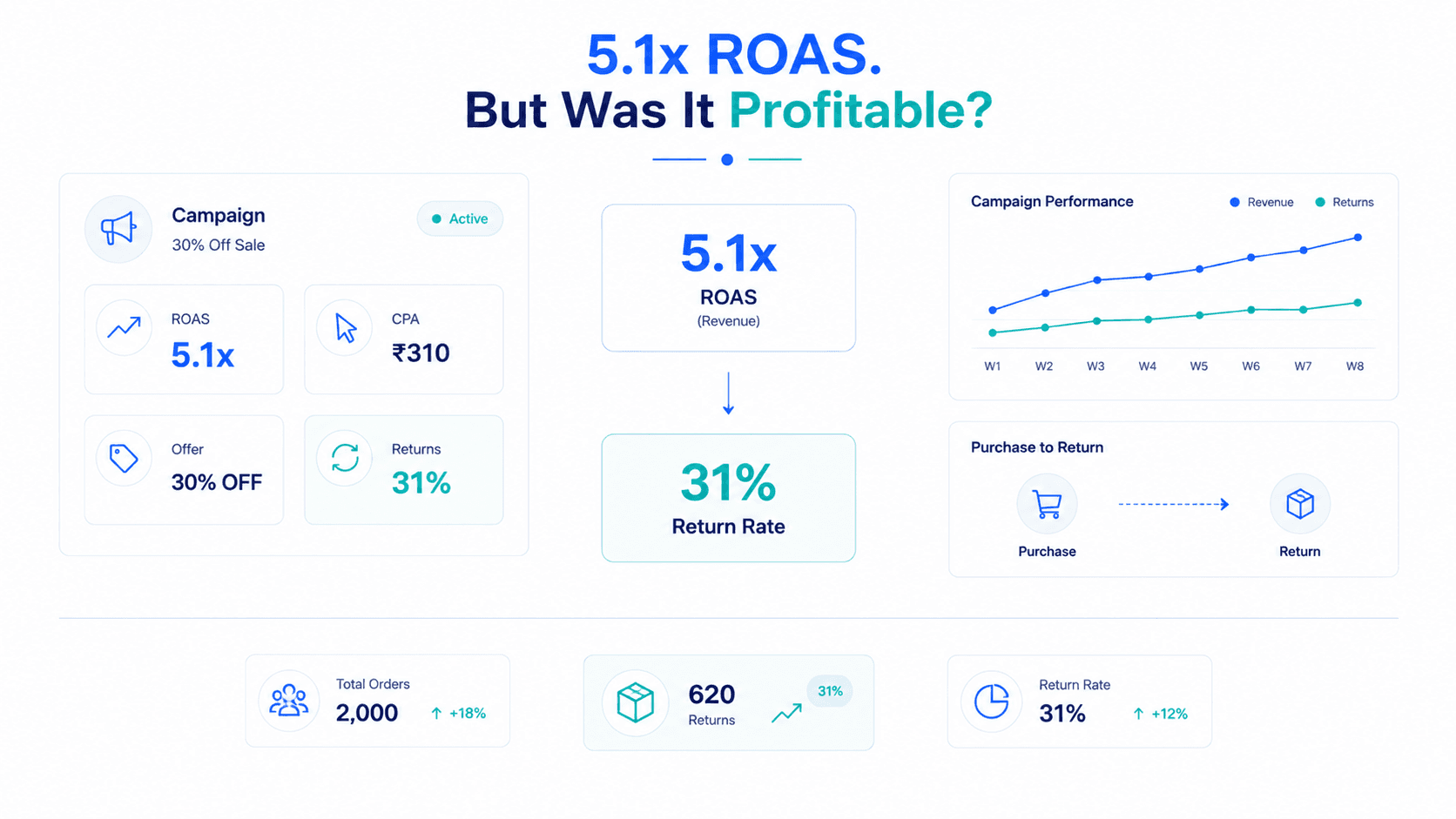
Their best campaign: 5.1x ROAS.
Their agency loved it. Their team celebrated it. Every Monday call started with this campaign as evidence that things were working.
I killed it.
Here’s why, and why it was the right decision.
On paper, everything about this campaign checked out.
Strong ROAS (5.1x). Low CPA (₹310). High click-through rate. Healthy impression volume. The creative was a 30% off sale, and it was converting beautifully.
But when we pulled the full picture:
5.1x
What Ads Manager reported
31%
Nearly 1 in 3 buyers returned
0.28x
Gross profit per ₹1 of ad spend
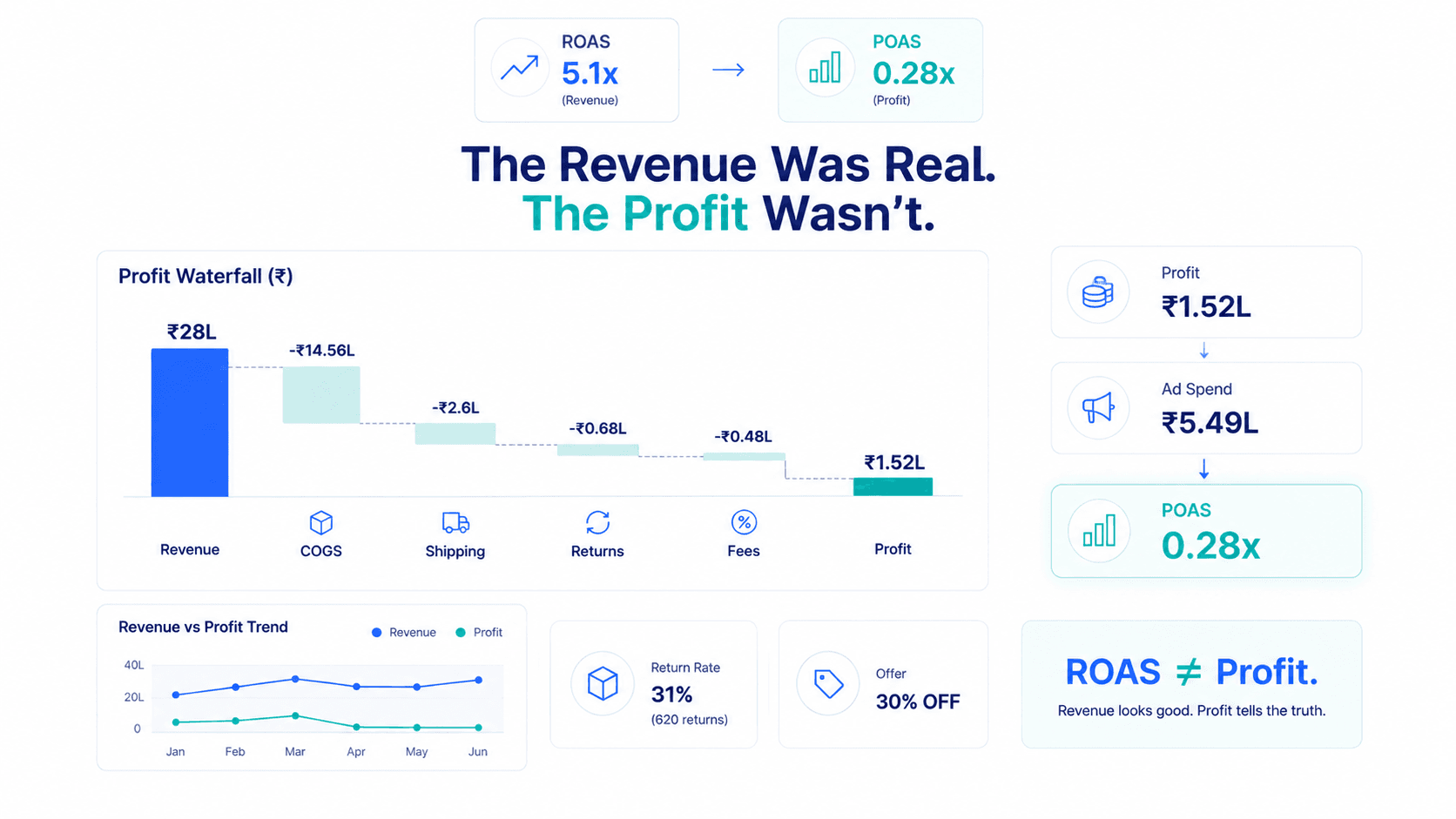
Nearly 1 in 3 customers who bought through this campaign returned the product. And when we ran the real numbers:
The real P&L of the 5.1x campaign
Gross profit
₹19.3L − ₹14.56L − ₹2.6L − ₹68,200 − ₹48,250 = ₹1,51,550
POAS
₹1,51,550 ÷ ₹5,49,000 = 0.28x
5.1x ROAS. 0.28x POAS.
The campaign was generating ₹0.28 in gross profit per rupee of ad spend, before team costs, before rent, before software. Effectively burning cash at scale.
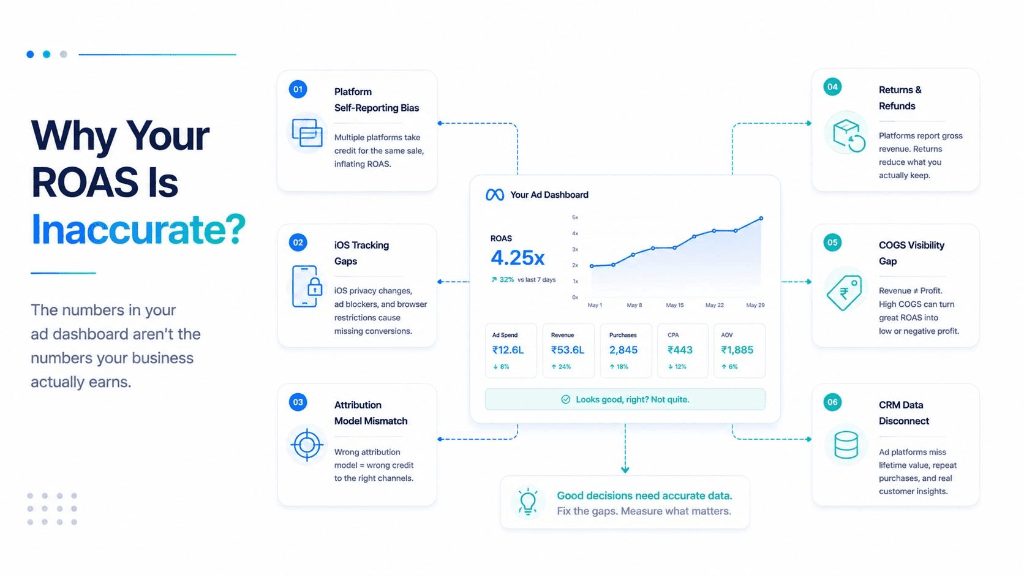
Meta’s pixel sees the purchase event.
It does not see the return.
When 620 customers returned their products 10–14 days after purchase, those conversions stayed in Ads Manager unchanged. Revenue stayed attributed. ROAS stayed at 5.1x.
The return hit Shopify. It hit the logistics partner. It hit the founder’s bank account.
Meta never knew.
And so the algorithm kept optimising toward this campaign. Kept finding more customers who would click a 30% off offer, buy, and return. The cycle kept running. The losses kept accumulating.
Here’s the thing about 30% off campaigns with 31% return rates.
You’re not acquiring customers. You’re acquiring transactions.
Customers who were attracted by a 30% discount have a specific profile:
The 5.1x ROAS campaign was efficiently finding and acquiring exactly these people. At enormous cost.
The founder was nervous. Understandably. The campaign was their highest ROAS. Killing it felt like choosing to perform worse.
Two things happened in the four weeks after:
Result 1
Individual campaign ROAS declined, we’d removed a high-ROAS campaign. But MER (Shopify net revenue ÷ total marketing spend) barely moved. Which told us what we suspected: the campaign was attributing revenue that was either coming back as returns or coming from other channels anyway.
Result 2
Overall brand return rate dropped from 19% to 13% in six weeks. The campaign had been responsible for a disproportionate share of all returns, and without it, the whole brand’s return economics improved.
19% → 13%
In six weeks
+11 pts
No change to remaining campaigns
Contribution margin improved by 11 percentage points. Without a single change to the remaining campaigns.
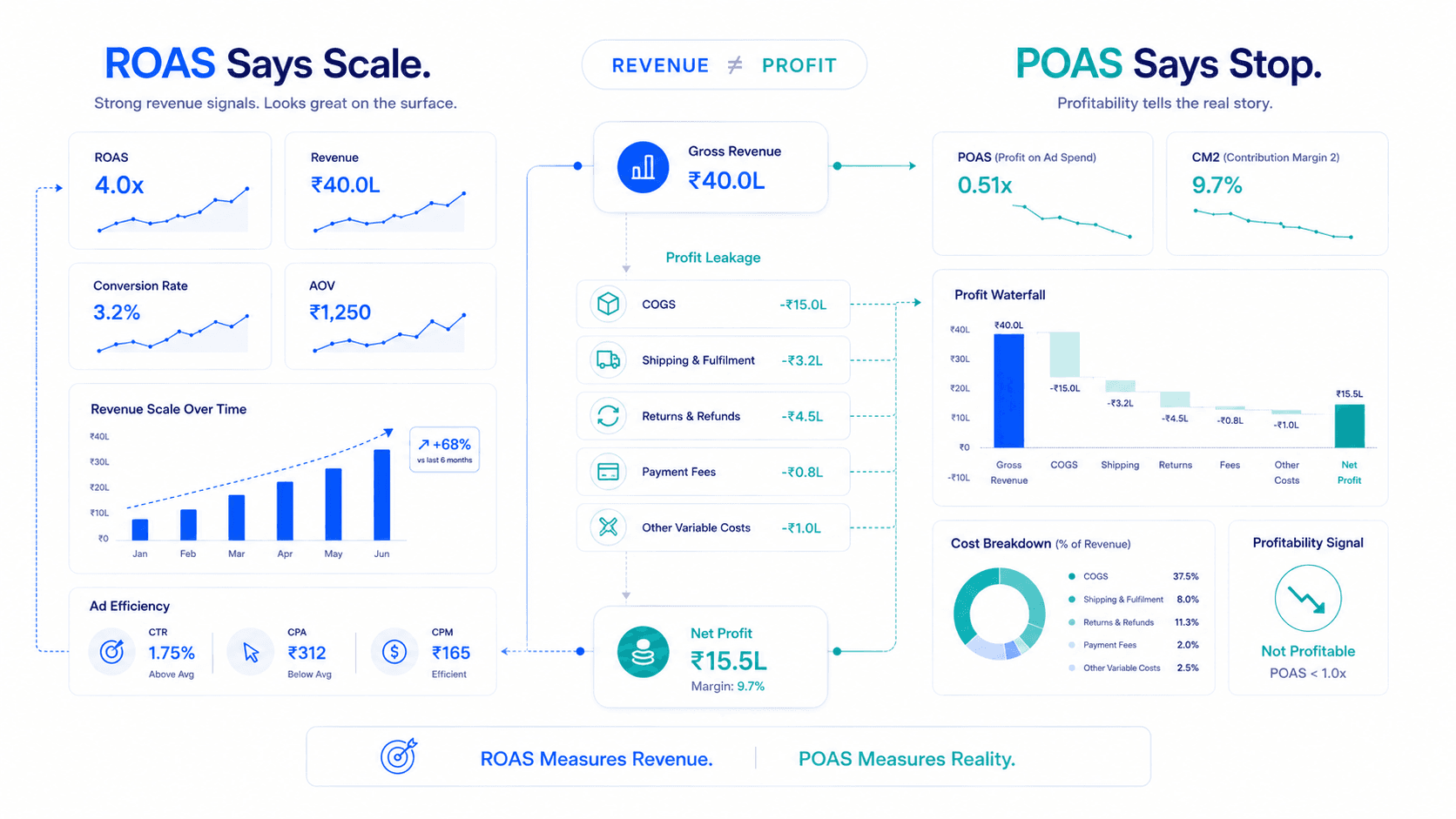
ROAS rewards campaigns that generate attributed revenue efficiently.
It does not reward campaigns that generate profit.
A discount campaign that converts brilliantly, 30% off, high CTR, high CVR, will always show strong ROAS. The discount is priced into the conversion, not into the return.
The return, which is where the damage lives, happens after the attribution window. After the platform has already celebrated the conversion. After the ROAS has already been calculated and reported.
You need a metric that catches what ROAS misses.
POAS. Profit on Ad Spend.
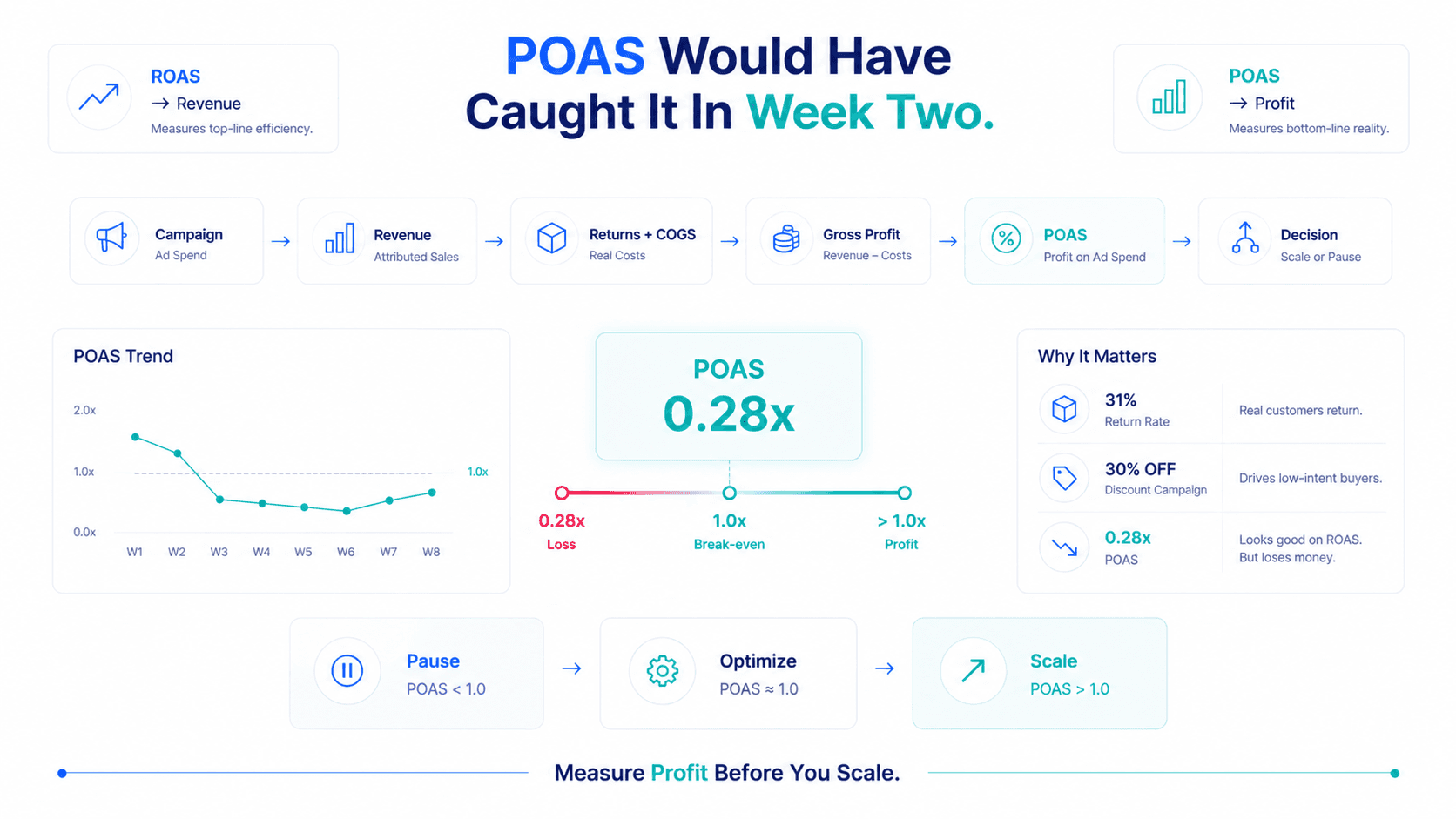
If the founder had been tracking POAS per campaign, not just ROAS, this campaign would have been flagged in week two. Not month four.
Profit on Ad Spend
POAS = Gross Profit ÷ Ad Spend
The fix isn’t stopping discount campaigns. Discounts have a legitimate role in D2C marketing.
The fix is measuring discount campaigns on POAS, knowing your return rate for each campaign and applying it to the calculation. So when a “30% off” campaign has a 31% return rate that pushes POAS to 0.28x, you catch it before it costs you ₹20L.
Pull your current campaigns. For each one, especially your best-performing ones by ROAS, ask:
Then run the POAS calculation.
The campaign you’re most proud of might be the most important one to look at first.
ROAS divides attributed revenue by ad spend. It ignores COGS, shipping, payment fees and returns. In this case a 31% return rate, 52% COGS and shipping costs turned a 5.1x ROAS into a 0.28x POAS: 28 paise of gross profit for every rupee of ad spend.
Meta's pixel sees the purchase event, not the return. Returns arrive 10 to 14 days later in Shopify and with the logistics partner, after the attribution window has closed, so the conversion stays in Ads Manager unchanged and ROAS is never corrected.
Overall ROAS dropped but MER stayed flat, showing the campaign's attributed revenue was either coming back as returns or coming from other channels anyway. The brand's return rate fell from 19% to 13% in six weeks and contribution margin improved by 11 percentage points.
No. Discounts have a legitimate role in D2C marketing. The fix is to measure discount campaigns on POAS using each campaign's own return rate, so a 30% off campaign with a 31% return rate is caught in week two rather than month four.
POAS is Gross Profit divided by Ad Spend, and its break-even is always 1.0. Anything below 1.0 means the campaign is destroying margin, regardless of what ROAS says.
Flable AI calculates real-time POAS per campaign, connecting your ad spend, Shopify revenue, returns data and COGS automatically.