AI & Ecommerce
Most D2C brands treat all customers the same.
The customer who spent ₹12,000 across 6 purchases last year gets the same email as the customer who spent ₹800 once and never returned. The customer who buys only during sales gets the same ad as the customer who buys at full price every month.
Same campaign. Same message. Same spend.
This is how brands leave significant revenue on the table while simultaneously overspending on customers who will never become profitable.
Customer segmentation, dividing your customer base into distinct groups based on purchase behaviour, value, and engagement, is the structural fix. It lets you communicate with the right message to the right customer at the right spend level. And it directly improves POAS because you stop paying to re-acquire customers who were going to come back anyway while underinvesting in the customers most worth retaining.
Customer segmentation is the process of dividing your customer base into distinct groups (segments) that share meaningful characteristics, and then developing different acquisition, retention, and reactivation strategies for each group.
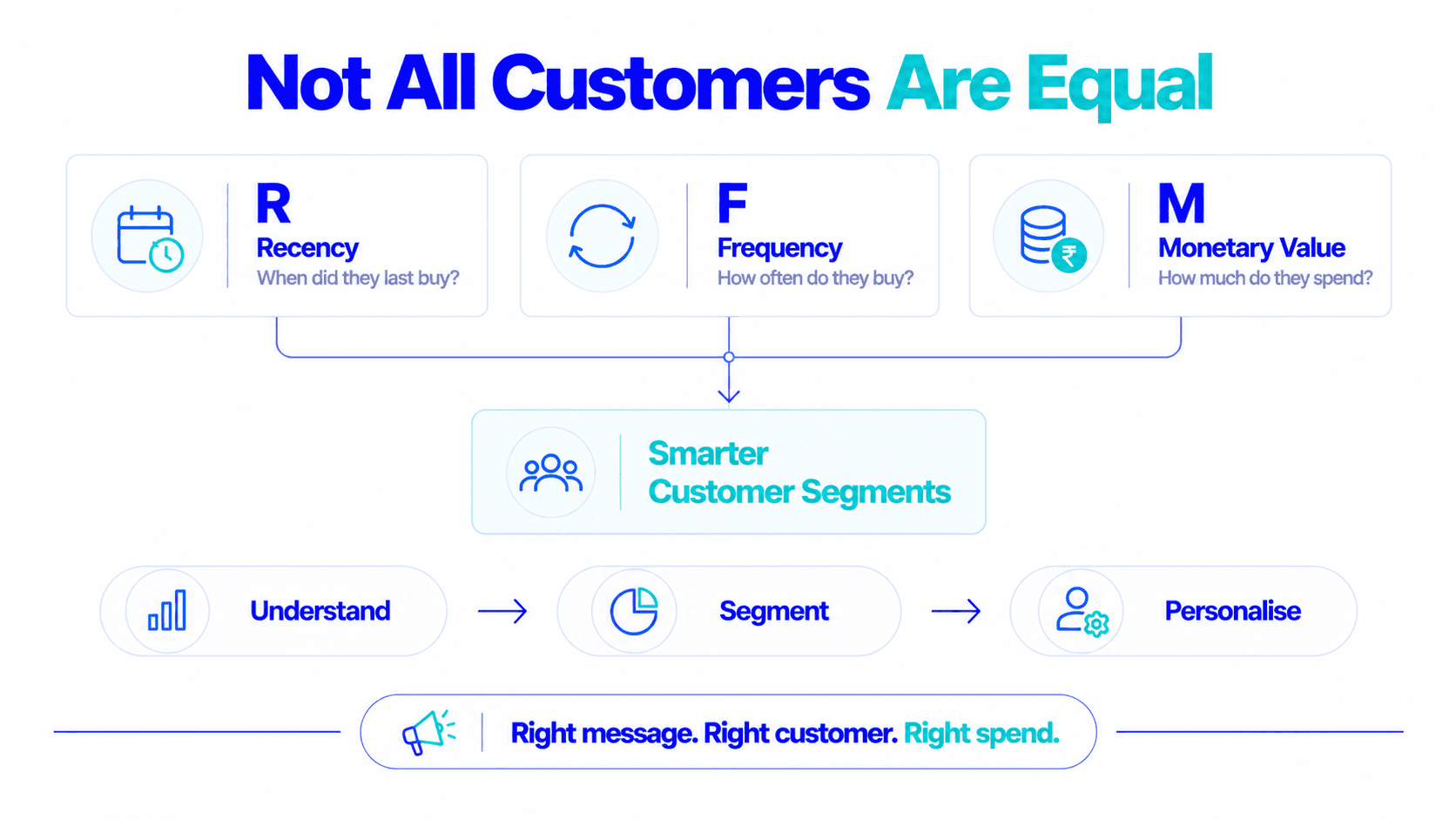
For D2C brands, the most useful segmentation framework is RFM analysis:
R
How recently did the customer make their last purchase?
F
How many times have they purchased in a defined period?
M
How much have they spent in total?
RFM creates a three-dimensional view of each customer. Combined, the three dimensions tell you exactly how valuable each customer is and what action to take next.
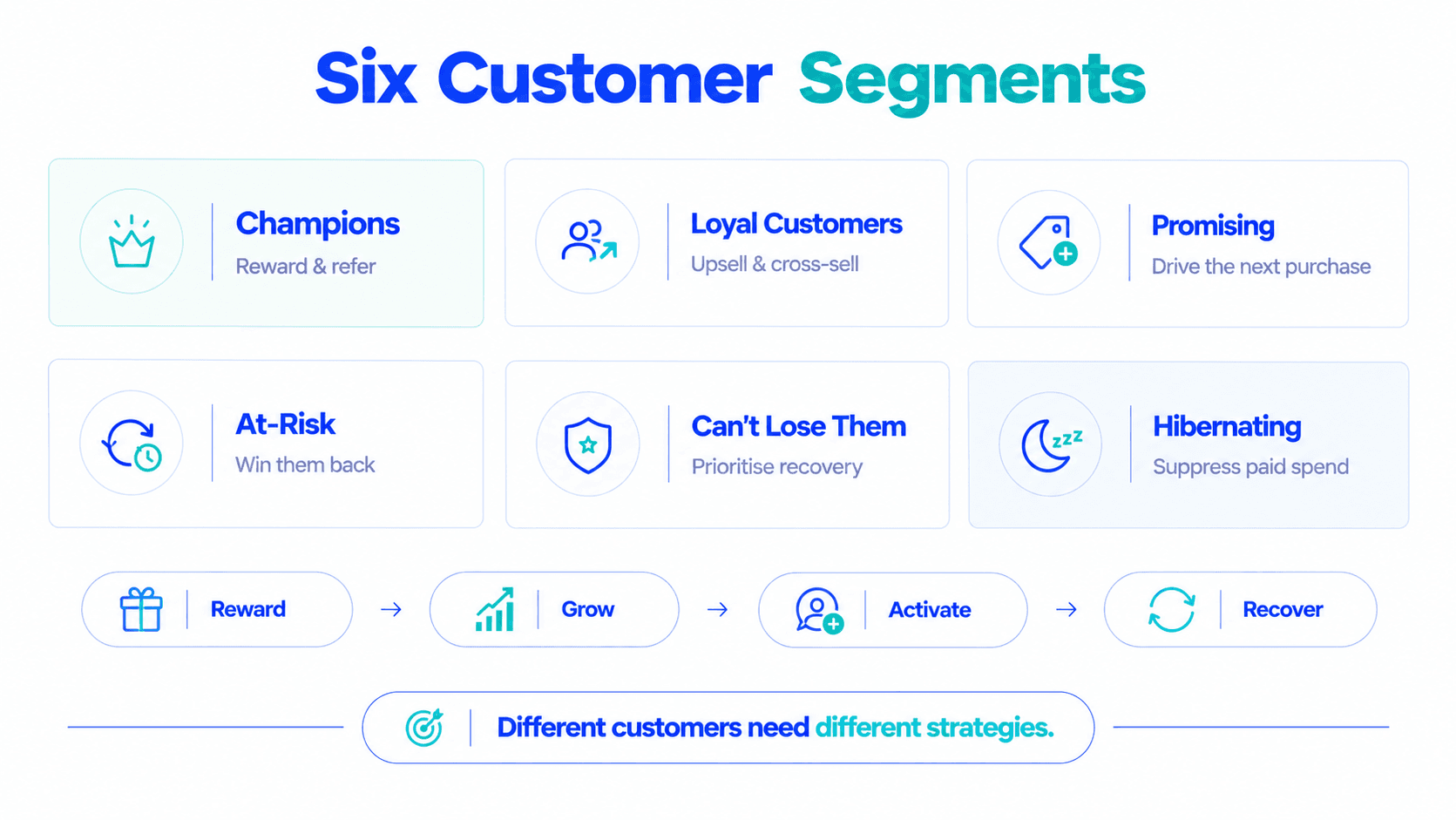
Six segments, six strategies
Segment 1
High R · High F · High M
Who they are: Your most valuable customers. They bought recently, buy frequently, and spend the most. They love your brand.
Profile: Last purchase within 30 days. 5+ orders. Top 20% by spend.
Segment 2
Medium-High R · High F · Medium-High M
Who they are: Reliable repeat buyers who haven’t quite reached Champions status. They buy regularly and are brand-loyal, just not at the top spend tier.
Profile: Last purchase within 60 days. 3–5 orders. Middle-upper spend tier.
Segment 3
Medium R · Low-Medium F · Low-Medium M
Who they are: Relatively new customers who’ve bought once or twice and show signs of engagement. The question is whether they become loyal or lapse.
Profile: Last purchase within 90 days. 1–2 orders. Average or below-average spend.
Segment 4
Low R · Medium-High F · Medium-High M
Who they are: Previously valuable customers who haven’t bought recently. They were loyal but something changed, a better competitor offer, a disappointing product experience, or simply no repurchase trigger.
Profile: Last purchase 90–180 days ago. 3+ historical orders. Medium-high historical spend.
Segment 5
Low R · High F · High M
Who they are: Your most valuable historical customers who are at serious risk of permanent churn. They were Champions but haven’t bought in over 6 months.
Profile: Last purchase 180+ days ago. Very high historical orders and spend.
Segment 6
Low R · Low F · Low M
Who they are: One-time buyers or low-value customers who haven’t engaged in 6+ months. Most were never high-potential.
Profile: Last purchase 6+ months ago. 1–2 historical orders. Low historical spend.
Most D2C brands have a significant percentage of their total customer base in the Hibernating segment, and continue spending on them through broad email campaigns and unfiltered retargeting. Suppressing Hibernating customers from campaigns immediately improves campaign POAS by removing the lowest-converting, lowest-value audience from the spend pool.
Shopify doesn’t natively build RFM segments, but the data is all there.
Export your full customer list with: total orders, total spend, date of last order. In a spreadsheet:
| Score | Recency (last purchase) | Frequency (orders) | Monetary (spend rank) |
|---|---|---|---|
| 5 | Within 30 days | 5+ | Top 20% |
| 4 | 31–90 days | 4 | Next 20% |
| 3 | 91–180 days | 3 | Middle 20% |
| 2 | 181–365 days | 2 | Next 20% |
| 1 | 365+ days | 1 | Bottom 20% |
Sum the three scores:
| Combined score | Segment |
|---|---|
| 13–15 | Champions |
| 10–12 | Loyal |
| 7–9 | Promising |
| 5–7 | At Risk |
| Below 5 | Hibernating |
Customer segmentation directly improves Meta and Google advertising efficiency:
Lookalike seeds
A Meta Lookalike built on Champions (top 5% of customers by LTV) outperforms a Lookalike built on all customers because it selects people who resemble your most valuable buyers, not your average buyer.
Exclusions
Suppressing Hibernating and Lost customers from prospecting campaigns stops you from paying to re-acquire one-time buyers who’ve already demonstrated low LTV potential.
Retargeting
At-Risk and Can’t Lose customers should see win-back creative in retargeting, different from the acquisition creative shown to cold audiences. Showing acquisition-focused creative to customers who already know you is wasted reach.
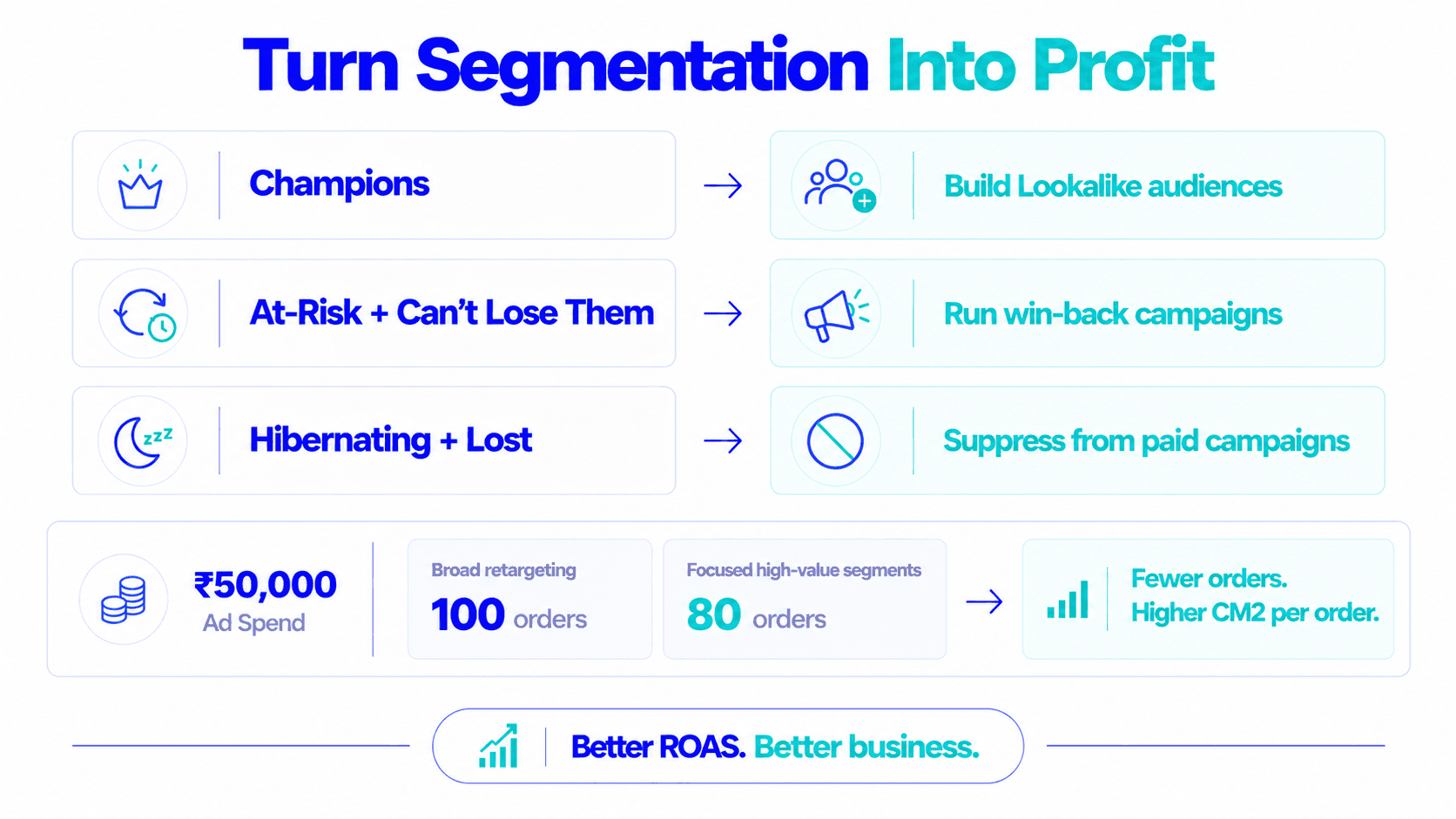
Customer segmentation improves CM2 directly when you stop spending acquisition budget on segments that won’t generate the LTV to justify it.
₹50,000/month, all past visitors
₹50,000/month, At-Risk + Can’t Lose only
The second excludes Champions who’ll reorder anyway, and Hibernating customers who won’t respond.
Fewer orders. Higher CM2 per order. Better POAS. Better business.
Customer segmentation is what separates brands that scale efficiently from brands that scale messily, spending more on retargeting, winning back customers who were going to return anyway, and re-acquiring customers who should have been suppressed.
Build your RFM segments. Develop a distinct strategy for each. Use Champion segments as your Lookalike seed. Suppress Hibernating segments from paid campaigns. Invest most heavily in Promising customers, they’re the ones whose trajectory is still being shaped.
Not all customers are equal. Your strategy and spend shouldn’t treat them like they are.
Customer segmentation divides your customer base into distinct groups based on purchase behaviour, value, and recency, most commonly using RFM analysis (Recency, Frequency, Monetary Value). Each segment receives a different acquisition, retention, or reactivation strategy based on their value potential.
RFM stands for Recency (how recently they purchased), Frequency (how often they purchase), and Monetary Value (how much they've spent). Scoring customers on all three dimensions and combining the scores produces segments from Champions (highest value) to Hibernating (lowest).
By using highest-LTV customer segments as Lookalike audience seeds (improving prospecting quality) and suppressing lowest-value segments from retargeting (reducing wasted spend on customers unlikely to reactivate). Both changes improve POAS by concentrating ad spend on audiences with the highest probability of generating profitable orders.
Flable tracks CM2 and POAS per campaign and per channel, making it visible when retargeting campaigns are generating low-POAS orders (often from Hibernating customers who buy rarely and at discounts) vs high-POAS orders (from loyal customers and Champions reordering). This segmentation-level profitability data guides where to concentrate and suppress spend.
Flable AI tracks CM2 and POAS per campaign and channel, so low-POAS retargeting to Hibernating customers shows up next to high-POAS Champion reorders.