Segmentation Guide
Every D2C founder has heard the pitch by now.
“AI will transform your business.” “AI-powered ads.” “AI-driven insights.” “Let AI handle your growth.”
And somewhere behind all of it, a very reasonable question: what is AI actually doing for ecommerce brands right now, in practice, and does any of it translate to real profit?
The honest answer: yes. But not in the ways most of the hype suggests.
AI in ecommerce in 2026 is not a magic button. It doesn’t replace judgment. It doesn’t manufacture demand out of thin air. What it does, when implemented correctly, is take the measurement and optimisation tasks that previously required hours of manual work and make them continuous, real-time, and significantly more accurate.
For D2C brands, that specifically means: knowing whether your campaigns are profitable faster, scaling winners before competitors do, and stopping losses before they compound.
Here’s the complete picture.
“AI” in the ecommerce context covers several distinct capabilities. Conflating them is how brands end up buying tools that do one thing while expecting another.
Predictive analytics
Using historical data patterns to forecast future behaviour. Predicting which customers are likely to churn, which products are likely to sell out, which campaign audiences are most likely to convert. Useful for planning. Weak at real-time optimisation.
Automated optimisation
Continuously adjusting campaign parameters, bids, budgets, audience targeting, based on live performance signals. Meta’s Advantage+, Google’s Performance Max, and purpose-built D2C AI tools like Flable AI all operate in this layer.
Natural language & generative AI
AI that writes copy, generates visuals, answers customer queries. This is the layer that gets most of the media coverage, and has the least direct impact on D2C profitability metrics.
Measurement & attribution AI
AI that reconciles data across multiple sources, ad platforms, Shopify, returns portals, COGS records, to produce accurate profitability metrics that no single platform can calculate alone.
Automated optimisation and measurement AI are where the meaningful D2C impact is happening.
D2C advertising at scale involves hundreds of simultaneous decisions:
Doing all of this manually, weekly reviews, spreadsheet reconciliation, gut-feel scaling decisions, produces decisions that are always slightly stale. The data you’re acting on is 7 days old. The campaign you should have paused 5 days ago has already spent another ₹40,000.
AI solves the lag problem. It monitors continuously, adjusts continuously, and surfaces the right information at the right moment, without waiting for the weekly review.
Four places it pays
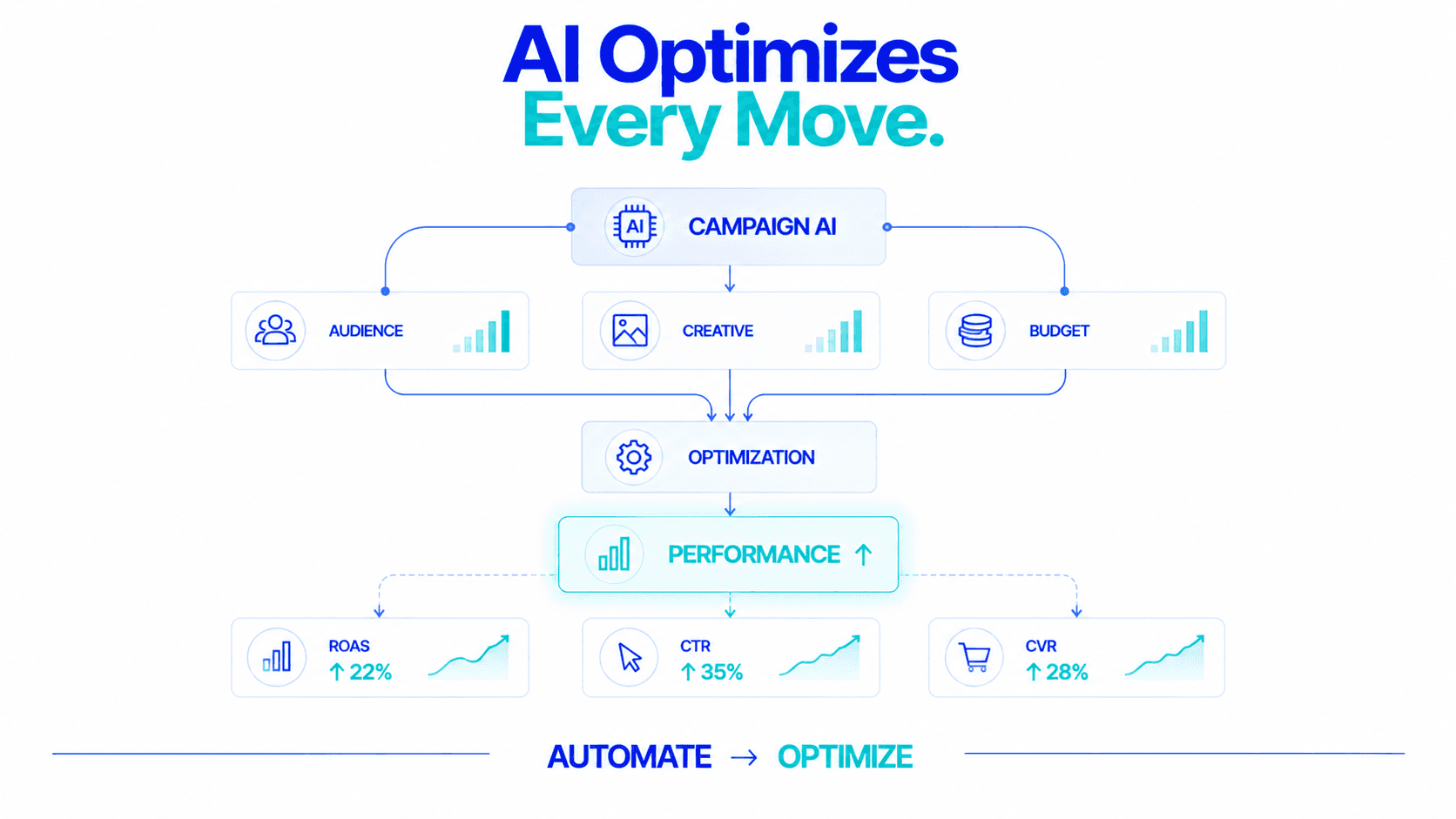
Both Meta and Google now deploy AI across their entire campaign infrastructure. Advantage+ Shopping Campaigns and Performance Max are both AI-driven systems that handle audience targeting, creative selection, budget allocation, and bid strategy automatically.
The results when implemented correctly: approximately 22% better ROAS than manually managed campaigns, according to Meta’s data across Advantage+ campaigns.
These systems optimise for platform-reported ROAS, not for your actual contribution margin.
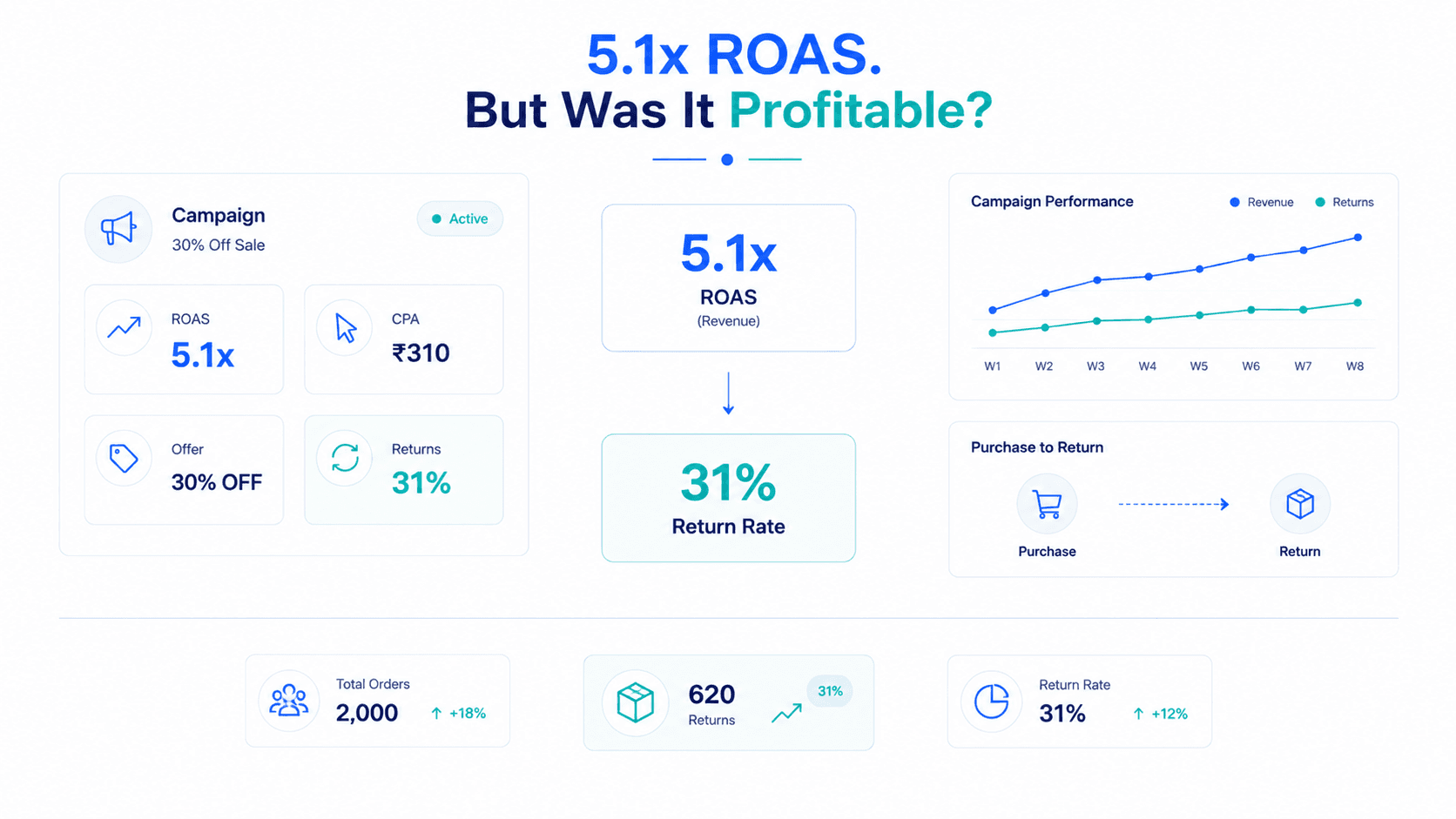
A Meta AI campaign that drives ₹10L in attributed revenue at 4x ROAS might have a POAS (Profit on Ad Spend) of 0.8x once COGS, returns, and shipping are factored in. The AI optimised exactly as instructed. The instruction was wrong.
The fix: Configure AI bid strategies using POAS-derived tROAS targets rather than ROAS benchmarks. When AI bidding is pointed at the right signal, profitability, not revenue, it compounds efficiency in the direction that actually matters.
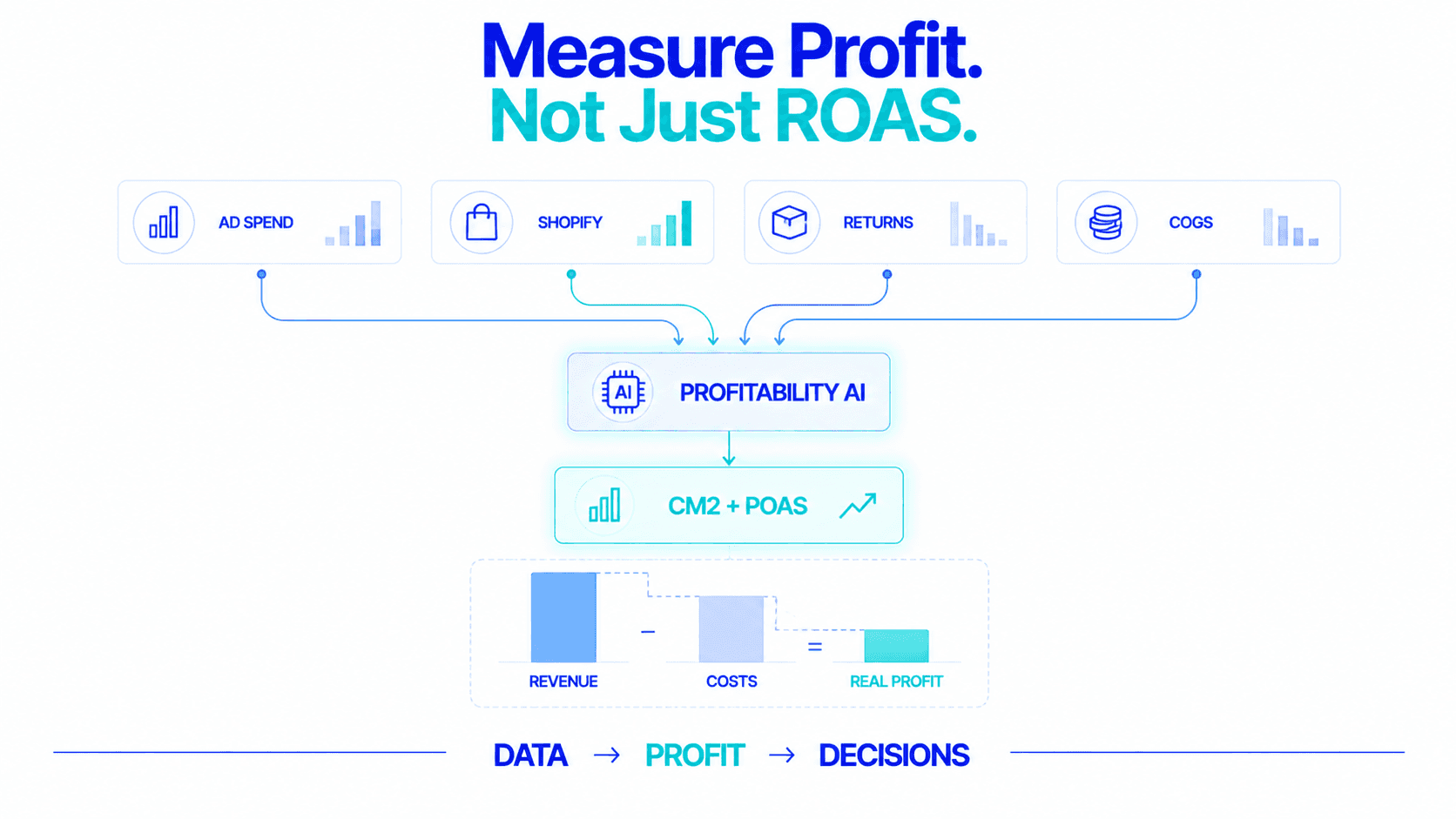
The most impactful AI application for D2C brands in 2026 isn’t campaign management. It’s measurement.
Knowing whether a campaign is profitable requires connecting four data sources that don’t natively talk to each other:
Source 1
Meta / Google
Source 2
Shopify
Source 3
Logistics platform
Source 4
Your records
Doing this manually produces a number that’s accurate once a week and stale the rest of the time. AI-powered measurement tools do this continuously, connecting the data sources, reconciling attribution, applying return rate adjustments, and surfacing real CM2 (Contribution Margin 2) and POAS per campaign in real time.
When you know your POAS per campaign live, not weekly, scaling decisions happen faster and with more confidence. Unprofitable campaigns get caught before they compound. Winners get scaled before the window closes.
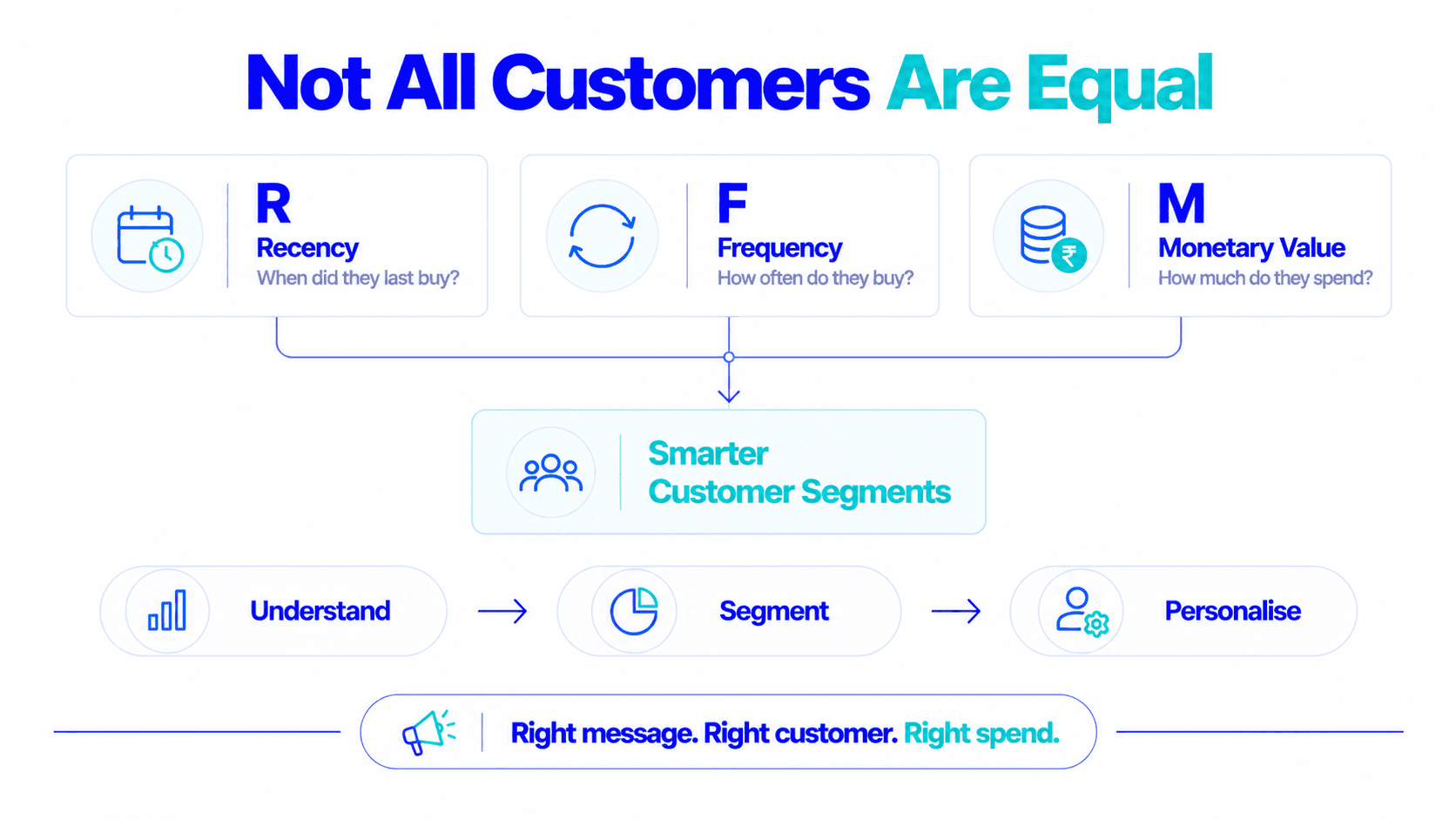
AI-driven customer segmentation identifies patterns in purchase behaviour that manual analysis misses: customers most likely to churn in the next 30 days, customers with high predicted LTV who should receive different post-purchase treatment, segments where a subscription offer would improve retention significantly.
For D2C brands, retention AI most commonly manifests through:
Email platform AI
Predictive sending, sending at the optimal time for each individual customer based on their historical open patterns. Predictive segmentation identifying which customers are “about to buy” based on browse and session behaviour.
Repurchase prediction
Identifying customers approaching their product’s consumption window and triggering a repurchase nudge before they run out (and potentially try a competitor).
The economic impact: a 10% improvement in 90-day repeat purchase rate is typically worth more to a D2C brand than a 20% reduction in new customer CAC. Retention AI drives this directly.
For D2C brands with large catalogues or seasonal demand patterns, AI-driven pricing and inventory management can significantly improve margin.
Dynamic pricing adjusts product prices based on demand signals, competitor pricing, inventory levels, and time-to-conversion patterns. For a fashion brand running end-of-season clearance, AI can optimise the markdown depth to clear inventory at the highest possible margin rather than applying a blanket percentage off.
Inventory AI forecasts demand at the SKU level, preventing both stockouts (which lose sales) and overstocking (which requires margin-destroying discounting).
Being clear about the limits prevents the most common disappointments.
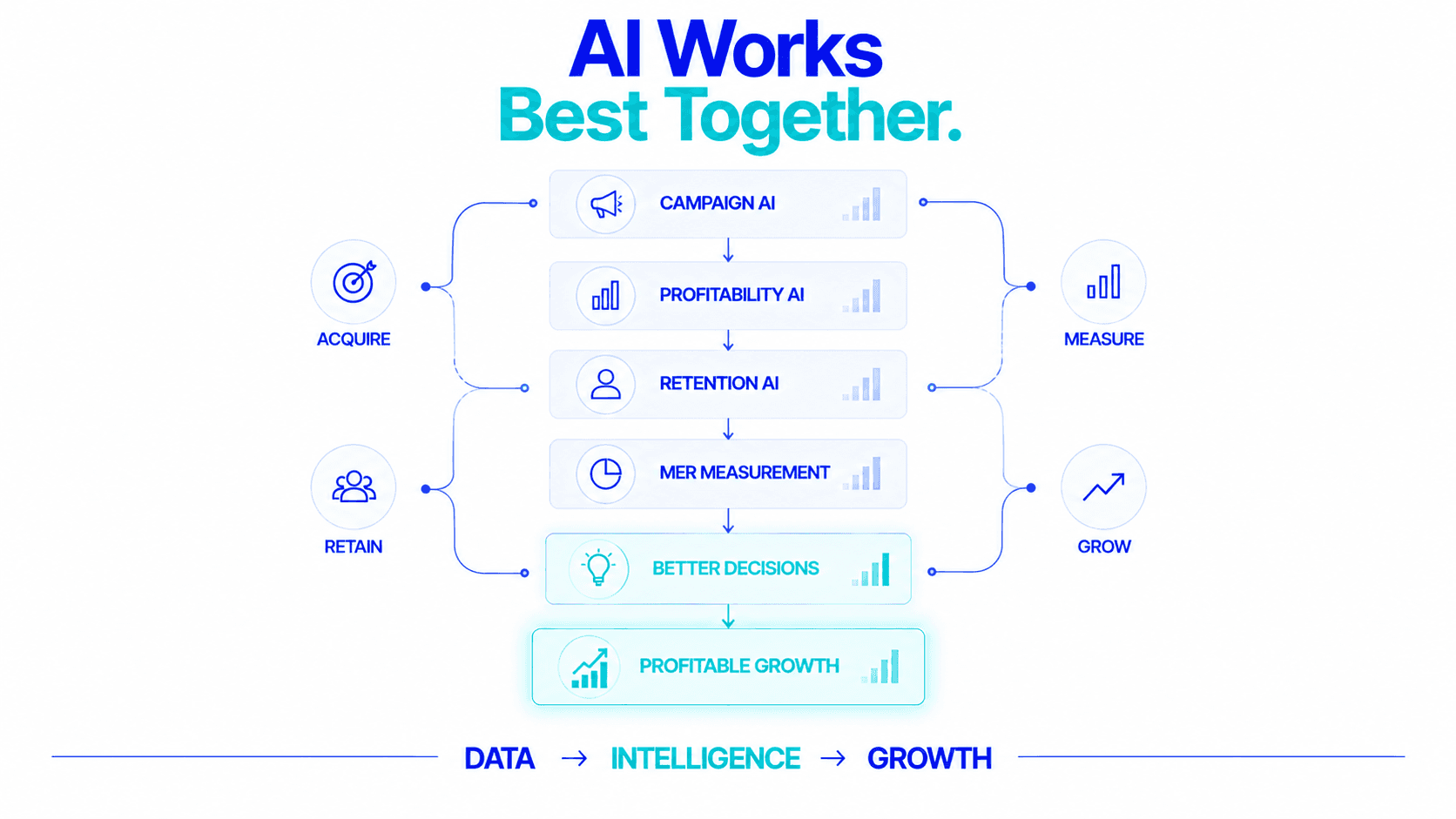
For a D2C brand spending ₹5–50L/month on Meta and Google, the high-impact AI stack in 2026 looks like this:
Layer 1: Campaign AI
Meta Advantage+ Shopping Campaigns and Google Performance Max for reach and conversion efficiency. Configured with POAS-derived tROAS targets.
Layer 2: Profitability AI
A D2C-specific platform (like Flable AI) that connects ad spend, Shopify revenue, returns, and COGS to calculate real-time CM2 and POAS per campaign. This is the layer that tells you whether the campaign AI is producing profitable outcomes, not just platform-reported ROAS.
Layer 3: Retention AI
Klaviyo or equivalent email/SMS platform with predictive segmentation, optimal send-time AI, and repurchase prediction. Manages the customers campaign AI acquires.
Layer 4: Measurement synthesis
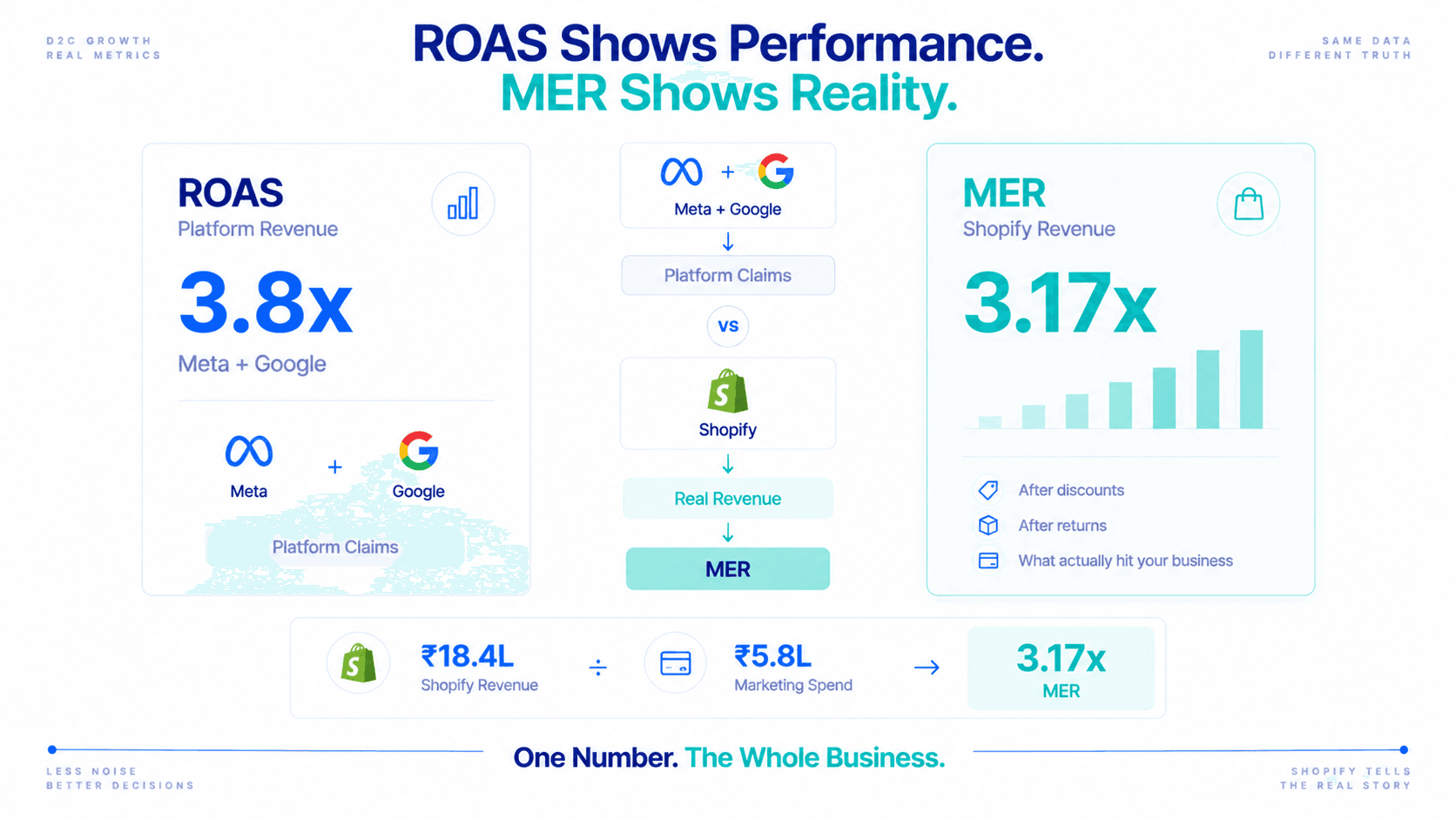
MER tracking (total Shopify net revenue ÷ total marketing spend) as the weekly aggregate signal that tells you whether Layers 1–3 combined are working for your business.
Each layer depends on the others. Campaign AI without profitability AI scales on wrong signals. Profitability AI without campaign AI has nothing to optimise. Retention AI without acquisition AI has no customers to retain.
India’s D2C market has specific characteristics that affect how AI tools perform:
COD and RTO
Most AI ad platforms are trained predominantly on prepaid customer data from Western markets. High COD volumes and 20–30% RTO rates in Indian Tier 2/3 markets create attribution gaps that generic AI tools don’t account for. A profitability AI built for Indian D2C must incorporate RTO costs and COD-specific customer behaviour.
Regional languages
AI creative tools trained on English content underperform for Hindi, Tamil, Telugu, or regional language campaigns. Brands targeting non-metro audiences need to verify AI content performance specifically for their regional markets.
Festive spikes
India’s festive calendar creates demand patterns that AI systems trained on steady-state Western ecommerce may misread. During Diwali, Meta’s AI may scale aggressively on volume signals while ignoring the fact that festive return rates run 5–8 points higher than baseline.
Every AI tool in ecommerce ultimately needs to answer one question: is this producing profitable outcomes for my business?
Not “is it generating attributed revenue”, that’s what every platform’s AI will tell you.
Not “is ROAS above my target”, that’s a revenue metric dressed as a profitability metric.
What is our POAS per campaign, per channel, after COGS and returns, right now?
AI tools that answer this question, connecting your ad spend, your Shopify revenue, your returns data, and your product margins, are genuinely transformative for D2C brands at scale.
AI tools that give you better dashboards showing the same ROAS you already had, are not.
It makes measurement and optimisation continuous: AI-driven campaign optimisation (Meta Advantage+, Google Performance Max), real-time profitability measurement, customer segmentation and retention, and dynamic pricing and inventory forecasting. The biggest D2C impact sits in automated optimisation and measurement AI.
No. They optimise for platform-reported ROAS, not contribution margin. A campaign at 4x ROAS can have 0.8x POAS once COGS, returns and shipping are included. Configure AI bidding with POAS-derived tROAS targets so it is pointed at profitability.
It can't fix bad product economics, replace brand strategy, eliminate attribution uncertainty, or see your COGS, return processing cost and shipping invoices. An ad platform AI that is never told about a 22% return rate optimises as if every conversion were equally profitable.
Four layers: campaign AI (Advantage+ and PMax with POAS-derived targets), profitability AI that connects spend, Shopify revenue, returns and COGS for real-time CM2 and POAS, retention AI (Klaviyo or equivalent), and weekly MER tracking as the aggregate check.
Most are trained largely on prepaid Western data. High COD volumes and 20–30% RTO in Tier 2/3 markets, regional-language creative and festive-season return spikes of 5–8 points above baseline all create gaps a generic tool doesn't account for.
Flable AI connects ad spend, Shopify revenue, returns and COGS to show real-time CM2 and POAS per campaign, the signal campaign AI can’t see.