Deep Dive
Instagram is where D2C brands are built. Over 2 billion active users. A feed built for product discovery. This guide walks you through exactly how to set up, run, and optimise Instagram ads — with the specific considerations that matter for D2C brands trying to grow profitably.
Instagram has its own “Boost Post” button. Don’t use it for serious campaigns.
Meta Ads Manager gives you access to everything the Boost button doesn’t:
Full audience targeting — custom audiences, lookalikes, interest stacks
All ad placements — Feed, Stories, Reels, Explore
Full campaign objective control — sales, traffic, awareness, leads
A/B testing and creative split testing
Real budget controls — daily and lifetime
Pixel-based conversion tracking
Detailed analytics and breakdown data
For a D2C brand spending anything above ₹5,000/month on Instagram, Meta Ads Manager is non-negotiable. It’s where the real control lives.
Before creating a single ad, make sure these three things are in place:
Your business Facebook Page and Instagram account connected in one place. This is where ad accounts, pixels, and assets live.
The code snippet on your website that tracks what visitors do after clicking your ad. Add to cart, purchase, checkout initiated — all feeds back into Meta and makes targeting smarter over time. Without the Pixel, you're flying blind.
If you sell multiple products, connect your product catalogue. This unlocks Dynamic Ads — ads that automatically show each user the specific product they viewed on your website. One of the highest-ROAS ad types available.
Get these right before spending. They’re infrastructure. Without them, every rupee you spend is less efficient than it could be.
Meta Ads Manager asks you to choose a campaign objective first. This is the most important decision in the entire setup — it tells Meta’s algorithm what to optimise for.
For D2C brands, three objectives matter:
The default for D2C. Optimises for purchase events on your website. Requires a working Meta Pixel with purchase tracking. Best when you have at least 50 purchase events per week — this gives the algorithm enough data to optimise effectively.
Use this only if you're new, have no Pixel data, and need to build initial website visitor volume. Switch to Sales as soon as you have enough purchase data.
Rarely the right choice for a D2C brand optimising for profit. Use only for brand-building campaigns where you're not expecting direct response.

Instagram audience targeting through Meta Ads Manager has four main options:
Age, gender, location, interests, behaviours. The broadest targeting available. Use as a starting point for cold prospecting. Aim for 2–5 million audience size.
Built from your own data — website visitors, customer email lists, video viewers, Instagram engagers. Your warmest audiences. Consistently outperform cold targeting on ROAS.
Meta finds new people who share characteristics with your best customers. Use your top 20% by LTV as the seed — not your full customer list. Among the most efficient prospecting tools available.
AI-driven automated targeting (2025 onwards). You provide minimal inputs and Meta's algorithm finds the audience. For brands with strong Pixel data, this often outperforms manual targeting for scaling.
Different formats work for different objectives. Here’s what performs for D2C brands:
Full-screen vertical video. The highest-reach format on Instagram right now. Best for new audience prospecting and UGC-style product content. Hook in the first 2 seconds is everything.
The classic Instagram ad. Still one of the strongest conversion formats for D2C. Best for product showcase, testimonial-led creative, and clear offers. Static images often outperform video in Feed for direct response.
Full-screen vertical between organic Stories. High impression volume, lower intent than Feed. Best for retargeting warm audiences and limited-time offers with urgency-based copy.
Multiple images or videos users swipe through. Best for multi-product showcases, before/after content, and step-by-step demonstrations. Among the highest engagement formats.
Opens a full-screen product catalogue experience directly from the ad. Mobile-first and seamless. Best for D2C brands with large catalogues — fashion, home goods, any browsing-heavy category.
The ad creative is where most D2C campaigns live or die. The targeting can be perfect and the budget can be right — but if the creative doesn’t stop the scroll, nothing else matters.
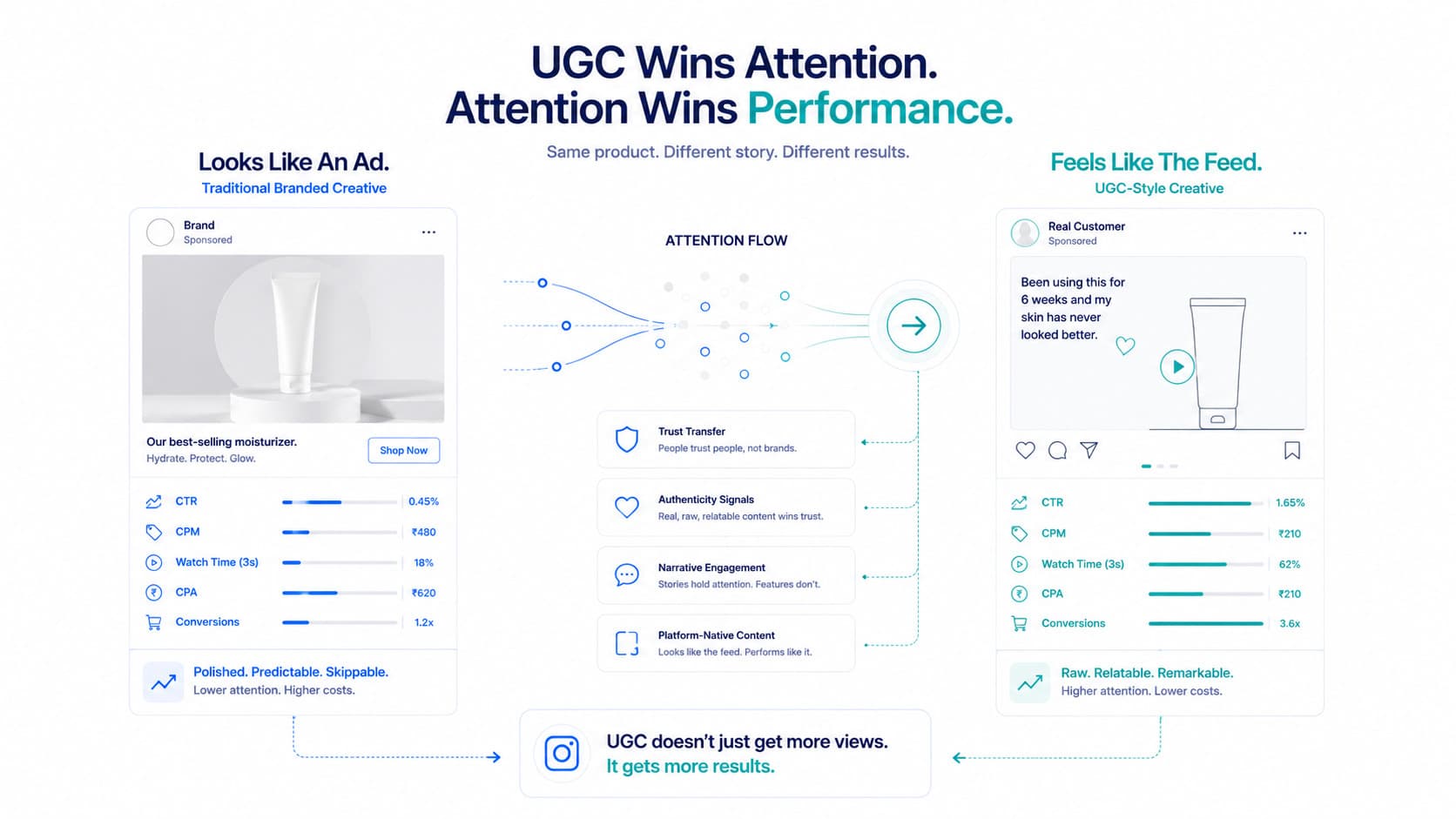
Raw, authentic, customer-or-creator-shot content. Performs because it doesn't look like an ad. Especially powerful for beauty, health, food, and fitness.
Lead with the most interesting thing — a bold claim, a surprising result, a relatable problem. The first 3 seconds determine whether someone watches or scrolls.
Reviews, ratings, customer count. "Over 50,000 customers" or "4.8 stars from 12,000 reviews" in the first frame is one of the highest-converting hooks available.
What is it? What does it cost? What do I get? Why now? Answerable in 5 seconds. One action — Shop Now, Try It Today — not three. Decision fatigue kills conversion.
Daily vs. Lifetime Budget: Daily budget means Meta spends up to your daily cap each day — more predictable, better for always-on campaigns. Lifetime budget means Meta optimises pacing across the entire campaign period — better for time-limited promotions.
Rule of thumb:
Your daily budget should be enough to generate at least 5–10 of your target conversion event per day. For most D2C purchase campaigns, that means ₹1,000–₹3,000/day minimum.
Starting a Sales objective campaign at ₹200/day with a ₹1,500 product means the algorithm will take weeks to exit the Learning Phase. Data costs money — start with enough to learn quickly.

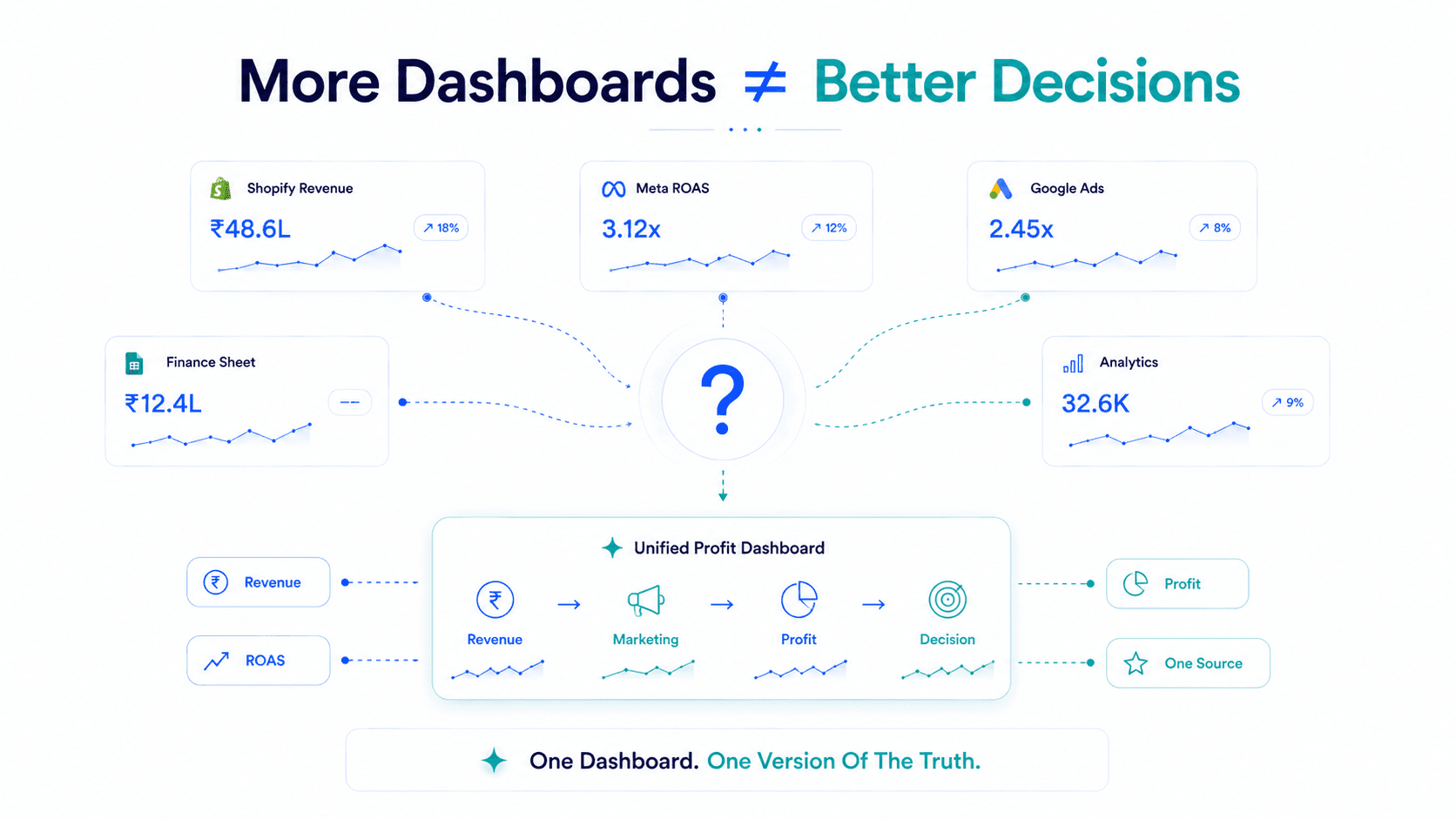
Your Meta Ads Manager will show you ROAS, CPA, link clicks, purchase value, and cost per result. What it won’t show you is whether those Instagram customers are profitable.
An Instagram-acquired customer who returns the product costs you the product, the shipping both ways, the return processing, and the ad spend to acquire them. A customer who buys once at full price and never comes back has a CAC that looks fine and an LTV that’s invisible.
Most D2C brands optimise their Instagram campaigns based on platform-reported ROAS. They scale what looks good on the dashboard. And they wonder why margins are shrinking as revenue grows.
The real metric is contribution margin per Instagram campaign — revenue minus COGS, returns, shipping, and ad spend. That’s what actually tells you whether to scale. This is what Flable AI is built to show you — not what Meta reports, but what your business actually earned.
Instagram ads through Meta Ads Manager are one of the most powerful growth tools available to D2C brands — when used correctly.
Set the foundation right (Pixel, catalogue, Business Suite). Choose the correct objective for your data maturity. Build audiences intelligently — custom first, lookalikes second, Advantage+ when you have the data. Match your creative format to your objective. Set budgets that give the algorithm enough data to work.
And then measure what actually matters: not ROAS, but contribution margin.
That’s not just running Instagram ads. That’s building a profitable D2C business on Instagram.
Frequently Asked Questions
Boosting is a simplified, limited tool. Meta Ads Manager gives you access to all campaign objectives, full audience targeting controls, A/B testing, Pixel-based conversion tracking, and detailed analytics. For any serious D2C advertising, Ads Manager is always the right choice.
Enough to generate at least 5–10 of your target conversion events per day. For purchase-focused campaigns, this typically means ₹1,000–₹3,000/day minimum. Starting too low extends the Learning Phase and makes it harder for Meta's algorithm to optimise efficiently.
It depends on objective, but UGC-style Reels and static Feed ads consistently perform well for D2C direct response. Reels for prospecting and reach, Feed images for conversion-focused retargeting. Carousel works well for multi-product brands.
Meta Advantage+ is AI-driven automated audience targeting. It works best for brands with strong Pixel data and proven creative. For brands with 50+ purchase events per week and multiple winning ad creatives, Advantage+ often outperforms manual audience targeting — especially for scaling.
Flable connects your Instagram ad spend with your actual revenue, returns, and COGS to show you real contribution margin per campaign — not just Meta-reported ROAS. This tells you which Instagram campaigns are genuinely profitable and worth scaling.
Contribution margin per campaign, per channel — live, automatic, no spreadsheets.
See Your Real Profitability →Setup in 48 hours · No credit card required · Backed by Microsoft & NVIDIA