Operations Guide
The market for AI ad optimization tools has exploded. This is the honest breakdown: what AI ad optimization actually means, which tools do it well, and the one capability gap almost every tool has that D2C brands need to fill themselves.
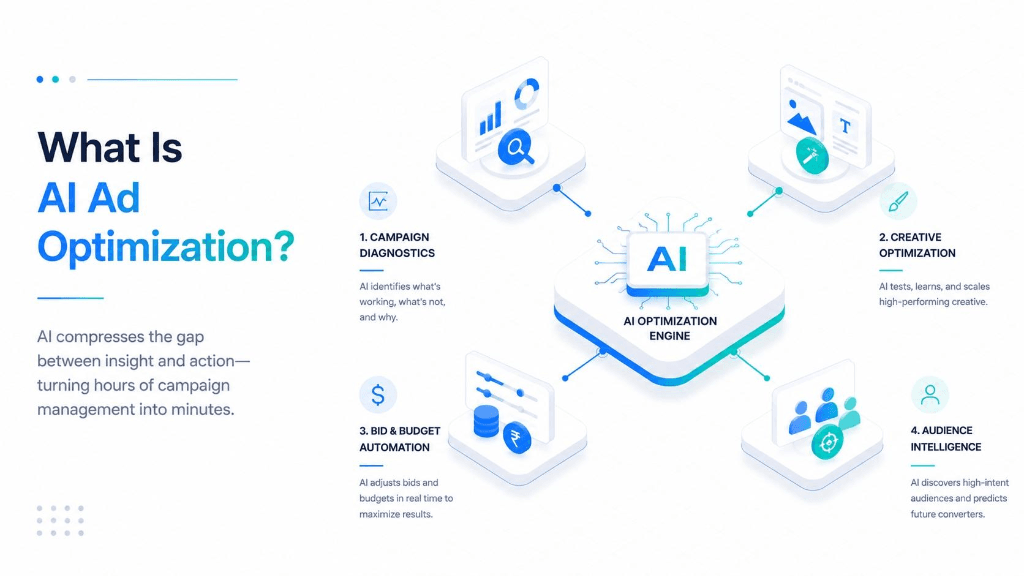
AI ad optimization is the use of artificial intelligence to automate and improve the performance of digital ad campaigns — adjusting bids, reallocating budgets, rotating creatives, and identifying audience segments in real time without constant manual intervention.
At its core, it solves the fundamental speed problem in performance marketing. Human media buyers can review campaign performance and make adjustments once or twice a day. AI ad optimization tools monitor continuously and adjust in minutes.
Identifying what's wrong and why. Which ad sets have audience overlap? Which creatives are entering fatigue? Where is budget being wasted?
Generating, testing, and scaling ad creative. Which hooks convert? Which formats outperform for this audience? What needs refreshing?
Adjusting spend in real time toward the highest-performing campaigns, audiences, and placements. Shifting budget off underperformers early.
Finding new pockets of potential customers, building lookalikes, and identifying which audience segments produce the most valuable customers.
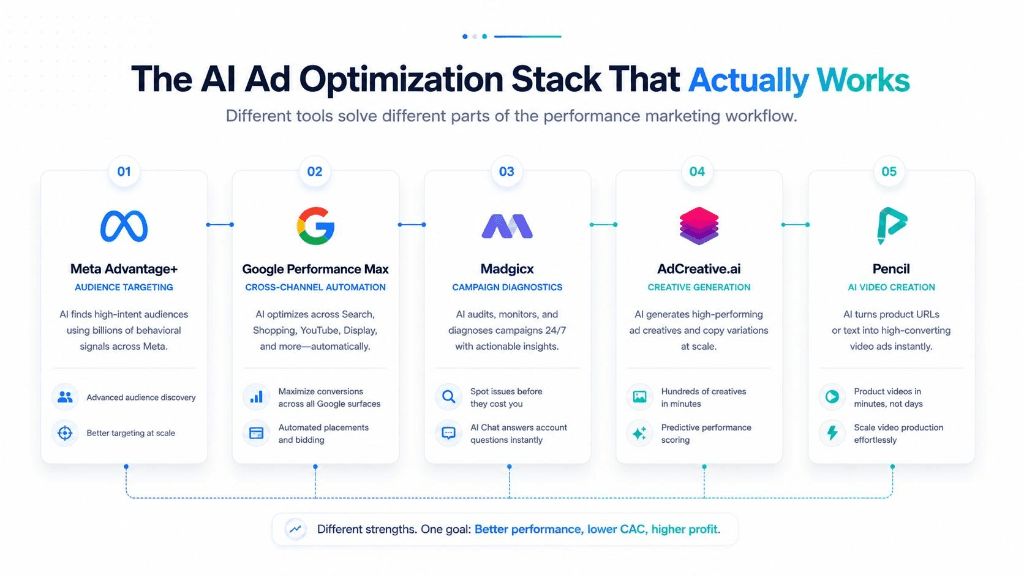
What it does: Meta's own AI targeting system. Instead of manually building audience stacks, Advantage+ uses Meta's algorithm to find the right people automatically.
Why it matters for D2C: For brands with a proven Pixel dataset and strong creative, Advantage+ Shopping Campaigns (ASC) consistently outperform manual structures on ROAS.
The limitation: Meta optimises toward its own conversion signals. It doesn't know your return rates. A campaign driving high volume with a 20% return rate looks great to Advantage+. It may be destroying your CM2.
What it does: Google's cross-channel automation campaign type serving Shopping, Search, Display, YouTube, and Gmail from a single campaign.
Why it matters for D2C: For brands with clean product feeds and strong history, PMax often outperforms manual Shopping campaigns on volume and efficiency.
The limitation: Less control. You can't see which placements are converting, and Google's AI optimises toward platform-reported ROAS or purchase volume, not true CM2.
What it does: An all-in-one AI ad optimization platform for Meta, combining 24/7 campaign monitoring, automated diagnostics, creative analysis, and an AI Chat.
Why it matters for D2C: Madgicx's AI Marketer runs daily audits on your account — flagging audience overlap, creative fatigue, budget leaks — and surfaces one-click fixes.
The limitation: Madgicx is Meta-focused. It's an excellent specialist tool for brands running serious Meta spend, but not a cross-channel optimization platform.
What it does: AI-powered ad creative generation at volume. Upload your brand assets and it generates hundreds of ad variations with a predicted performance score.
Why it matters for D2C: Creative fatigue is real. AdCreative.ai solves the production bottleneck — generating a month's worth of variations in an afternoon.
What it does: AI video ad generation. Upload existing assets and Pencil generates new video ad concepts it predicts will perform well.
Why it matters for D2C: Video is the dominant format. Creating enough variation to test properly is expensive and slow with traditional production. Pencil reduces both cost and time.
Every tool in this list optimises for something useful. None of them optimises for what D2C brands ultimately need: contribution margin per campaign after all costs.
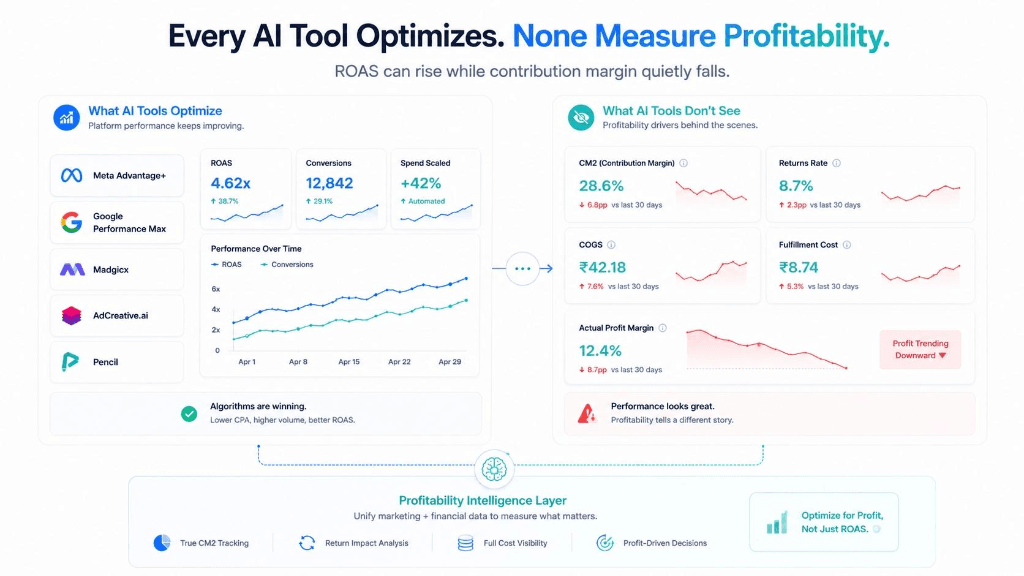
This is not a criticism of these tools. It's a structural limitation. Ad optimization platforms see ad spend and attributed conversions. They don't see your COGS. They don't see your returns. They don't see your fulfilment costs. They cannot calculate CM2 without that data.
Flable AI is the layer that catches this. It connects your ad data, revenue, returns, COGS, and fulfilment costs to show real-time CM2 per campaign — the number that tells you whether to scale, hold, or kill.
→ AI ad optimization tools (Advantage+, PMax, Madgicx) for campaign execution
→ Flable AI for real CM2 measurement per campaign
→ Feed CM2 insights back to inform what the optimization tools are told to scale
AI ad optimization tools are genuinely valuable. The best ones save time, surface insights faster, and improve campaign performance in measurable ways.
But every one of them has the same blind spot: they optimise for what they can see. Fill that gap with real CM2 measurement. Then let the AI tools do what they're good at on top of a foundation that knows what "good" actually means for your business.
Tools optimise campaigns. Measurement optimises businesses.
Frequently Asked Questions
An AI ad optimization tool uses machine learning to automate and improve paid advertising performance — including bid management, budget allocation, audience targeting, creative testing, and campaign diagnostics. The goal is to compress the time between insight and action, improving efficiency and results compared to manual campaign management.
Creative fatigue happens when an audience has seen your ad so many times that engagement drops — CTR declines, CPA rises, ROAS falls. AI tools detect fatigue signals early (declining CTR trends before CPA climbs) and can automatically pause fatigued creatives, flag for refresh, or rotate in new variations.
Yes, for brands with sufficient Pixel data (50+ weekly purchase events) and proven creative assets. Advantage+ Shopping Campaigns consistently outperform manual campaign structures for brands at this stage. The critical caveat: Advantage+ optimises for purchase volume, not contribution margin. Pair it with independent CM2 measurement to know if the customers it's acquiring are actually profitable.
Flable provides real-time contribution margin per campaign — after returns, COGS, and fulfilment costs. While AI ad optimization tools like Madgicx or Meta Advantage+ optimise toward platform-reported ROAS, Flable shows what each campaign actually earned for your business. Together they form a complete performance loop: optimize execution, measure real outcomes, refine accordingly.
Platform-native AI (Meta Advantage+, Google PMax) is worthwhile from the start — it's free and effective once you have sufficient conversion data. Paid specialist tools like Madgicx become worthwhile at ₹3–5L/month on Meta. Real-time CM2 measurement via Flable becomes critical at any spend level where campaign decisions are being made based on ROAS.
Real CM2 per campaign — live, automatic, no spreadsheets.
See Your Real Profitability →Setup in 48 hours · No credit card required · Backed by Microsoft & NVIDIA