Operations Guide
Every D2C founder running paid ads in 2026 is dealing with the same tension. The platforms keep getting smarter — but decisions still feel hard, margins are still unpredictable, and scaling still feels like guesswork.
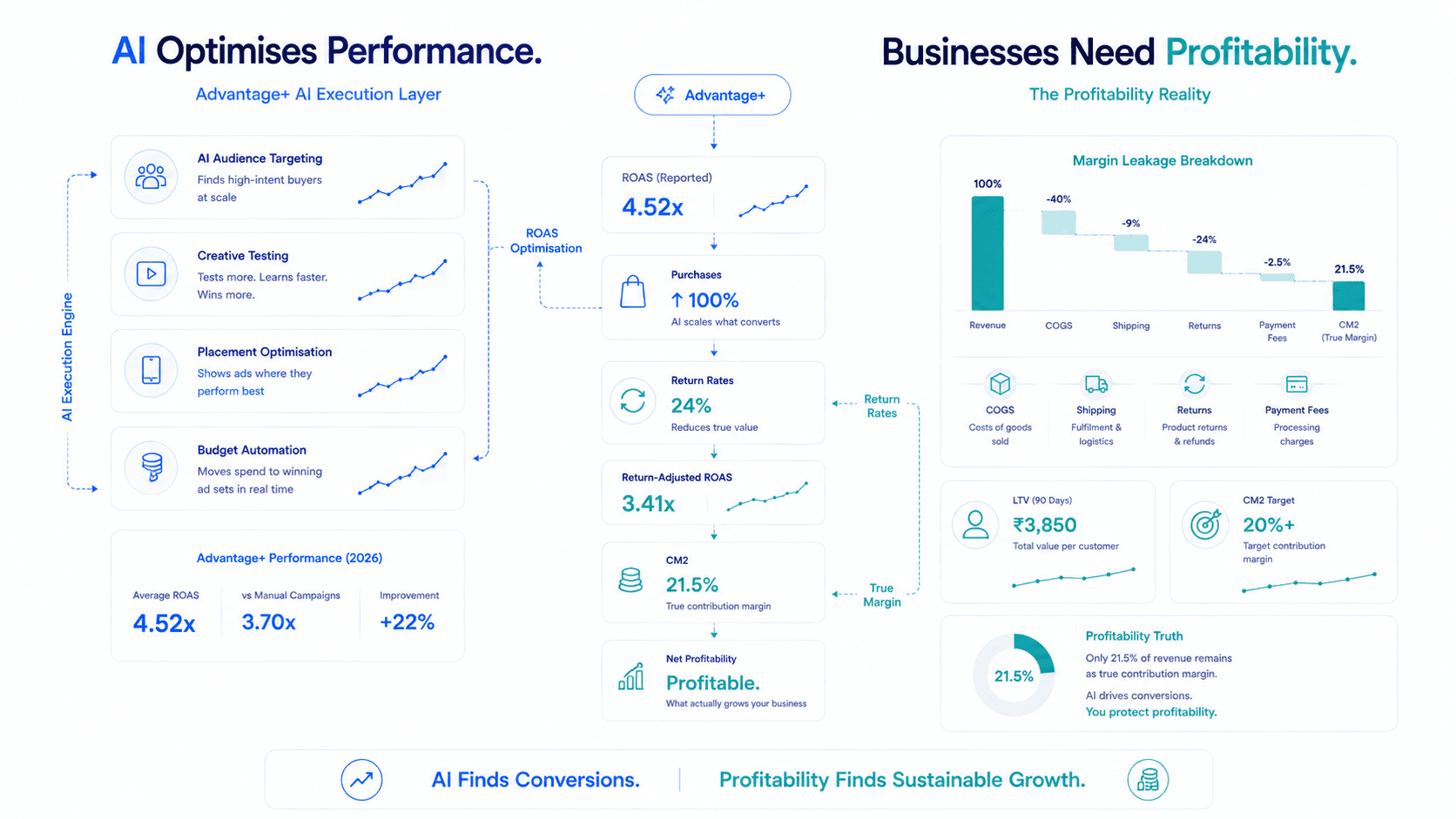
Here’s why: AI is getting better at optimising campaigns. It is not getting better at understanding your business. It doesn’t know your COGS. It doesn’t know your return rates. It doesn’t know that campaign A looks profitable on ROAS but is actually destroying margin when you account for fulfilment costs.
That’s the gap performance marketing AI hasn’t filled — and it’s the one that matters most for D2C brands.
AI optimises your campaigns. Flable tells it what to optimise for.
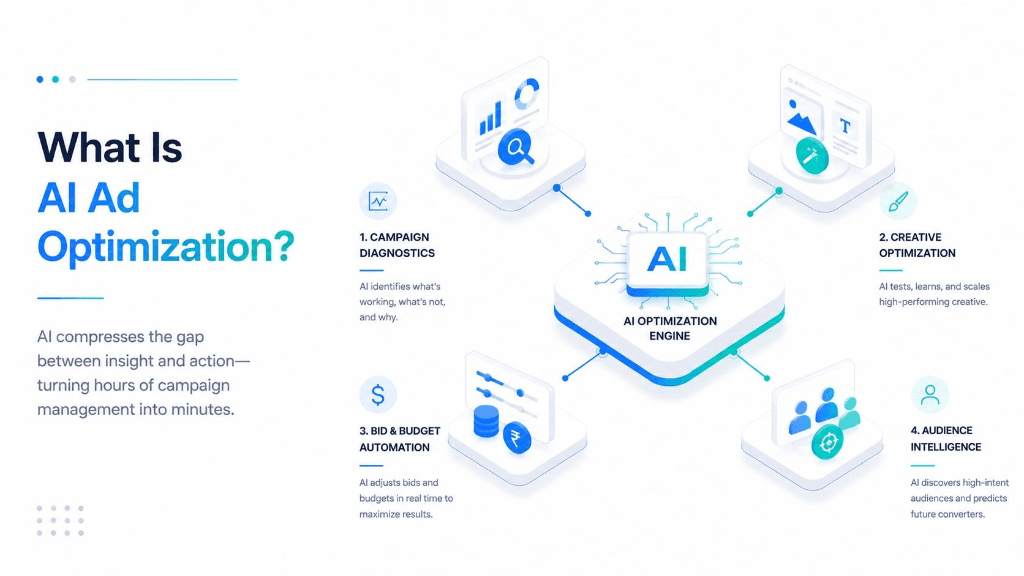
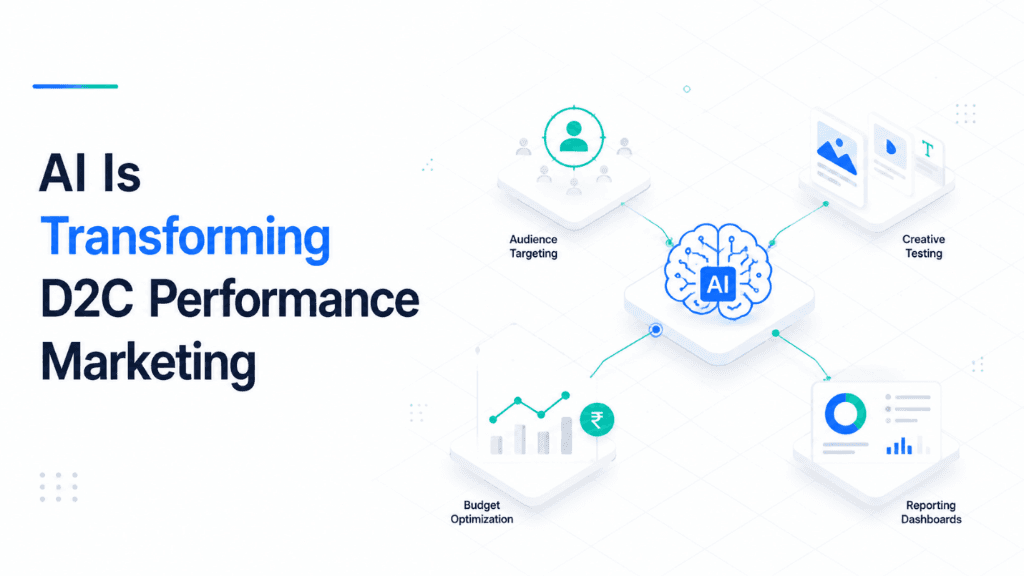
AI for performance marketing is the use of machine learning and data-driven automation to improve the efficiency and outcomes of paid advertising campaigns. In practice, this covers a wide range of activities:
Audience targeting — AI identifies which segments of people are most likely to convert based on behavioural signals, purchase history, and real-time intent data. Instead of relying on static demographic targeting, AI builds and updates audiences dynamically.
Creative testing — AI tools test multiple ad variations simultaneously — different hooks, formats, copy lengths, visuals — and automatically identify and scale the best performers while pausing underperformers.
Bid and budget optimisation — AI monitors campaign performance in real time and shifts spend toward the highest-performing ad sets, automatically adjusting bids to maximise the conversion goal.
Predictive analytics — AI models use historical performance data to forecast what’s likely to work next, helping brands move from reactive optimisation to proactive planning.
Automated reporting — AI removes the manual work of pulling together performance dashboards, surfacing key insights without requiring hours of data wrangling.
Each of these use cases is genuinely valuable. Together, they represent a meaningful shift in how D2C performance marketing operates — and the brands that are using AI well are running leaner, moving faster, and getting more from every rupee of ad spend.
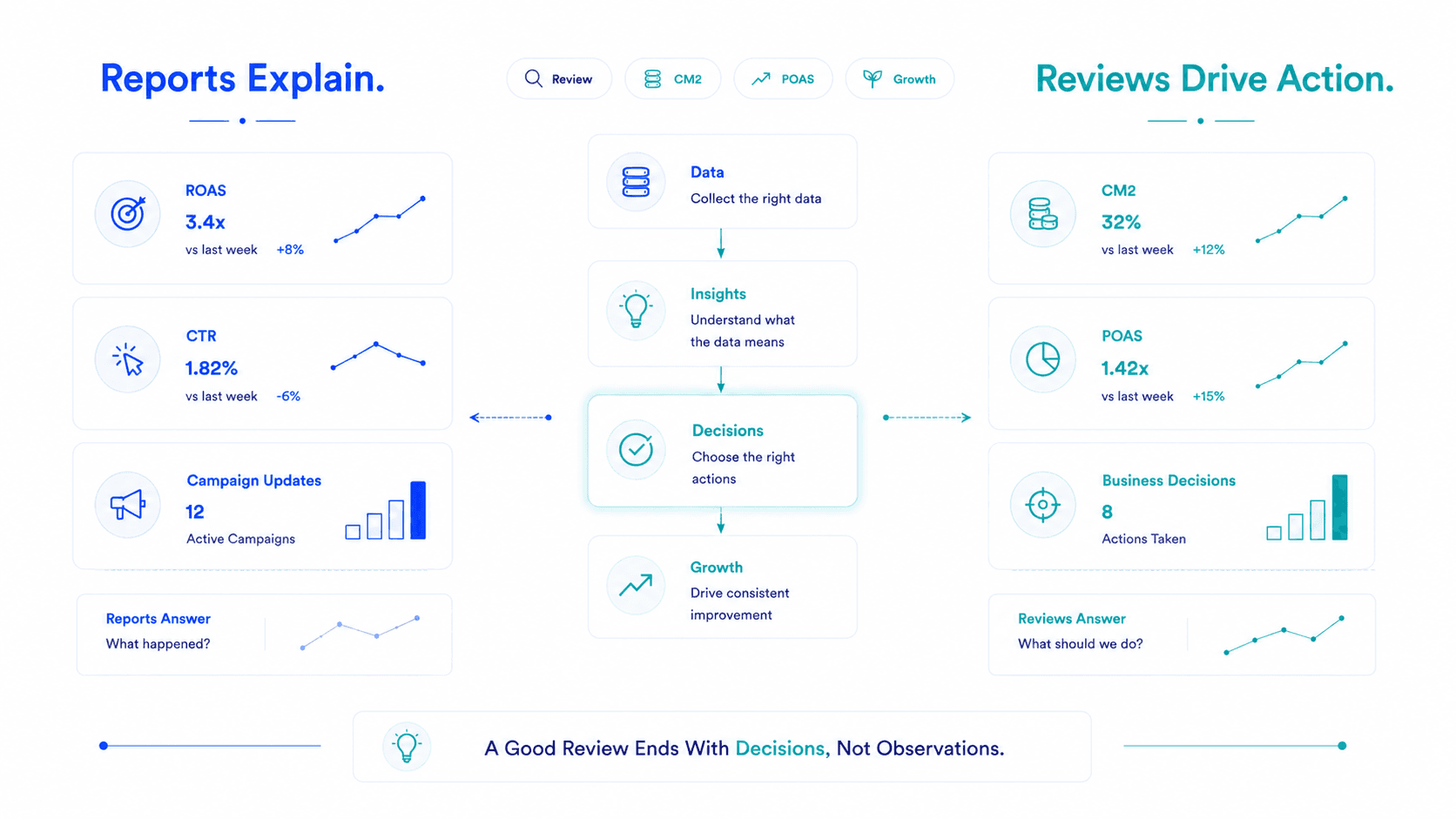
Traditional performance marketing ran on weekly or monthly reporting cycles. By the time a PDF landed in your inbox, the decisions it should have informed were already two weeks old.
AI changes the decision-making cadence entirely. Real-time dashboards, automated anomaly detection, and instant campaign diagnostics mean that performance issues surface immediately rather than at the next reporting cycle.
Basic interest-based targeting was how most D2C brands ran Meta ads for the first decade of the platform’s life. AI has made this obsolete.
This is the difference between showing an ad to “women 25–35 interested in skincare” and showing an ad to “women who viewed a competitor’s collagen serum landing page in the last 7 days and have purchased in the supplement category before.” The second segment converts at a completely different rate.
Creative is the biggest lever in D2C performance marketing — the quality of the ad itself drives more performance variance than targeting or bid strategy. AI creative tools can generate dozens of ad variations and test them simultaneously, analysing what’s working at the element level.
The result is a creative testing flywheel that accelerates over time. The more you test, the better the AI understands what resonates with your specific audience.
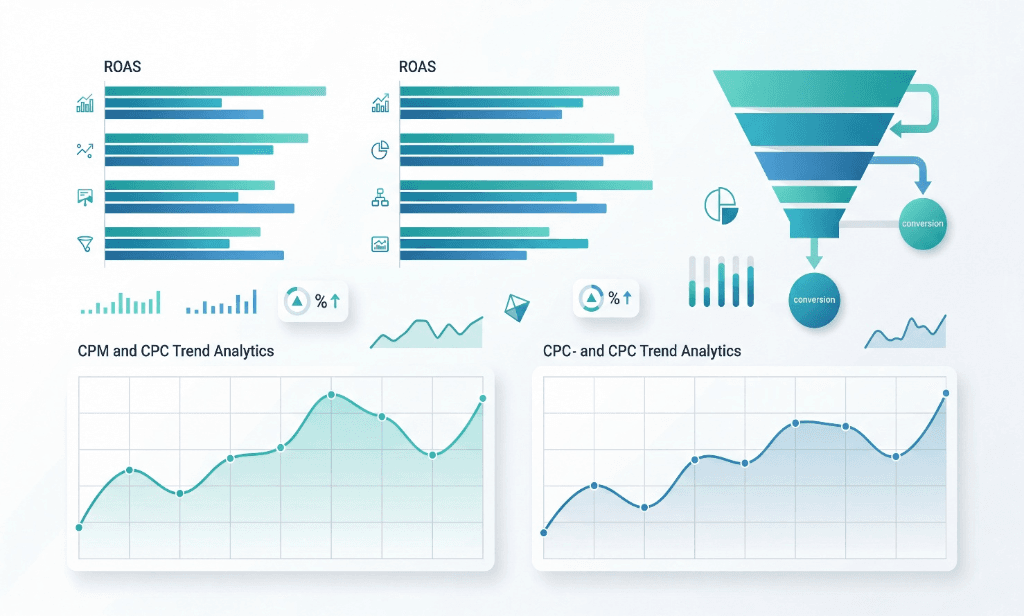
Manual bid management was both time-intensive and inherently slow. AI monitors performance continuously and adjusts in real time. When a campaign is outperforming, AI shifts budget toward it automatically. When audience fatigue sets in, AI reduces bids or expands targeting before performance degrades significantly.
For D2C brands spending ₹5–50L/month on paid ads, this real-time optimisation compounds significantly over time.
Build audiences based on real-time behavioural signals — website visitors, product page viewers, cart abandoners, competitor engagers. AI tools that track and segment these signals automatically create far more accurate prospecting and retargeting audiences.
Use AI to generate and test creative variations at volume. Run them with equal budgets for 7 days. Scale what performs. This replaces gut-feel creative decisions with evidence-based ones — dramatically faster.
Feed the model your top 20% of customers by LTV and let it find new prospects who match their behaviour patterns. These lookalike audiences consistently outperform broad interest targeting.
Set up automated alerts for anomalies — sudden CPA spikes, creative fatigue signals, audience saturation. AI monitoring tools catch these issues before they become expensive problems.
Replace manual weekly performance pulls with AI-driven dashboards that automatically surface the insights that need action.
Here’s the honest limitation of AI performance marketing tools in 2026. They are excellent at optimising what they can see — ad spend, clicks, attributed conversions, and platform-reported revenue.
What they cannot see without explicit data integration is what happens to your business after the conversion: Returns. Net revenue after COGS. Fulfilment costs. The true contribution margin of each campaign.
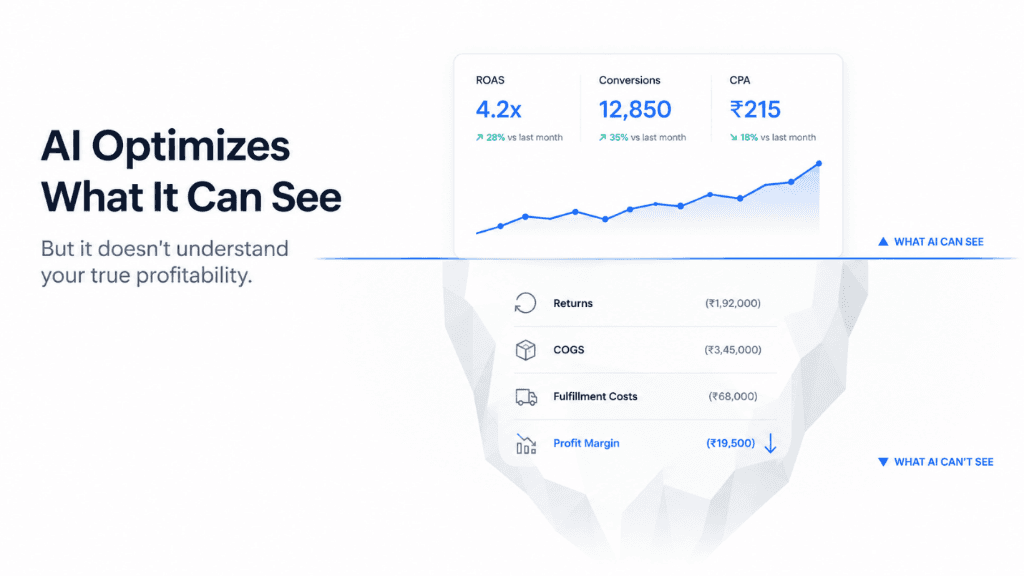
A Meta AI algorithm optimising for purchases will happily scale a campaign that generates high purchase volume with a 25% return rate. It doesn’t know about your returns. It doesn’t know about your margin. It’s optimising for an event, not an outcome.
This is the most expensive blind spot in D2C performance marketing.
The brands that are actually winning with AI performance marketing in 2026 have solved this. They use AI to optimise campaigns, and they use an independent profitability layer — contribution margin per campaign, per channel, adjusted for returns and COGS — to tell the AI what to optimise for.
This is exactly what Flable AI is built to provide. Not another ad optimisation tool — but the profit layer that makes your AI-driven campaigns optimise for the right outcome.
| Tool | Best For | D2C Relevance |
|---|---|---|
| Meta Advantage+ | Automated audience targeting on Meta | High — best for prospecting and scaling |
| Google Performance Max | Cross-channel automation on Google | High — especially for Shopping |
| Madgicx | Meta ads optimisation and diagnostics | High — strong for e-commerce |
| AdCreative.ai | AI ad creative generation at volume | Medium — solves creative bottleneck |
| Pencil | AI video ad generation | Medium — strong for Reels/TikTok |
| Flable AI | Real-time CM2 per campaign, post-returns | Critical — the profitability layer everything else needs |
The right AI stack for a D2C brand isn’t one tool. It’s a combination that covers the full performance loop:
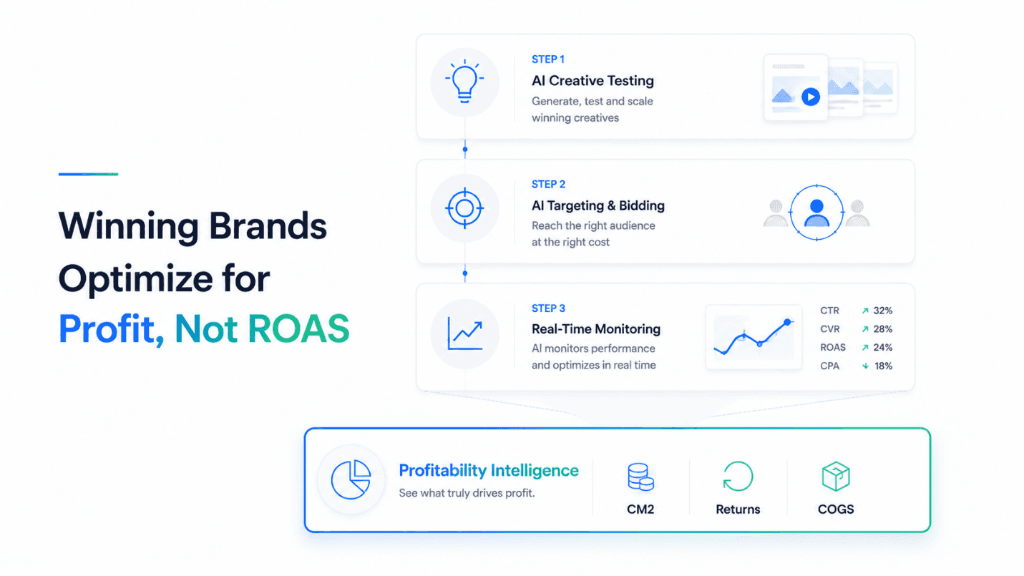
Each layer depends on the one beneath it. AI targeting and optimisation is only as good as the signal you’re giving it. If you’re feeding platforms purchase events on campaigns with a 20% return rate and calling it success, the AI will optimise for more of that — which means more returns, more margin erosion, more of the wrong outcome.
Real CM2 data, fed back as optimisation signal, tells the AI what you actually want. That’s the stack.
AI for performance marketing in 2026 is genuinely powerful. It makes targeting smarter, creative testing faster, and budget allocation more efficient. The D2C brands getting the most out of it aren’t the ones with the most sophisticated tool stack — they’re the ones who have solved the measurement problem underneath it.
Optimise what you can see. Measure what actually matters. Feed the AI signals that reflect real profitability, not just reported conversions.
That is how AI performance marketing compounds. Everything else is just faster guessing.
Frequently Asked Questions
AI performance marketing is the use of machine learning and automation to improve the efficiency of paid advertising — including audience targeting, creative testing, bid optimisation, and campaign reporting. For D2C brands, it covers everything from Meta Advantage+ to AI creative tools to real-time budget management.
Faster decision-making, smarter audience targeting, automated creative testing and iteration, real-time bid and budget optimisation, and reduced manual reporting work. The compounding benefit is that each improvement feeds into the others — better targeting produces better conversion data, which improves AI optimisation over time.
They optimise for what they can see — clicks, attributed conversions, and platform-reported revenue. They cannot see returns, COGS, or fulfilment costs without explicit data integration. This means AI will happily scale a campaign that looks profitable on ROAS but is destroying contribution margin.
Flable provides the contribution margin layer that AI performance marketing tools are missing. It connects ad spend with actual revenue, returns, and COGS to show real CM2 per campaign in real time. This gives D2C brands the profitability signal needed to tell their AI tools what to actually optimise for.
Start with platform-native AI (Meta Advantage+, Google Performance Max) as the foundation. Layer in creative testing tools (AdCreative.ai, Pencil) to solve the creative production bottleneck. And most critically, implement an independent profitability measurement layer (Flable AI) so every AI optimisation decision is anchored to real CM2, not platform-reported ROAS.
Real contribution margin per campaign — live, automatic, connected to your ad data, COGS, and returns.
See Your Real Profitability →Setup in 48 hours · No credit card required · Backed by Microsoft & NVIDIA