Business Model Guide
Most D2C founders price their products one of two ways.
They look at what competitors charge and price close to that. Or they calculate their COGS, add a multiple that feels reasonable, and call it done.
Both approaches produce a price. Neither guarantees a profitable business.
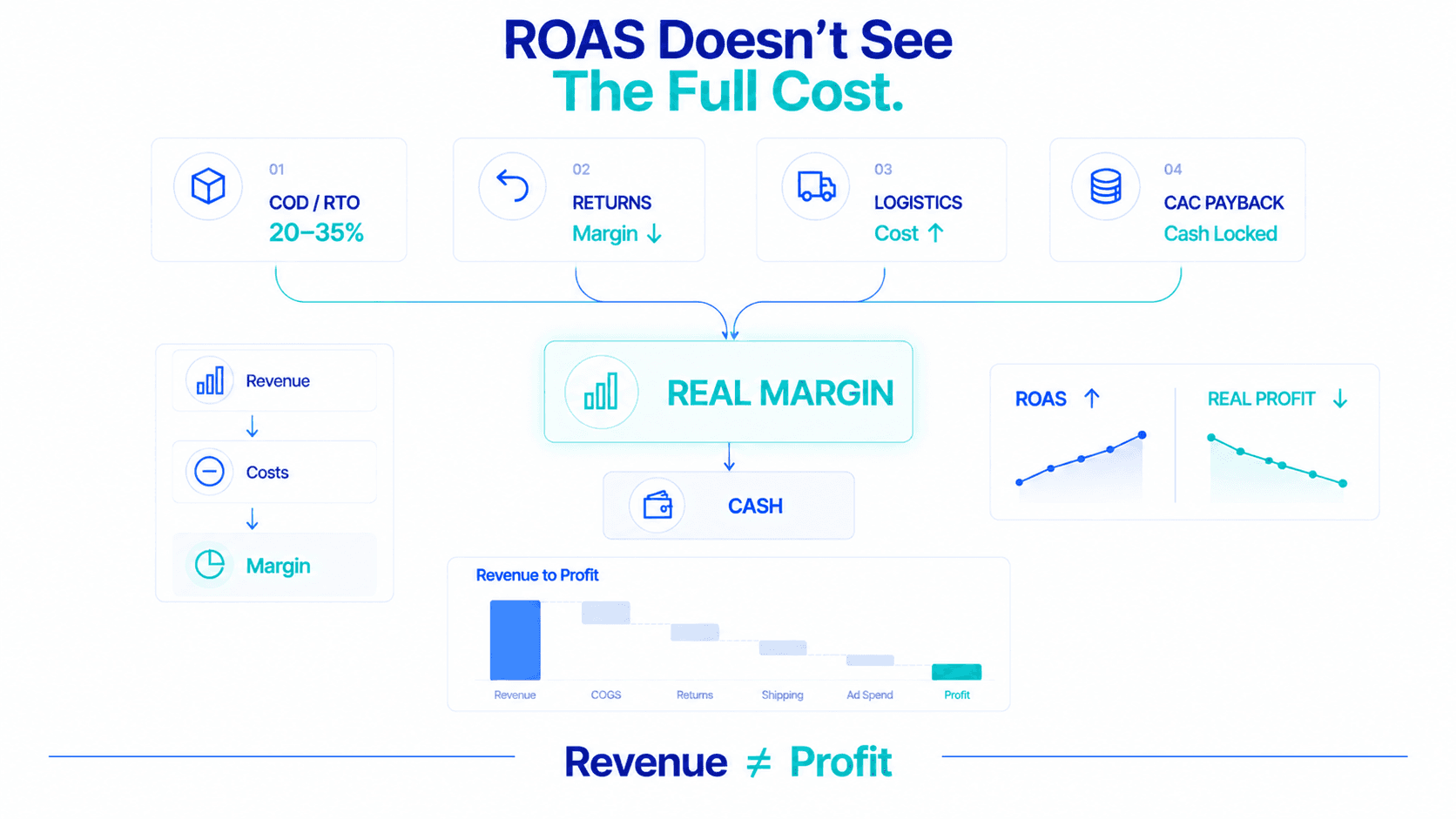
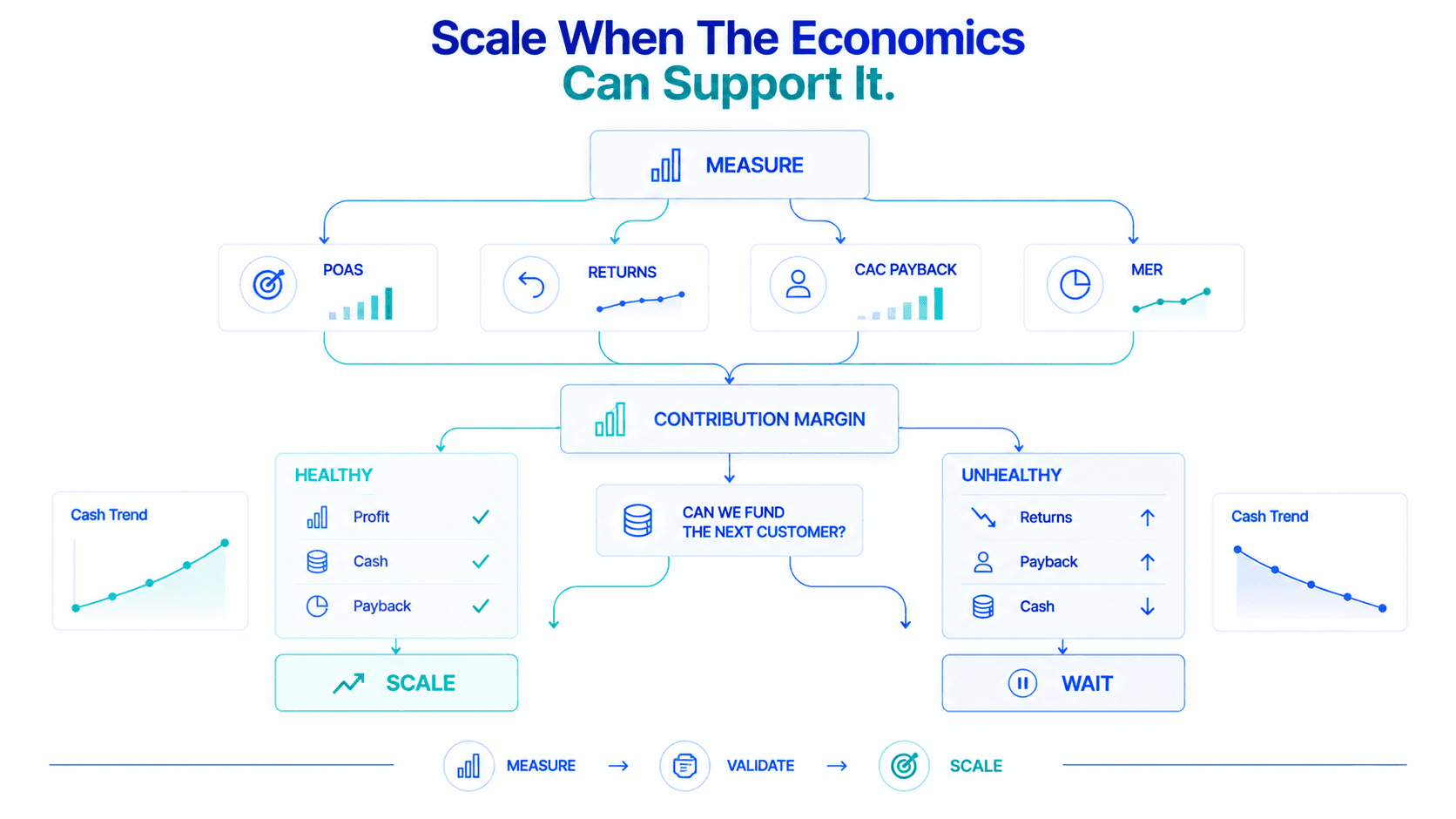
Pricing is not just a number that captures revenue. It’s the variable that determines whether paid advertising can ever be profitable, whether returns destroy your margin or leave something behind, and whether you can afford to acquire customers at the scale you want to reach.
The right price isn’t the highest price the market will accept or the lowest price that beats competition. It’s the price at which your unit economics, CM1, CM2, POAS, actually work.
Here’s how to find it.
Before choosing a price, decide what contribution margin you need to build a viable business.
Calculate what CM2 you need
CM2 is what remains after COGS, shipping, returns, payment fees, and ad spend. For most D2C categories, you need CM2 above 15% to cover fixed costs and generate profit at scale.
Work backwards from CM2 to CM1
If you’re targeting 20% CM2 and your variable operating costs (shipping + returns + payment fees) typically consume 18% of revenue, you need CM1 of at least 38%.
Work backwards from CM1 to price
If CM1 must be 38% and your COGS per unit is ₹280:
Minimum price
Minimum Price = COGS ÷ (1 − CM1 %) = ₹280 ÷ (1 − 0.38) = ₹451
Everything above ₹451 is margin headroom for advertising spend, competitive pricing strategy, and profit.
Where does your price sit?
Zone 1 · Danger
Price is below the floor needed to generate positive CM2 at any realistic ad spend level.
Brands in this zone grow revenue and destroy margin simultaneously. Common in highly competitive categories where founders set prices to match the cheapest competitor without checking whether that competitor’s economics actually work.
What to do: Either increase price or radically reduce COGS through better manufacturing terms, packaging optimisation, or higher MOQ.
Zone 2 · Marginal
Price generates enough CM1 to cover variable costs, but leaves thin room for advertising. A 20% return rate or a slight CPM increase can push POAS below 1.0.
Brands in this zone need to be operationally excellent, low return rates, efficient fulfilment, high repeat purchase rates, to survive. Any inefficiency collapses the margin.
What to do: Focus ruthlessly on reducing return rates and improving LTV before scaling ad spend. Or test a price increase.
Zone 3 · Target
Price generates CM1 that supports advertising at realistic efficiency levels. POAS can exceed 1.3x on core campaigns. There’s room to run promotions without going below break-even. A manageable return rate doesn’t destroy the economics.
This is where D2C brands should aim to operate.
Zone 4 · Margin-Rich
Price is at or above the premium ceiling for the category. Strong brand equity or genuine differentiation justifies it.
Brands in Zone 4 have the most freedom: aggressive advertising, deep promotions, high-return categories, all can be accommodated because the base margin is so strong.
Getting to Zone 4 requires: superior product quality, strong brand positioning, or a category where customer education creates perceived value beyond the commodity price.
Calculate your current zone
Zone 1–2
Marginal or dangerous
Zone 3
Healthy
Zone 4
Premium
At least once a year, ask: what would happen if we increased price by 15%?
Most D2C founders assume the answer is: we’d lose significant conversion volume. They price defensively because they fear the CVR impact.
The reality is usually more nuanced.
Conversion rate typically drops 5–15% when price increases 15%. But the margin improvement often more than compensates, especially in categories where perceived quality correlates with price.
Run a price test on your second-highest-volume product (not your hero, less risk). A/B test current price vs 15% higher on equal traffic for 14 days. Measure: CVR, AOV, return rate, and crucially, CM2 per order.
Often brands find:
−10%
Fewer orders
−5–8%
More deliberate buyers
+20–30%
More profit per order
Fewer orders. More profit per order. Better customer quality. Net result: stronger CM2 and better LTV despite lower volume.
Not always. But often enough to be worth testing before assuming price can’t move.
The most common D2C pricing mistake isn’t the base price. It’s what happens during promotions.
30% off a product with 55% gross margin
No D2C brand consistently achieves 18x ROAS. Which means every order placed during a 30% off campaign on this product is loss-making, regardless of how many orders the campaign generates.
Promotional pricing rule: before any promotion, calculate
Break-even ROAS = 1 ÷ Effective Margin % (at promotional price)
If the break-even ROAS is above what you realistically achieve, the promotion destroys margin on every order. You’re literally paying customers to shop with you.
The right promotional depth is the deepest discount where your break-even ROAS is still achievable. For most D2C brands, this is 10–20% off, not the 30–40% off that’s become standard in Indian D2C.
Bundles solve two problems simultaneously: they increase AOV and improve the unit economics of each order.
Single product
3-unit bundle
Same shipping cost. Dramatically different economics.
Additionally: COGS typically improves slightly on bundles (packaging efficiency, reduced per-order overhead), and customers who buy bundles have meaningfully lower return rates than single-unit buyers, they’ve committed more to the product category.
Bundle pricing framework
Bundle price = (Individual unit prices × Number of units) × 0.85–0.92
Offer 8–15% bundle discount. Price the bundle to generate CM1 above 50% even after the discount. The shipping and COGS improvements mean CM2 on the bundle often exceeds CM2 on individual units despite the lower price per unit.
Pricing is not marketing. It’s unit economics.
The right price isn’t the one that maximises conversion rate. It’s the one that generates the CM1 you need to build a profitable business, to support advertising spend, absorb returns, and leave something behind for fixed costs and profit.
Start with the CM2 you need. Work backwards to CM1. Work backwards to the minimum viable price. Then test whether the market accepts a price above that minimum, and how much above it you can go.
Price first. Advertise second. That’s the sequence that builds a D2C brand that lasts.
Minimum Price = COGS ÷ (1 − Required CM1 %). First determine your required CM1 (typically above 35–40% for most D2C categories to support paid advertising), then divide your per-unit COGS by (1 minus that percentage). Any price below this floor makes profitable paid acquisition structurally impossible.
A price increase directly improves CM1 and, if conversion volume holds or drops less than the margin improvement, improves POAS. A 15% price increase with a 10% CVR decline typically improves POAS by 15–25% because the margin gain on each remaining order outweighs the volume reduction.
The deepest discount where your break-even ROAS (1 ÷ effective margin % at the promotional price) is still achievable. For most D2C brands this is 10–20% off, not the 30–40% off that has become standard in Indian D2C.
Bundle price = (individual unit prices × number of units) × 0.85–0.92, an 8–15% bundle discount, priced so CM1 stays above 50% after the discount. Lower shipping share and lower return rates often make bundle CM2 higher than single-unit CM2.
Flable shows real-time CM2 and POAS per campaign and product, making it immediately visible when a product's margin is too thin to support profitable advertising. Price increase tests show their impact on CM2 within days, giving data to make permanent pricing decisions.
Flable AI shows real-time CM2 and POAS per campaign and product, so a margin too thin to advertise on shows up the day it happens.