AI Campaigns
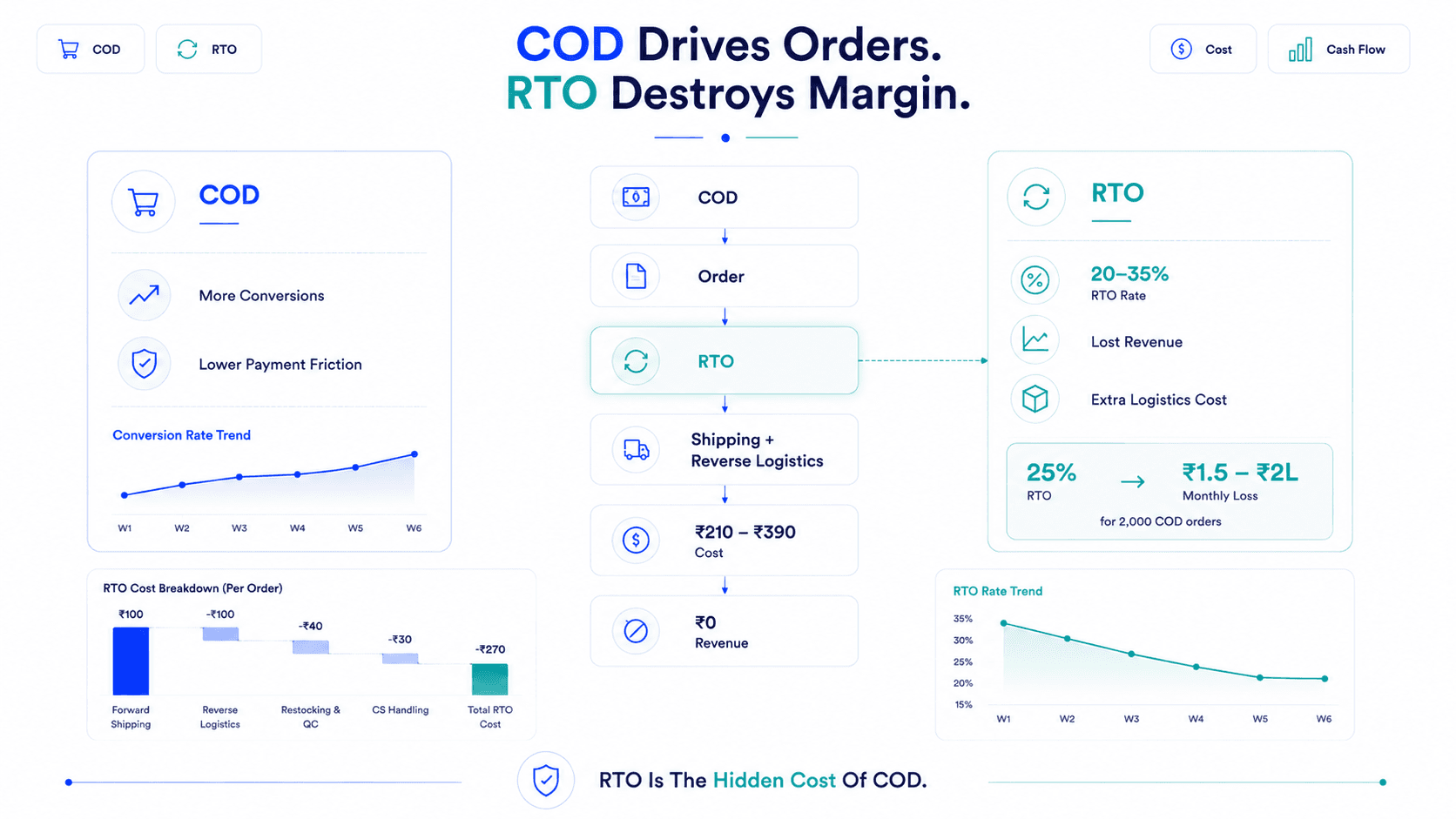
COD is both the best and most expensive thing about selling D2C in India. It removes the payment trust barrier, but refused deliveries eat into real profit.
₹210 – 390
Per refused order
25% – 40%
Immediate RTO reduction
< 15%
Healthy D2C target
It removes the payment trust barrier that kills conversions for new brands. A customer who wouldn't enter their card details on an unfamiliar website will happily click “Cash on Delivery” and complete the purchase.
But that same customer refuses delivery at a rate of 20–35% in high-COD categories. The order comes back. The forward shipping is gone. The reverse logistics fee lands. Zero revenue. Full cost.
For D2C brands scaling fast in India, RTO (Return to Origin) is often the hidden variable that makes what looks like a profitable quarter into a cash flow crisis. And unlike product returns (where at least you get the item back), RTO means the customer never even opened the package.
This is the complete playbook for reducing RTO without giving up the conversion volume that COD enables.
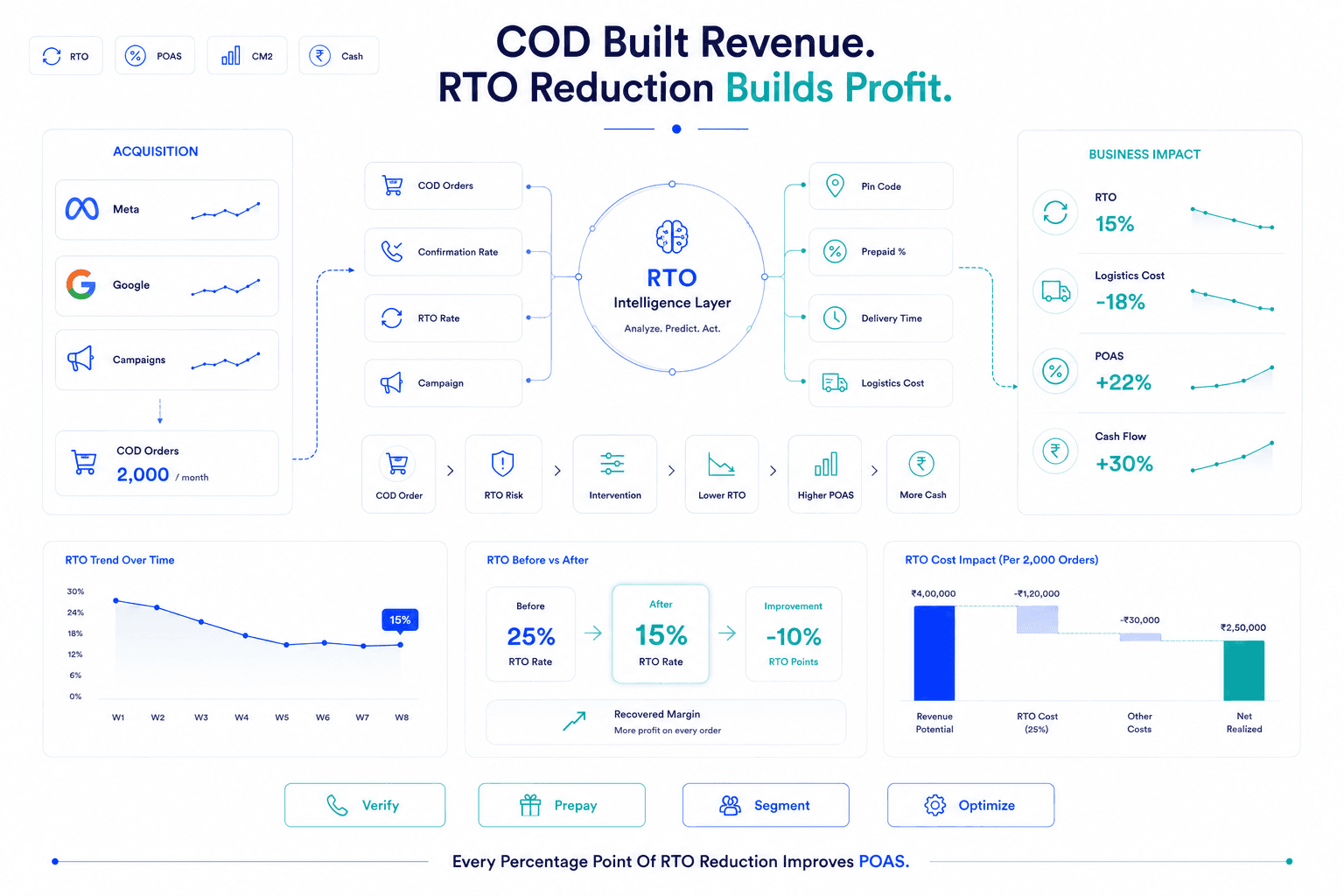
COD built your revenue. RTO reduction builds your profit.
RTO is not random. The customers who refuse COD deliveries share a predictable profile, and understanding that profile is the first step to reducing the rate:
Impulse purchase buyers
The ad was compelling in the moment. By the time the courier arrives 4–6 days later, the impulse has faded. Particularly common with fashion and lifestyle products where the purchase was driven by aesthetic appeal rather than need.
Low purchase intent customers
Ordering on COD has zero upfront cost or commitment. Some customers order from multiple brands for the same need, intending to keep only the first delivery that arrives. The others get refused.
Inaccurate address and unavailability
The courier arrives at the right address but the customer isn't there, didn't communicate delivery preferences, or gave an incomplete address. Multiple failed delivery attempts lead to RTO.
Discovered a better deal
Between ordering and delivery, the customer found the same or similar product cheaper elsewhere. COD makes it trivially easy to refuse, there's no cost to them.
Suspicion of quality
First-time buyers for new brands sometimes refuse delivery if the package looks different from what they expected, damaged packaging, unexpected size.
Most D2C brands calculate RTO cost as: courier charge (forward) + reverse logistics fee. The full cost is higher:
| Cost Component | Typical Amount |
|---|---|
| Forward shipping (non-recoverable) | ₹80–150 |
| Reverse logistics fee | ₹80–130 |
| Repackaging / restocking | ₹20–50 |
| Lost cash on delivery opportunity | Full AOV |
| Customer service handling | ₹30–60 |
| Total RTO cost | ₹210–390 per order |
On a ₹1,200 AOV product with a 25% RTO rate, you're absorbing approximately ₹70–98 per order placed in RTO costs, before accounting for the 25% of revenue that never materialised.
At scale, this is significant. A brand doing 2,000 COD orders/month at 25% RTO is absorbing approximately ₹1.5–2L/month in pure RTO losses that don't appear in their ad platform reporting.
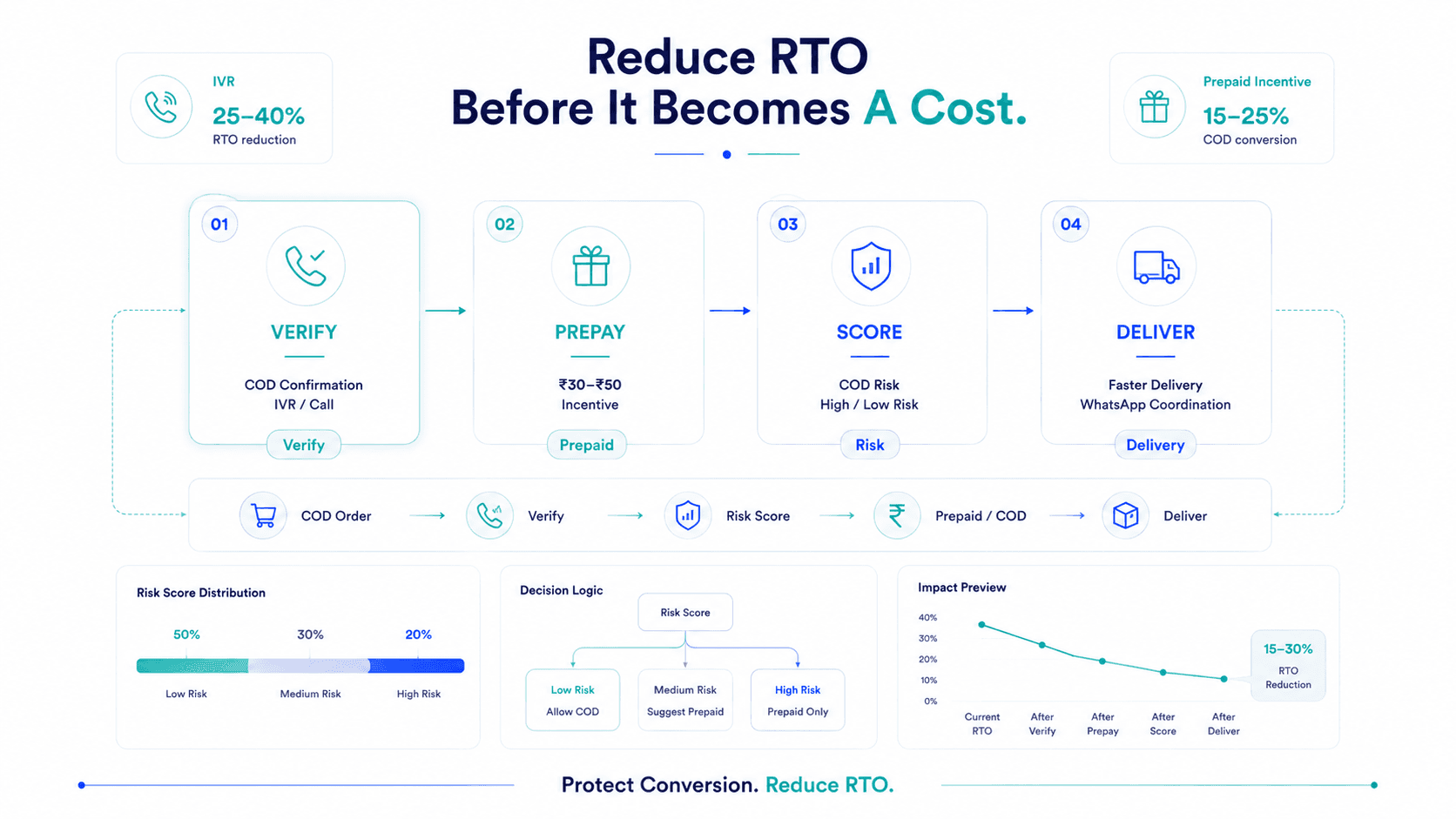
The single most effective RTO reduction tactic for Indian D2C brands: a pre-shipment confirmation call or automated IVR (Interactive Voice Response) to verify the order before it's dispatched.
How it works:
After a COD order is placed, an automated call is made to the customer within 15–30 minutes: “We've received your order for [product]. Press 1 to confirm, Press 2 to modify, Press 3 to cancel.”
Customers who don't answer or who press 3 (cancel) never receive a shipment. Their RTO rate is eliminated entirely — instead of a refused delivery, you have a pre-dispatch cancellation that costs nothing in logistics.
RTO reduction: 25–40% reduction in overall RTO rate, depending on how aggressively it's applied.
Implementation: Most D2C logistics partners (Shiprocket, Delhivery, Pickrr) offer COD verification as a built-in service. Third-party tools like Exotel or Knowlarity can automate the IVR workflow independently.
The most sustainable RTO reduction strategy: convert COD buyers to prepaid before the order ships.
At checkout, offer:
The incentive doesn't need to be large. ₹30–50 in tangible value (free shipping or a small gift) converts 15–25% of COD-intent customers to prepaid, customers who then have zero RTO risk because they've already paid.
The economics:
Converting a ₹250 average RTO cost into a small discount (₹50) saves ₹200 per conversion.
Applying this to 20% of COD orders on a 2,000 order/month volume = ₹80,000/month in RTO cost recovery on a ₹20,000/month incentive spend.
Not every customer should see COD as an option. A first-time buyer from an address with high historical RTO rates should be offered different payment options than a repeat buyer with a clean delivery history.
Platforms & Scoring:
Shiprocket Intelligence, Pickrr SafeShip, and Razorpay Magic Checkout use address-level, pin-code-level, and customer behaviour data to assign an RTO risk score to each order.
Implementation typically reduces overall RTO rate by 15–30% without meaningfully reducing total order volume.
Time kills COD orders. The longer the gap between “I ordered this” and “the courier arrives,” the more time buyer's remorse has to develop, the more competitors' ads the customer sees, and the more likely they are to refuse.
Same-Day / Next-Day Delivery
8% – 12% RTO
4–6 Day Delivery Window
22% – 30% RTO
The fix: Warehouse placement and logistics partner selection matter enormously for RTO, not just for customer satisfaction. A brand with a warehouse in Mumbai serving Maharashtra orders next-day will have dramatically lower RTO than a brand shipping from Delhi with 5-day delivery windows.
For orders going to Tier 2/3 cities where delivery infrastructure is less reliable, proactive WhatsApp communication dramatically reduces RTO from failed delivery attempts:
Message 1 (day before delivery):
“Your order is arriving tomorrow! Our courier will call before visiting. Please keep your phone available between 10am–6pm.”
Message 2 (day of delivery):
“Your [product] is out for delivery today! If you'd like to reschedule, reply to this message.”
This communication converts a significant number of “unavailable at home” RTOs into scheduled or rescheduled deliveries. Implementation cost: ₹0.50–0.80 per WhatsApp message. RTO reduction per prevented refusal: ₹200–350.
Your RTO rate is not uniform across campaigns. Meta campaigns targeting Tier 2/3 audiences with broad interest targeting generate significantly more COD orders, and significantly higher RTO rates — than Google brand search campaigns or email-driven orders.
Pull RTO rate by acquisition campaign UTM source from your logistics platform data. If specific campaigns have RTO rates above 30%, they're acquiring customers with poor delivery intent possibly because the ad is reaching impulse buyers who never intended to keep the product.
Action for high-RTO campaigns:
Some D2C brands run split tests where COD is hidden for cold prospecting traffic but shown for retargeting traffic, based on the insight that warm audiences have materially lower RTO rates than cold audiences.
Track these weekly alongside your standard performance metrics:
| Metric | Formula | Target |
|---|---|---|
| Overall RTO rate | RTOs ÷ Total COD orders | <15% (strong) / <25% (acceptable) |
| RTO rate by campaign | RTOs per campaign ÷ COD orders per campaign | Identify outliers |
| RTO rate by pin code | RTOs in zone ÷ COD orders in zone | Identify delivery zone problems |
| Prepaid % of total orders | Prepaid orders ÷ Total orders | Rising trend = improving profile |
| COD confirmation rate | Confirmed orders ÷ COD orders placed | Above 70% after IVR |
| True RTO cost per order | (Forward + reverse logistics + restocking) ÷ All orders | Tracking impact of tactics |
COD is not a problem to be eliminated. In India's D2C market, it's a customer acquisition tool with a specific cost, and that cost is manageable when you measure it correctly and address it systematically.
Verify before dispatch. Incentivise prepaid at the margin. Risk-score your orders. Deliver fast. Communicate proactively. And identify the campaigns that are generating your worst RTO customers, then fix or restructure them.
Every percentage point of RTO reduction improves POAS directly. A brand that moves from 25% to 15% RTO on its COD orders has just recovered meaningful margin without changing its ad spend, its pricing, or its product.
COD built your revenue. RTO reduction builds your profit.
RTO stands for Return to Origin — when a COD (Cash on Delivery) order is refused by the customer at delivery and the package is returned to the brand's warehouse. Unlike product returns (where the customer accepts and then returns), RTO means the product was never opened or kept. The brand absorbs forward shipping, reverse logistics, and restocking costs while receiving zero revenue.
Below 15% overall is strong. 15–25% is common and manageable. Above 25% indicates structural problems with COD audience quality, delivery timeframes, or product expectation gaps. High-COD categories (fashion, lifestyle) in Tier 2/3 markets often see 30–35% RTO without active reduction measures.
COD verification via IVR call before dispatch, filtering out customers who don't confirm the order. Reduces overall RTO by 25–40% within the first week of implementation. Most Indian logistics providers offer this as a built-in feature.
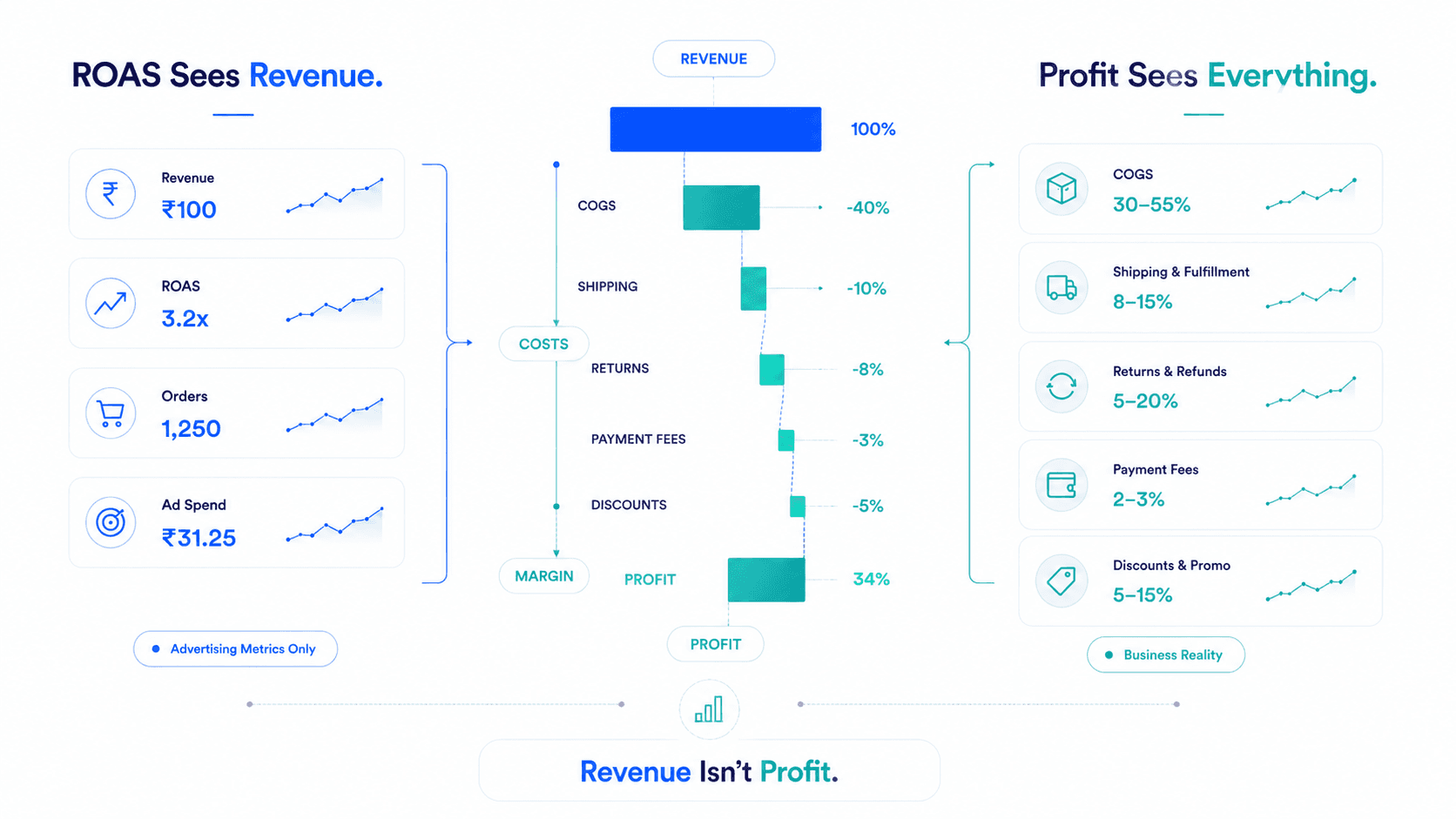
RTO directly destroys contribution margin: forward shipping is non-recoverable, reverse logistics adds cost, and the intended revenue never materialises. A 25% RTO rate on COD orders can reduce overall campaign POAS by 0.2–0.4x depending on product margin and logistics costs — a significant impact that platform ROAS reporting never shows.
Flable integrates logistics data alongside ad spend and Shopify revenue to calculate POAS adjusted for RTO costs, showing which campaigns are generating high-RTO COD orders that look profitable on ROAS but destroy margin in fulfilment.
Connect logistics, Shopify, and ad platforms into a single contribution margin engine. Stop spending on campaigns that drive high RTO.