Profitability
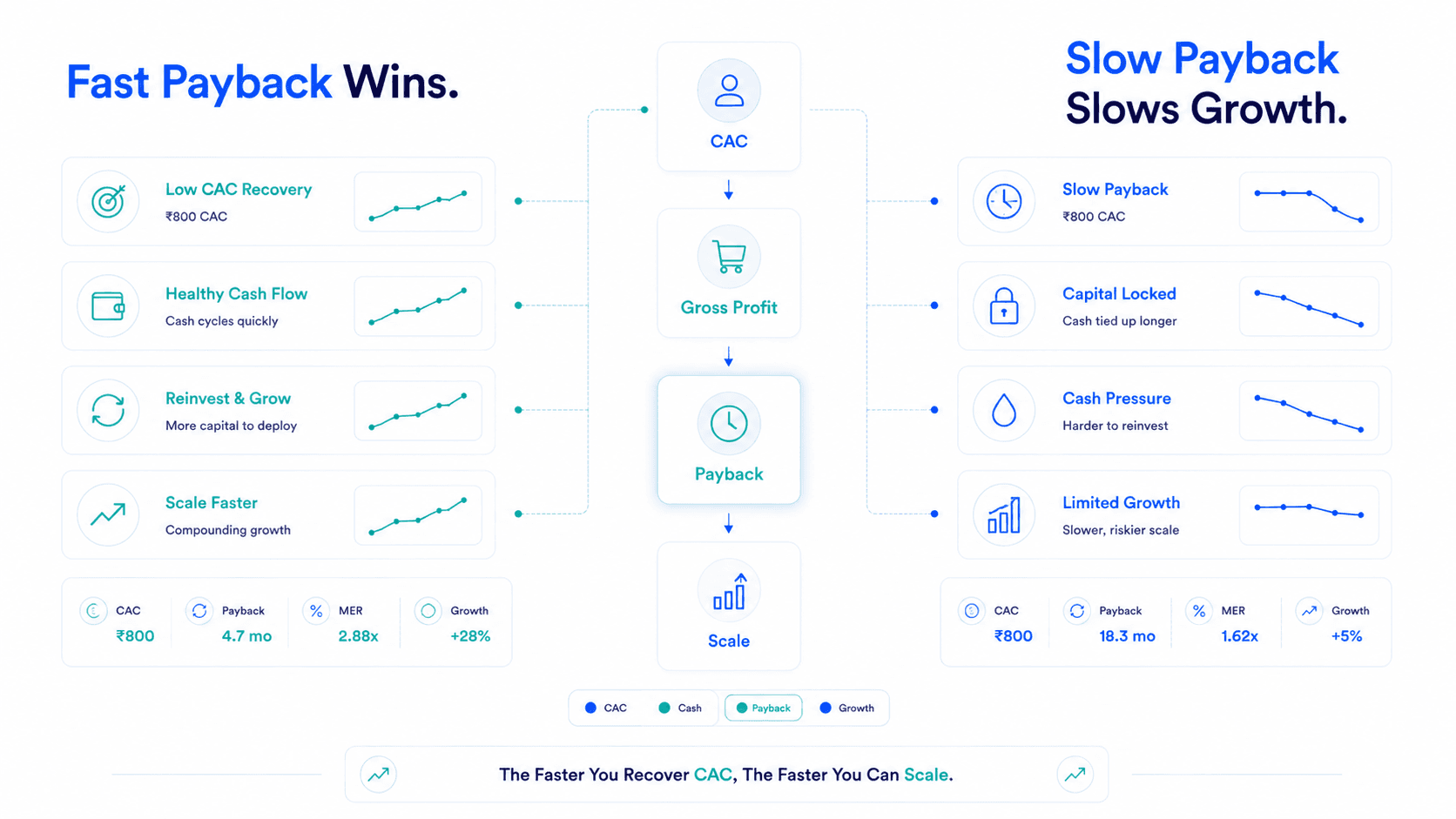
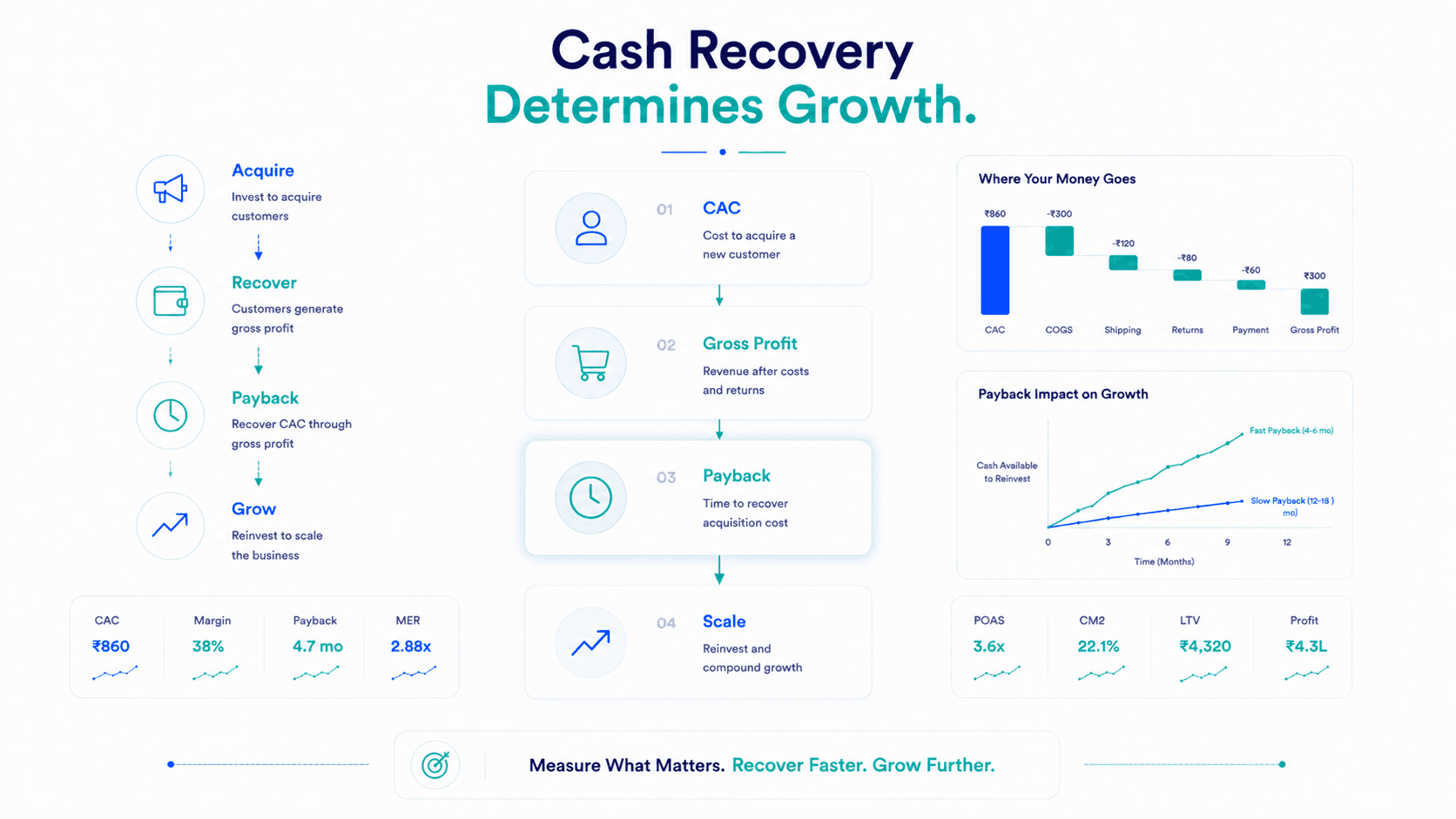
Two brands. Same CAC. Completely different businesses. Brand A acquires a customer for ₹800 and recovers it in 6 weeks. Brand B acquires a customer for ₹800 and never recovers it. The metric that separates them is CAC Payback Period.
2 – 6 Mos
Varies by category & repurchase
CAC ÷ Gross Profit
True Monthly Profit per Customer
Working Capital
Determines scaling velocity
Brand A can scale aggressively: every acquisition pays back quickly, freeing capital for the next one. Brand B is trapped: each acquisition ties up capital for months or indefinitely, making scaling a cash flow problem rather than a growth opportunity.
Most D2C brands don't calculate it. Almost all of them should.
CAC Payback Period is the number of months it takes to recover the cost of acquiring a new customer from that customer's contribution to gross profit.
CAC Payback Period (months) = True New Customer CAC ÷ Monthly Gross Profit per Customer
Monthly Gross Profit per Customer = (AOV × Purchase Frequency per Month) × Effective Margin %
Where Effective Margin % = Gross Margin % − Shipping % − Returns Cost % − Payment Processing %
LTV:CAC ratio (Lifetime Value divided by Customer Acquisition Cost) is the more commonly quoted metric for D2C business health. A ratio of 3:1 or higher is the standard benchmark.
But LTV:CAC has a critical blind spot: it doesn't tell you when you recover the CAC.
The 4-Month Payback Brand
Acquires customer for ₹800. Recovers ₹800 in 4 months. Reinvests to acquire another customer. Capital cycles quickly; growth compounds fast.
The 18-Month Payback Brand
Acquires customer for ₹800. Needs 18 months of purchases to recover. Fronts ₹800 for 1.5 years. Scaling creates a massive cash flow deficit.
True New Customer CAC = Prospecting Spend ÷ (Net New Customers × (1 − Return Rate))
Prospecting spend: ₹2,40,000
New first-time buyers: 340
New customer return rate: 18% → Net retained: 279
True New Customer CAC = ₹2,40,000 ÷ 279 = ₹860
AOV: ₹1,200
Purchase frequency: 0.4 orders/month
Effective margin: 38%
Monthly Gross Profit = ₹1,200 × 0.4 × 38% = ₹182.40
If acquiring 500 new customers/mo at ₹860 CAC with 4.7 month payback:
Outstanding Acquisition Investment = ₹860 × 500 × 4.7 = ₹20.2 Lakhs
That ₹20.2L is deployed capital not yet returned. Scaling to 1,000 customers/mo requires carrying ₹40.4L in working capital.
| Category | Purchase Frequency | Healthy Payback | Concern Zone | Red Flag |
|---|---|---|---|---|
| Health / Supplements | Monthly (0.8–1.2x/mo) | 2–4 mos | 4–8 mos | >8 mos |
| Beauty / Skincare | Bi-monthly (0.4–0.7x/mo) | 3–6 mos | 6–10 mos | >10 mos |
| Food & Beverage | Weekly (2–4x/mo) | 1–3 mos | 3–6 mos | >6 mos |
| Apparel / Fashion | Seasonal (0.2–0.4x/mo) | 4–8 mos | 8–14 mos | >14 mos |
| Home / Lifestyle | Low (0.1–0.3x/mo) | 6–12 mos | 12–18 mos | >18 mos |
| Electronics | Very low (0.05–0.1x/mo) | 12–24 mos | >24 mos | Single-purchase |
Cause 1: CAC Is Too High
Fix: Improve campaign creative, refine targeting, reduce discount depth on acquisition, or improve prospecting vs retargeting mix.
Cause 2: Repeat Purchase Rate Is Too Low
Fix: Post-purchase email/SMS sequences, subscription incentives, loyalty program, product bundling to encourage catalog exploration.
Cause 3: Effective Margin Is Too Low
Fix: Reduce return rates, negotiate shipping rates, increase initial order AOV through bundling, or reprice products.
CAC Payback Period is the metric that determines whether you can scale without running out of cash, and most D2C brands don't calculate it until the cash flow problem is already present.
Know your payback period. It's the bridge between your CAC and your LTV, and the most important thing your cash flow depends on.
Key Takeaway
Calculate yours now. If it's within healthy range for your category, you have a scalable model and the data to prove it.
Frequently Asked Questions
CAC Payback Period is the number of months required to recover the cost of acquiring a new customer from that customer's gross profit contribution. It's calculated as True New Customer CAC ÷ Monthly Gross Profit per Customer. It measures how quickly capital invested in customer acquisition is returned — a critical factor in determining how much working capital is required to scale.
Varies by category and purchase frequency. Supplements and food (high repurchase): 2–4 months is healthy. Beauty/skincare: 3–6 months. Apparel: 4–8 months. Home/lifestyle: 6–12 months. Electronics: 12–24 months. Above these ranges signals either high CAC, low repeat purchase rate, or thin margins, each with a specific fix.
LTV:CAC shows the long-term ratio but not the timing. Two brands with identical 3:1 LTV:CAC ratios can have payback periods of 4 months and 18 months respectively, meaning completely different working capital requirements and scaling risk profiles. Payback period adds the time dimension that LTV:CAC misses.
Returns compress effective margin per order, reducing the monthly gross profit that recovers CAC. A 20% return rate extends payback period significantly, both by reducing net revenue from the initial order and by increasing the cost burden per customer. Reducing return rates is one of the most direct ways to shorten CAC payback period.
Flable calculates true new customer CAC per campaign (prospecting spend ÷ return-adjusted new customers) alongside CM2 and POAS. Combined with Shopify cohort data, this gives you the inputs needed to calculate and track payback period by acquisition channel, so you know which channels produce customers who pay back fastest.
True new customer CAC, CM2, POAS, automatic, real-time.
Start Measuring Profitability →Setup in 48 hours · No credit card required · Backed by Microsoft & NVIDIA