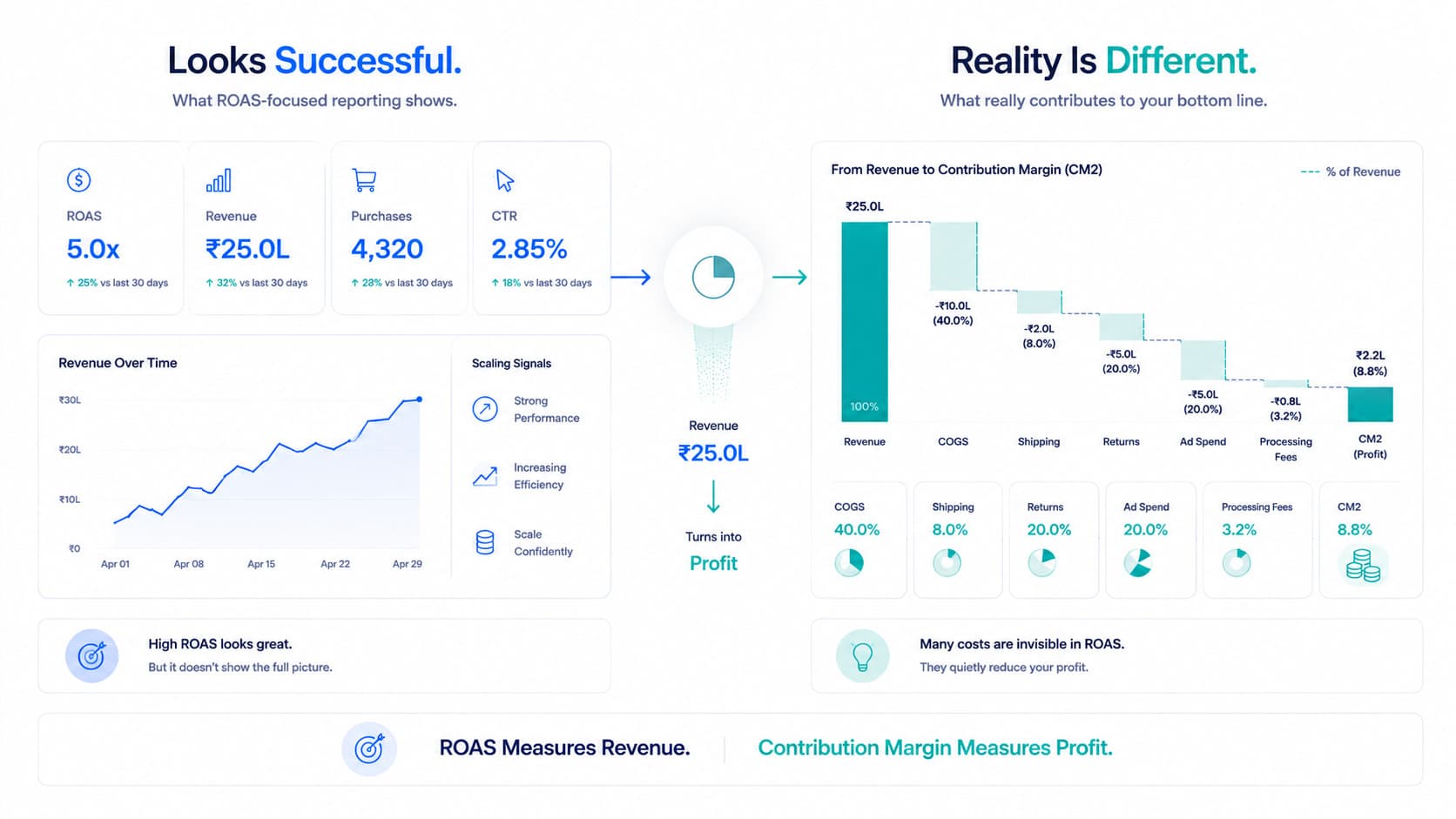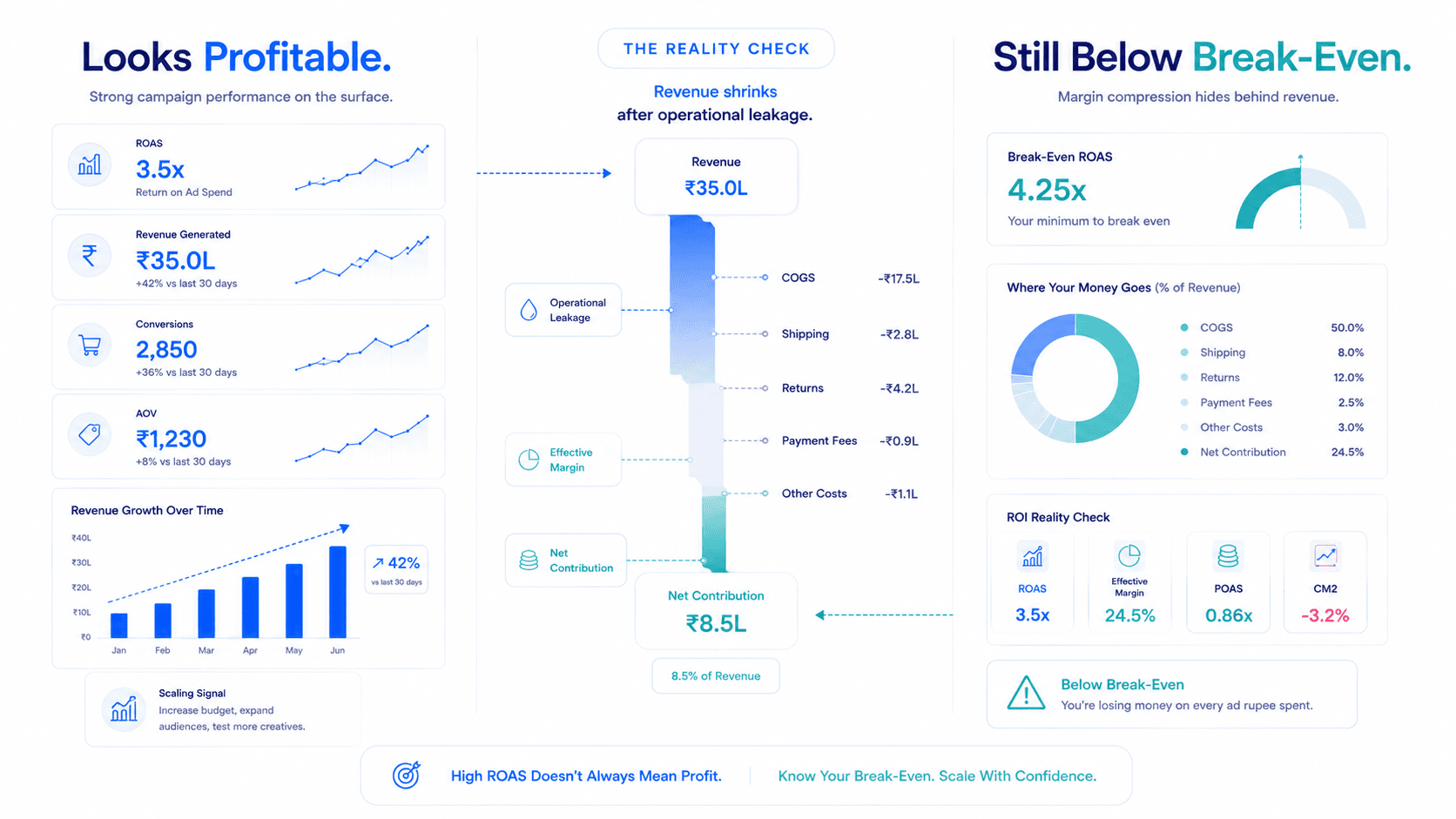
Deep Dive
It's the uncomfortable question nobody wants to sit with. Here are the 5 diagnostic tests to find out if your performance marketing agency is optimising for your real contribution margin, or just keeping the dashboard green.
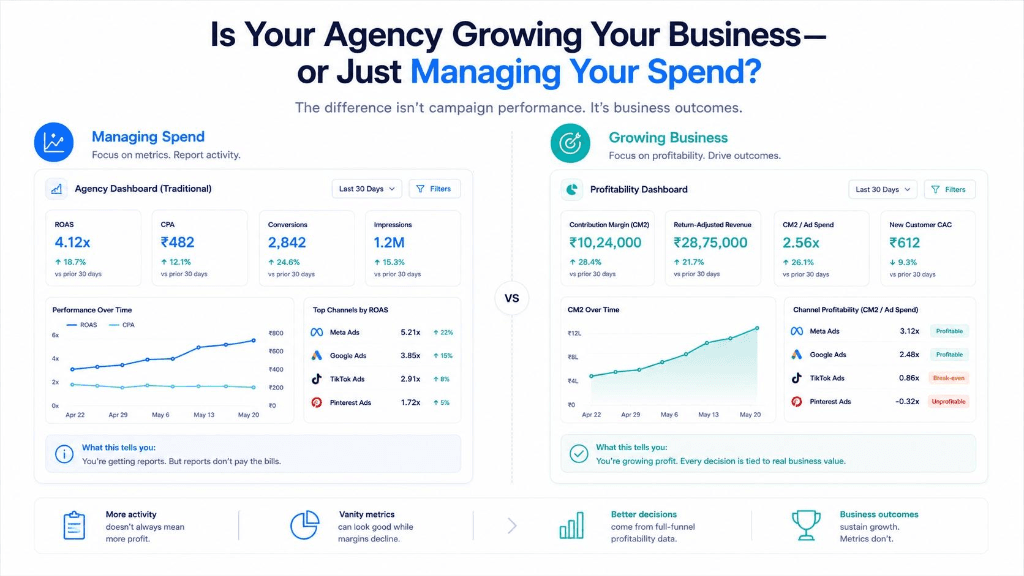
Because here's what makes this problem so expensive: it doesn't announce itself. It doesn't show up in the monthly call as a red flag. It shows up as a slow, quiet divergence between your ad dashboard and your bank account — and by the time the gap is undeniable, you've already burned through months of budget and a lot of trust.
So this is the practical piece. Not the problem — you already know the problem. This is the diagnostic. The specific tests, questions, and signals that tell you whether your agency is genuinely growing your business — or just comfortably managing your spend.
An agency managing your spend executes campaigns. They keep ROAS within an acceptable range. They produce reports that show improvement on the metrics they're responsible for. They renew your contract every quarter because nothing is visibly broken.
An agency growing your business operates differently. They know which campaigns are generating positive contribution margin. They tell you when to spend less. They flag when a channel is delivering volume but not profitability. They bring ideas you didn't ask for. They're uncomfortable with comfortable.
Here's how to tell which one you have.
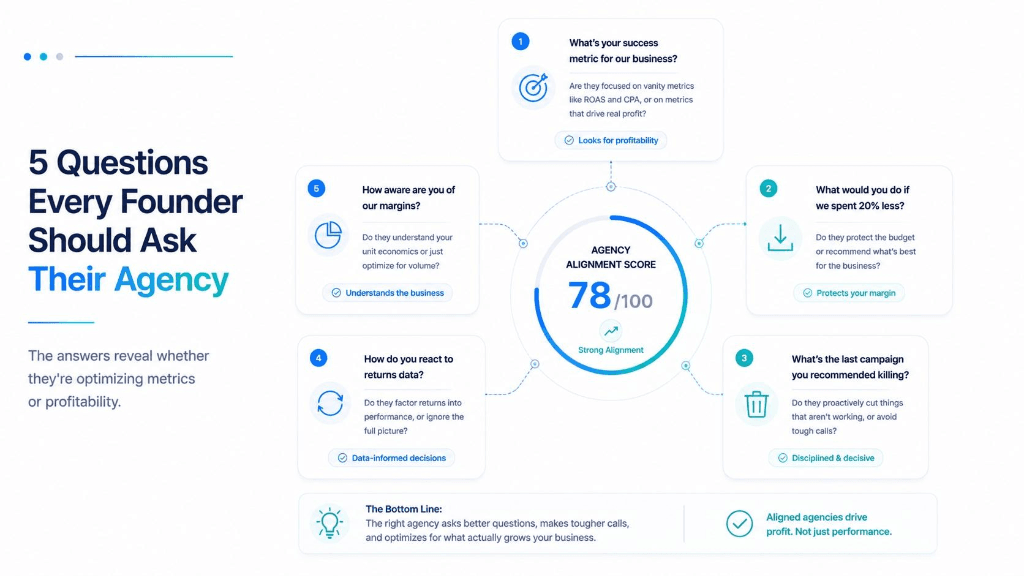
Not what they track. What they define as success. If the answer is ROAS — you have a problem. ROAS measures revenue against ad spend. It says nothing about what that revenue is worth after your COGS, your return rate, your shipping, and your fulfilment costs.
What good looks like: "Our goal is to drive profitable revenue which means we want to improve CM2 per channel. We use ROAS as a directional indicator but we know it's incomplete without your margin and returns data."
This one is sharp. Do it in your next call. Tell them: "We're thinking about pulling back budget by 20% next month. What's your recommendation?" An agency paid on a percentage of ad spend will almost always find a reason to maintain or grow the budget.
What good looks like: "Show us your CM2 by channel and we'll help you identify where to cut. We don't want your budget if it's not profitable."
A growing agency kills things. Regularly. Decisively. Before you ask them to. If an agency has been running your account for 6 months and has never proactively recommended pausing a campaign... that's conflict avoidance.
What good looks like: A specific example. A clear reasoning. A result from killing it — budget freed up, margin improved, something measurable.
This is the most revealing test. Take your last month's return rates by campaign or channel and share them. Ask: "How does this change your read on campaign performance?"
What good looks like: Active engagement with the implication. Not just acknowledgment but a change in how they evaluate and brief campaigns going forward.
Ask your agency, unprompted: "What's the gross margin on our top three SKUs?" If they don't know — they cannot be optimising for your profitability. Full stop.
What good looks like: They know. Or if they don't, their immediate response is: "We should have this. Can you share a product-level margin breakdown?"
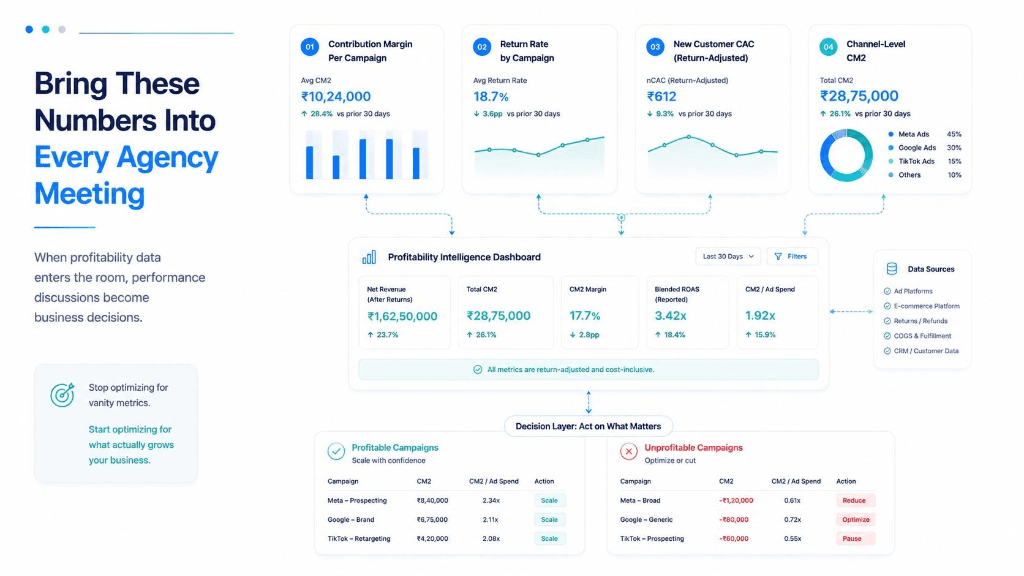
If you run these tests and the answers are good — you have a strong agency. Tell them. And give them your real margin data so they can do even better work.
If the answers reveal the gaps — that's not a reason to immediately fire anyone. Most agencies haven't been asked to work this way because most founders haven't had the data to hold them to it. The shift starts with you bringing the right information into the room.
This is exactly what Flable AI surfaces, automatically, in real time, from the moment you connect your ad accounts, your Shopify store, and your returns data. You don't build this in a spreadsheet. You walk into every agency call already knowing it.
Your agency is not your enemy. In most cases, they're working hard with incomplete context. Give them the right context and hold them to the right metrics — and the relationship becomes what it was supposed to be.
Stop being managed. Start being grown. That is the only relationship worth paying for.
Frequently Asked Questions
Ask them what their primary success metric is for your account. If the answer is ROAS or CPA without any reference to contribution margin, returns, or product profitability — they're optimising for platform metrics, not for your business health. Agencies aligned with your profitability define success in terms of CM2 and real new customer acquisition costs.
Yes, and the reaction you get tells you a lot. An agency that engages seriously with margin and return data will use it to restructure campaigns, adjust bidding by product tier, and brief creative with return rate signals. An agency that files it away and keeps reporting the same ROAS metrics wasn't using the right framework to begin with.
It's a two-way conversation, not a presentation. You arrive knowing your CM2 per campaign. The agency arrives with creative performance data, audience signals, and proactive recommendations — including what they think should be cut. The conversation is anchored in business outcomes, not green arrows.
"We beat last month" as the primary benchmark. When the agency measures success against last month's metrics rather than against your profitability targets, they're measuring momentum — not business health. Revenue can grow while margins shrink. A report that only celebrates growth has stopped looking at what that growth is worth.
Flable gives you real-time CM2 per campaign — return-adjusted, COGS-adjusted, fully reconciled. You walk into every agency review call already knowing which campaigns are profitable, which aren't, and by how much. This shifts the dynamic from passive audience to informed decision-maker and holds the agency accountable to metrics that actually reflect your business.
Contribution margin per campaign. Return-adjusted. Live. Before the PDF lands.
See Your Real Profitability →Setup in 48 hours · No credit card required · Backed by Microsoft & NVIDIA