Profitability Math
Claude and ChatGPT are incredible for analyzing data you give them. Flable shows you the data you didn't know you were missing. Here's why AI assistants and profitability platforms solve very different problems.
At a glance
Always-on profitability platform with attribution and creative intelligence. Connects live to Shopify, Meta, Google, TikTok, logistics, and payment processors. Automatically calculates contribution margin per channel, per campaign, per SKU. Sends proactive alerts when margins drop.
Automated · Live data · Always monitoringBrilliant general-purpose AI assistant. Analyzes data you upload (CSVs, reports, screenshots). Excellent at spotting trends, writing summaries, building models, and answering strategic questions. Requires manual data prep for every session.
Manual · Snapshot data · On-demand analysisThe Monday morning question: "Is my Meta spend profitable?"
You want to know if your Meta channel is making money after all costs.
⏱️ Time to answer: 2–4 hours
⏱️ Time to answer: 10 seconds
The core difference: Claude is the smartest analyst you've ever worked with — but it only knows what you tell it. Flable is the system that collects, unifies, and monitors the data so there's nothing to miss. One is a brain. The other is a brain plus eyes, ears, and a nervous system that never sleeps.
Capability comparison
| Capability | Flable | Claude / ChatGPT |
|---|---|---|
| 🔌 Data Connection & Collection | ||
| Live connection to Shopify | ✅ Always-on | ❌ Manual export |
| Live connection to Meta / Google / TikTok | ✅ Always-on | ❌ Manual export |
| Live connection to logistics / 3PL | ✅ Always-on | ❌ Manual export |
| Live connection to payment processor | ✅ Always-on | ❌ Manual export |
| Automatic data unification across sources | ✅ Per-order level | ❌ You must join manually |
| Persistent data — remembers history | ✅ Full history | ❌ Session-only |
| No manual CSV exports required | ✅ Zero | ❌ Every time |
| 💰 Profitability Intelligence | ||
| Real-time CM1 / CM2 / CM3 per channel | ✅ Automatic | ⚠️ If you provide all data |
| COGS mapped to channel performance | ✅ Auto per SKU | ⚠️ Manual mapping |
| Shipping cost per order & region | ✅ Yes | ⚠️ If you export it |
| Coupon stacking detection | ✅ Automatic | ❌ Would need custom analysis |
| Proactive margin alerts | ✅ Real-time | ❌ No monitoring |
| 📊 Attribution & Creative Intelligence | ||
| Last-touch attribution | ✅ Built-in | ❌ No attribution |
| Creative performance analytics | ✅ Built-in | ❌ No |
| Competitor creative analysis | ✅ Built-in | ❌ No |
| Natural language questions about your data | ✅ AI copilot | ✅ Core strength |
| 🏢 Agency & Operations | ||
| Multi-client agency dashboard | ✅ Built-in | ❌ No |
| White-label client reporting | ✅ Yes | ❌ No |
| Setup time | 48 hours | Immediate |
| Ongoing maintenance | Zero | 3–5 hrs/week (exports) |
The verdict
Always-on profitability monitoring. Real-time CM per channel, proactive alerts, automated cost tracking, agency dashboards. The system that watches your margins so you don't have to.
Strategic thinking and ad-hoc analysis. Brainstorming, competitive research, custom financial models, deep dives on specific questions, content creation, and creative strategy.
It makes perfect sense that D2C founders and ecommerce marketers are turning to Claude and ChatGPT for analytics. These AI assistants are remarkably capable. You can upload a Shopify CSV, a Meta Ads export, and a shipping report, and Claude will analyze them in minutes — spotting trends, calculating metrics, and generating insights that would take a human analyst hours.
According to industry research, 88% of marketers now use AI daily, and 93% say it makes content and analysis faster. Claude's 200,000-token context window means you can upload hundreds of pages of data in a single conversation. ChatGPT's Code Interpreter can run Python analysis on your exports in real time. These tools are genuinely powerful.
But there are three fundamental limitations that prevent AI assistants from replacing a dedicated ecommerce profitability platform — and they all stem from the same root problem: AI assistants only know what you tell them.
To get a complete profitability picture, you need data from at least five sources: your Shopify store (orders, COGS, discounts), your ad platforms (Meta, Google, TikTok spend and revenue), your logistics provider (shipping costs per order), your returns portal (return rates and reasons), and your payment processor (transaction fees).
Each of these requires a manual export. Each export has different formats, different date ranges, different column naming conventions. Before you can even ask Claude a question, you need to export, clean, standardize, and upload five separate data files. This takes 1–3 hours depending on your stack complexity. And you have to do it every time.
Here is the more dangerous issue: you don't know what you forgot to export.
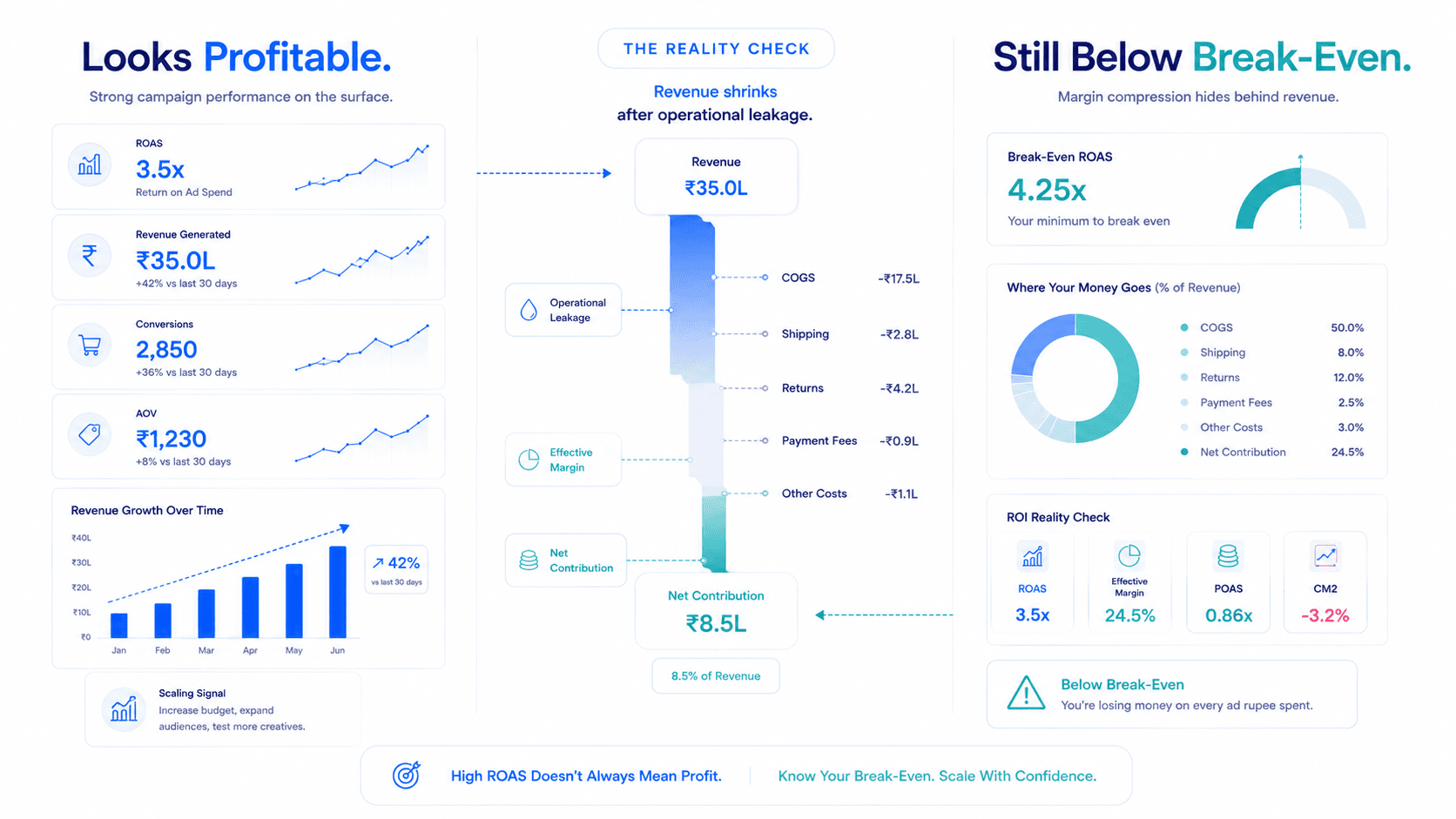
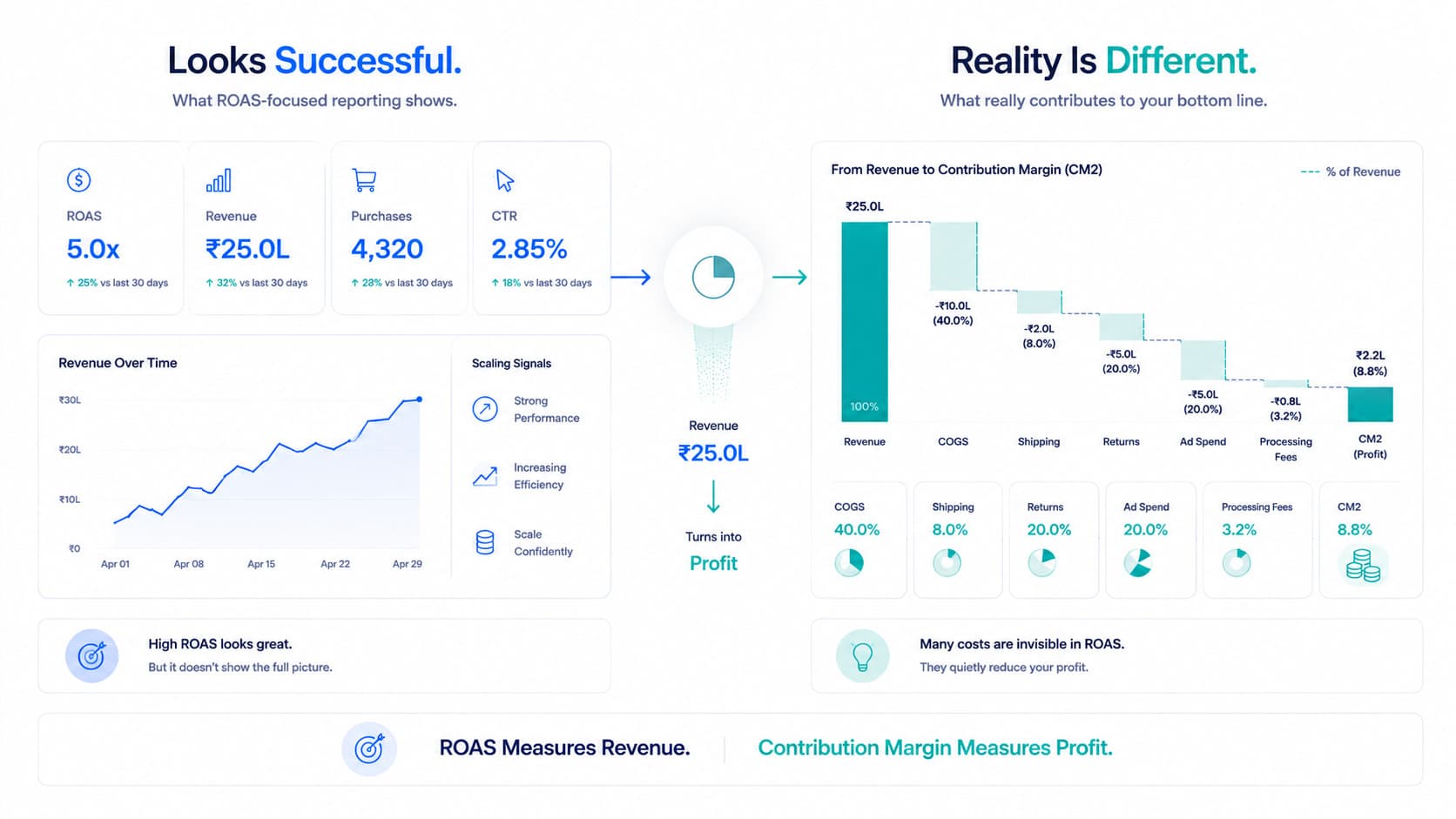
Claude will give you a brilliant, confident, well-structured analysis of the data you uploaded. If that data is incomplete — if it is missing shipping costs, return rates, or stacked discounts — the analysis will be confidently wrong. Claude does not know what it is missing. A smart analyst with partial data is more dangerous than a mediocre analyst with complete data, because partial-data confidence leads to scaling decisions that amplify losses.
AI assistants are reactive. You ask a question, you get an answer. They do not watch your data while you sleep. Margin problems do not announce themselves. Coupon stacking emerges gradually. Shipping costs creep up. Return rates spike when a new product launches. Flable monitors your margins continuously and sends proactive alerts when something changes.
The most effective D2C teams in 2026 are not choosing between AI assistants and analytics platforms. They are using both — each for what it does best.
Flable handles the plumbing and the intelligence. It connects your data sources, unifies costs at the order level, calculates contribution margin in real time, monitors for margin problems, and analyzes your creative performance.
Claude handles the thinking. When Flable flags that Meta channel profitability dropped 22% this week, you take that insight to Claude and ask: "Given this data, what are the three most likely root causes, and what should I test first?"
Flable tells you what is happening. Claude helps you decide what to do about it.
Frequently Asked Questions
You can use AI assistants to analyze exported data, and they will do a brilliant job — if the data is complete. The limitations are: you need manual CSV exports from 5+ sources every time, there's no persistent data between sessions, no live monitoring, no proactive alerts, and you may not know what data you forgot to include. Flable automates the entire pipeline and monitors margins 24/7.
Excellent for it. Claude can analyze uploaded spreadsheets, spot trends, build financial models, write reports, and answer strategic questions about your marketing data. Its 200K context window handles massive datasets. The limitation is that it only knows what you upload — it cannot connect to live data, detect patterns across time periods it hasn't seen, or monitor for problems between sessions.
Live data connections (Shopify, Meta, Google, TikTok, logistics, payments), automated cost unification at the order level, real-time CM1/CM2/CM3 calculation, coupon stacking detection, proactive margin alerts, multi-client agency dashboards, and persistent historical data. Claude requires manual exports and starts fresh every session.
The DIY approach with Claude or ChatGPT typically requires 3–5 hours per week: exporting data from multiple platforms, cleaning and formatting CSVs, uploading, writing prompts, and iterating on the analysis. Flable requires 48 hours for initial setup, then zero ongoing manual work.
This is the recommended approach. Flable handles automated data collection, cost unification, and real-time margin monitoring. Claude and ChatGPT handle strategic thinking, ad-hoc deep dives, competitive research, and creative work. Flable tells you what is happening. Claude helps you decide what to do about it.
Book a Flable walkthrough and see your real contribution margin per channel — live, automatic, no spreadsheets required. Keep using Claude for the strategic thinking. Let Flable handle the data plumbing.
See Your Margins in Real Time →Setup in 48 hours · No credit card required · Backed by Microsoft & NVIDIA