Deep Dive
You’ve decided to run Google Ads. You’ve looked at the platform. It’s complex. So you look for an agency. You get three proposals. The numbers are all different. This guide breaks down exactly how Google Ads PPC agency pricing works and which model makes sense at which stage.

PPC (Pay-Per-Click) is an advertising model where you pay each time someone clicks your ad. Google Search Ads are the most common form: you bid on keywords, your ad appears when someone searches that term, and you pay only when they click.
PPC management is the ongoing work of running those campaigns:
Keyword research and selection
Bid strategy and budget allocation
Ad copy writing and testing
Audience and match type management
Negative keyword lists
Performance monitoring and optimisation
Reporting
For most D2C brands, this is genuinely complex work. Google’s ecosystem — Search, Shopping, Display, YouTube, Performance Max — has more levers than most in-house teams have time to learn. Which is why agencies exist.
But not all agency pricing models are created equal. And one of them has a structural conflict with your profitability built right in.
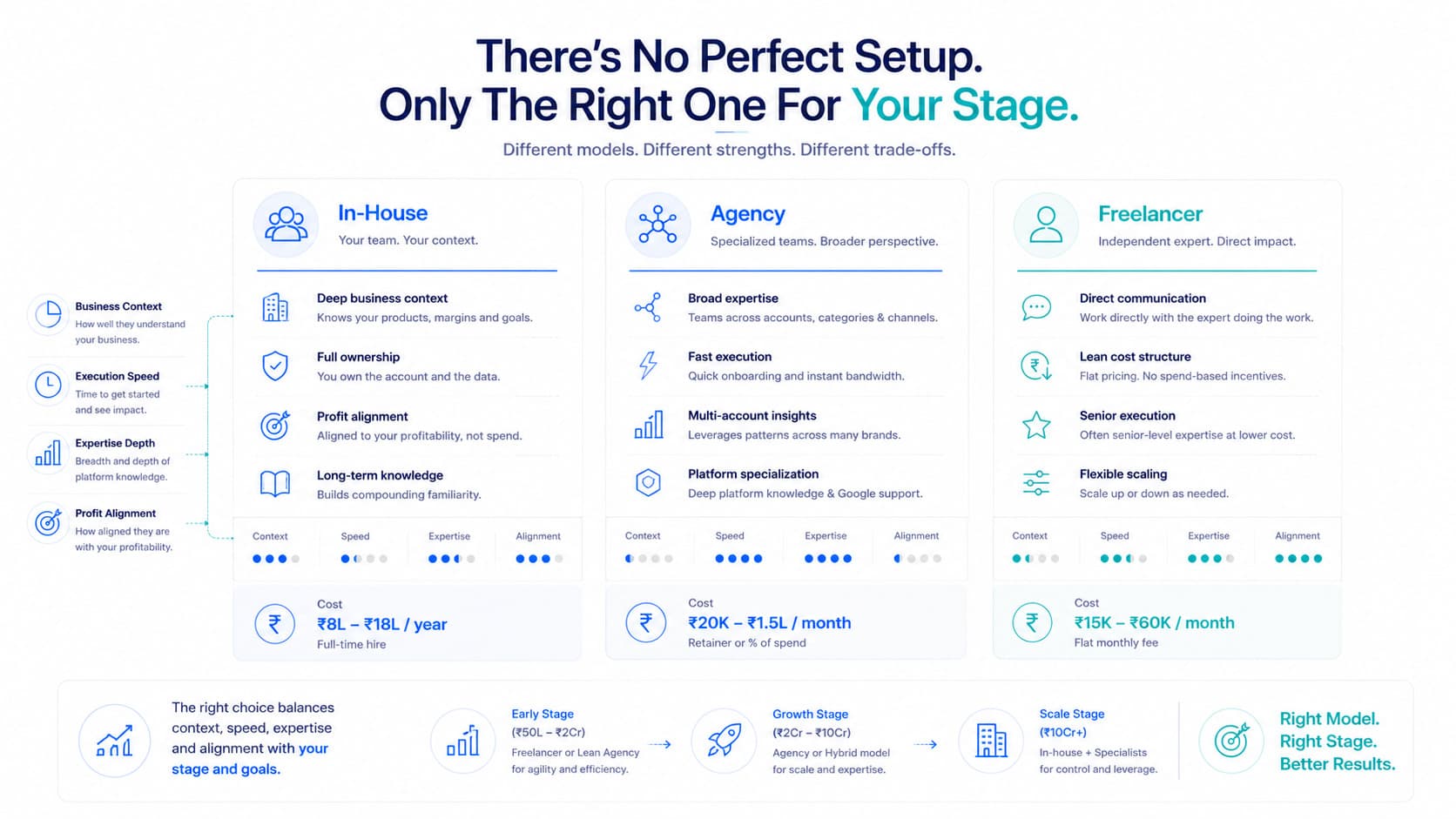
How it works: You pay a fixed monthly fee — typically ₹20,000–₹1,50,000 depending on agency size and scope — regardless of how much you spend on ads.
What’s included: Campaign setup, ongoing management, reporting, strategy recommendations, and usually a defined number of ad accounts or campaigns.
Best for: D2C brands with stable, predictable ad spend who want cost certainty. If you’re spending ₹3–5L/month consistently and want to know exactly what management costs, a flat retainer makes the math clean.
Watch for: Agencies on flat retainers have no financial incentive to recommend increasing your spend — which can be good (less upselling pressure) or bad (less proactive scaling recommendations).
How it works: The agency charges a percentage of whatever you spend on Google Ads — typically 10–20%. Spend ₹5L, pay ₹50,000–₹1L in management fees on top.
Best for: Brands scaling aggressively where spend is growing month-on-month.
The problem — and it’s a structural one: The agency makes more money when you spend more. Full stop. When they recommend increasing budgets, they earn more. When they could get you the same results with 20% less spend, they have zero financial incentive to tell you that.
For D2C brands specifically: A percentage-of-spend model creates pressure to scale spend before your unit economics support it. This is how brands end up with ₹10L/month in Google Ads, a 3.2x ROAS on the dashboard, and less money in the bank than the month before.
How it works: The agency earns a percentage of the revenue their campaigns generate — typically 3–8%. No revenue, no fee.
Best for: Brands where attribution is clean and both sides trust the measurement.
The problem: Attribution is almost never clean. Was that conversion driven by Google? By the Meta retargeting ads the customer saw three days earlier? Performance-based models live and die on attribution — which means you spend enormous energy arguing over credit instead of growing.
Also: performance-based agencies optimise for attributed revenue — which, as every D2C brand knows, is not the same as profitable revenue.

Here’s the framework that matters regardless of which pricing model you choose:
The question that matters:
Can you see your contribution margin per Google campaign?
Not ROAS. Not CPA. Not Google-attributed revenue. The actual contribution margin — revenue minus COGS, returns, shipping costs, ad spend, and management fees — per campaign, in real time.
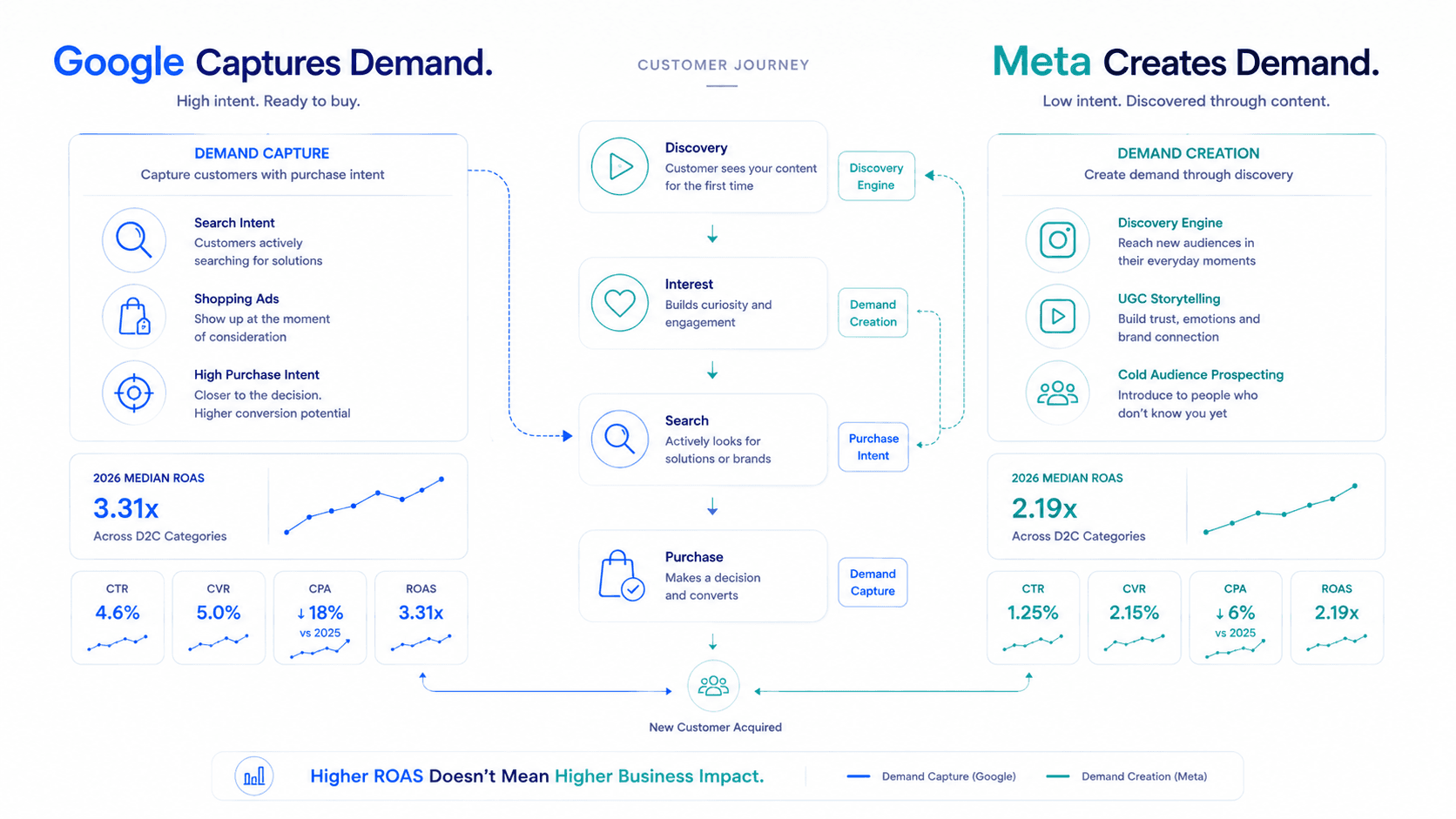
A 4x ROAS on a Google Shopping campaign sounds excellent. But if that campaign has an 18% return rate, thin COGS margin, and high average shipping cost, it might be contributing negative margin on every order.
The D2C brands managing this well have a system that sits outside the agency relationship — a profitability layer that reconciles ad spend with actual business outcomes.
How do you define success?
If the answer is ROAS or CPA, push back. Ask how they think about contribution margin.
What does your reporting look like?
Monthly PDFs are a red flag. You want campaign-level data at least weekly, ideally in a live dashboard.
What does your onboarding involve?
A good agency asks about your COGS, average return rate, target contribution margin, and product margins by SKU.
How do you handle unprofitable campaigns?
The answer should be: we kill them quickly and reallocate. Not 4–6 weeks of 'optimisation' on a losing campaign.
What's your process when spend isn't converting?
Speed of response to underperformance tells you more about an agency than their pitch deck.
| Flat Retainer | % of Spend | Performance-Based | |
|---|---|---|---|
| Cost predictability | ✅ High | ❌ Variable | ❌ Variable |
| Incentive alignment | ✅ Neutral | ❌ Spend-biased | ⚠️ Revenue-biased |
| Best spend range | ₹3–10L/month | ₹10L+/month | Any, if attribution is clean |
| Scaling | ⚠️ Limited | ✅ Yes | ⚠️ Attribution risk |
| Profit-aligned | Only if you measure CM1 separately | Only if you cap spend growth | Only if you track true CM1 |
The honest answer: no pricing model is profit-aligned by default. You have to build the profitability measurement layer yourself — or use a tool that does it for you.

They can tell you, in real time, that their Google Shopping campaign for Product X is at 28% CM1 while their Search campaign for Product Y is at 12% and declining.
Not monthly. Google Ads can move fast — a bidding shift, an algorithm update, a new competitor entering an auction — and monthly reporting leaves you reacting to decisions that are weeks old.
ROAS is the agency's metric. Contribution margin is yours. The brands getting this right make the distinction clearly and give their agency the data they need.
A campaign at 3x ROAS on ₹1L spend doesn't automatically remain profitable at ₹10L. Volume changes economics. Scaling requires validation, not assumption.
Google Ads PPC management pricing is not complicated once you understand the models. Flat retainer for cost certainty. Percentage of spend for scale — but watch the incentive problem. Performance-based for skin in the game — but watch the attribution arguments.
What matters more than the model is what you’re measuring.
An agency on any pricing model can look great on ROAS and leave you less profitable than when you started. The protection against that isn’t which fee structure you choose — it’s having independent visibility into your true contribution margin per campaign, per channel, in real time.
That’s the layer that makes any agency relationship honest.
Frequently Asked Questions
PPC (Pay-Per-Click) management is the ongoing work of running Google Ads campaigns — keyword research, bid strategy, ad copy testing, budget allocation, and performance optimisation. It's typically handled by an agency or specialist for D2C brands that don't have dedicated in-house Google Ads expertise.
Percentage of ad spend is the most common — typically 10–20% of monthly ad budget. Flat retainers are also widely used. Performance-based commission models exist but are less common due to attribution complexity.
Because the agency earns more when you spend more. This creates a structural incentive to recommend increasing budgets even when the right call might be to spend less more efficiently. The agency's financial interest and your profitability interest are not aligned.
Contribution margin per campaign — revenue minus COGS, returns, shipping, ad spend, and management fees. Not ROAS. A campaign can show strong ROAS while generating negative contribution margin once all costs are factored in.
Flable connects your Google Ads spend with actual revenue, returns, and COGS to show real contribution margin per campaign — not just platform-reported ROAS. This gives you independent visibility into whether your Google Ads investment is genuinely profitable, regardless of what your agency's report says.
Real contribution margin per campaign. Live. Automatic. No spreadsheets required.
See Your Real Profitability →Setup in 48 hours · No credit card required · Backed by Microsoft & NVIDIA