Attribution
Your ROAS isn’t a single source of truth. It’s the output of multiple systems, attribution assumptions, missing data, and modeled estimates all compressed into one number. Here’s why that matters — and what to do about it.

When you open Meta Ads Manager, performance feels simple.
Clean. Linear. Actionable.
But that’s not how performance marketing behaves in the real world.
In production, it doesn’t act like an equation.
It behaves like a distributed system — messy, delayed, and full of partial signals.
Your ROAS isn’t a single source of truth. It’s the output of multiple systems, attribution assumptions, missing data, and modeled estimates all compressed into one number. Behind that number are signals updating at different times, across different layers. And in many cases, no signal doesn’t mean success — it means uncertainty.
At Flable AI, this is the exact gap we see across scaling brands. The dashboard looks precise. The underlying system is not.
ROAS appears to follow a straightforward pipeline: spend leads to clicks, clicks lead to conversions, and conversions generate revenue.
But each of these steps lives in a different system, and none of them are perfectly connected.
Spend is accurately recorded by Meta. Clicks are partially observable — users switch devices, block tracking, or simply drop off. Conversions are inferred using pixels and APIs that don’t capture everything. Revenue, the only thing that truly matters, lives in your backend — not inside Meta.
So when ROAS is reported, what you’re seeing is not a clean measurement. It’s an approximation stitched together from incomplete visibility.
It feels deterministic.
But the system producing it is fundamentally probabilistic.

Every conversion exists in two parallel worlds.
In Meta’s world, there is a record of which ad was shown, who clicked, and whether a tracked conversion event occurred within a defined attribution window. This is Meta’s version of reality — self-contained and optimized for its own measurement system.
In your business’s world, the picture looks very different. You see who the customer actually is, how they moved across channels, and whether the purchase was truly incremental or would have happened anyway.
Self-contained attribution based on its own pixels, APIs, and measurement system. Optimized for its own reporting logic.
Actual customer identities, cross-channel journeys, and whether the purchase was truly incremental or would have happened without the ad.
Neither system has full visibility. Meta cannot see your entire funnel, and you cannot fully access Meta’s attribution logic. So when ROAS is reported, it isn’t exactly wrong — it’s just incomplete. The problem begins when that incomplete perspective is treated as absolute truth.
Under the hood, Meta operates like an event-driven system. It processes signals such as impressions, clicks, and conversion events, and assigns credit based on these inputs.
But event systems in production are never perfect.
Some signals are lost due to privacy restrictions, especially in post-iOS environments. Others are delayed because of network latency or API limitations. Some are duplicated or misfired entirely. To compensate for these gaps, Meta relies on modeled data — filling in missing pieces using statistical assumptions.
This is necessary for the system to function, but it introduces an important reality: not all of your ROAS is directly measured. A portion of it is inferred.
Meta is designed to drive conversions efficiently. To do that, it prioritizes users who are already likely to convert — people who have visited your website, engaged with your brand, or shown intent elsewhere.
This creates a natural bias toward capturing existing demand rather than generating new demand.
When these high-intent users convert, Meta attributes that revenue to its campaigns. As a result, ROAS increases. But the increase often has less to do with true growth and more to do with efficiently harvesting users who were already close to buying.
This creates a dangerous illusion. Campaigns appear highly profitable, but actual business growth may not be accelerating at the same pace.
Real customer journeys are rarely linear.
A user might see your ad, ignore it, search for your brand later, visit directly, and then convert. But attribution systems tend to assign credit based on the last measurable interaction.
This creates a mismatch between what actually influenced the user and what gets reported as the cause of conversion.
In distributed systems, this is similar to events being processed out of order, where the most recent signal overwrites the full history. The result is distorted attribution. Channels that assist conversions get undervalued, while channels closest to conversion receive disproportionate credit.
Even if Meta’s tracking were perfect, relying on platform data alone would still give you an incomplete picture.
There are entire segments of user behavior that remain invisible — interactions across devices, offline conversations, organic discovery, and word-of-mouth. When conversions happen, Meta attributes them based on what it can see, not on the full journey that actually occurred.
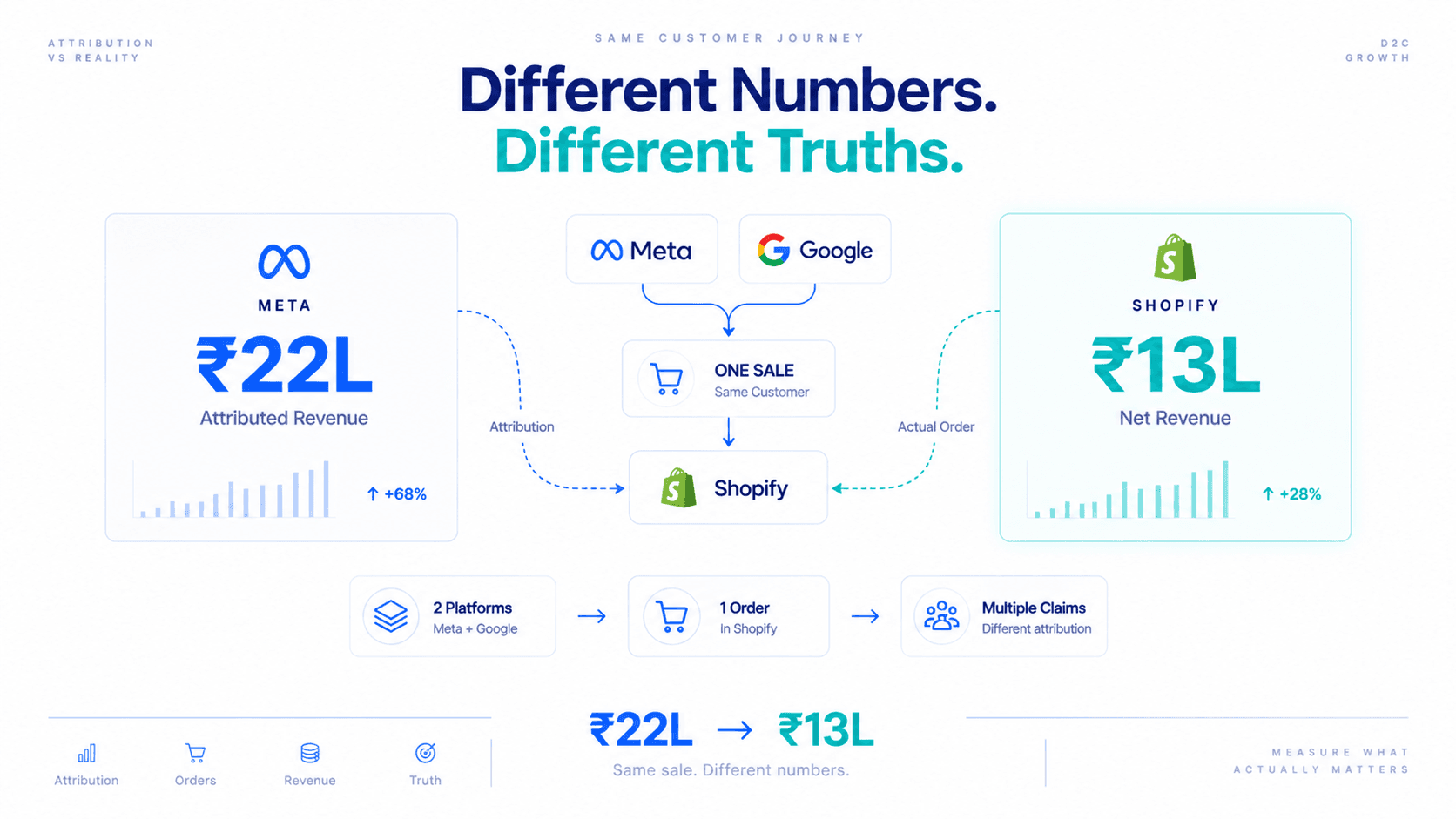
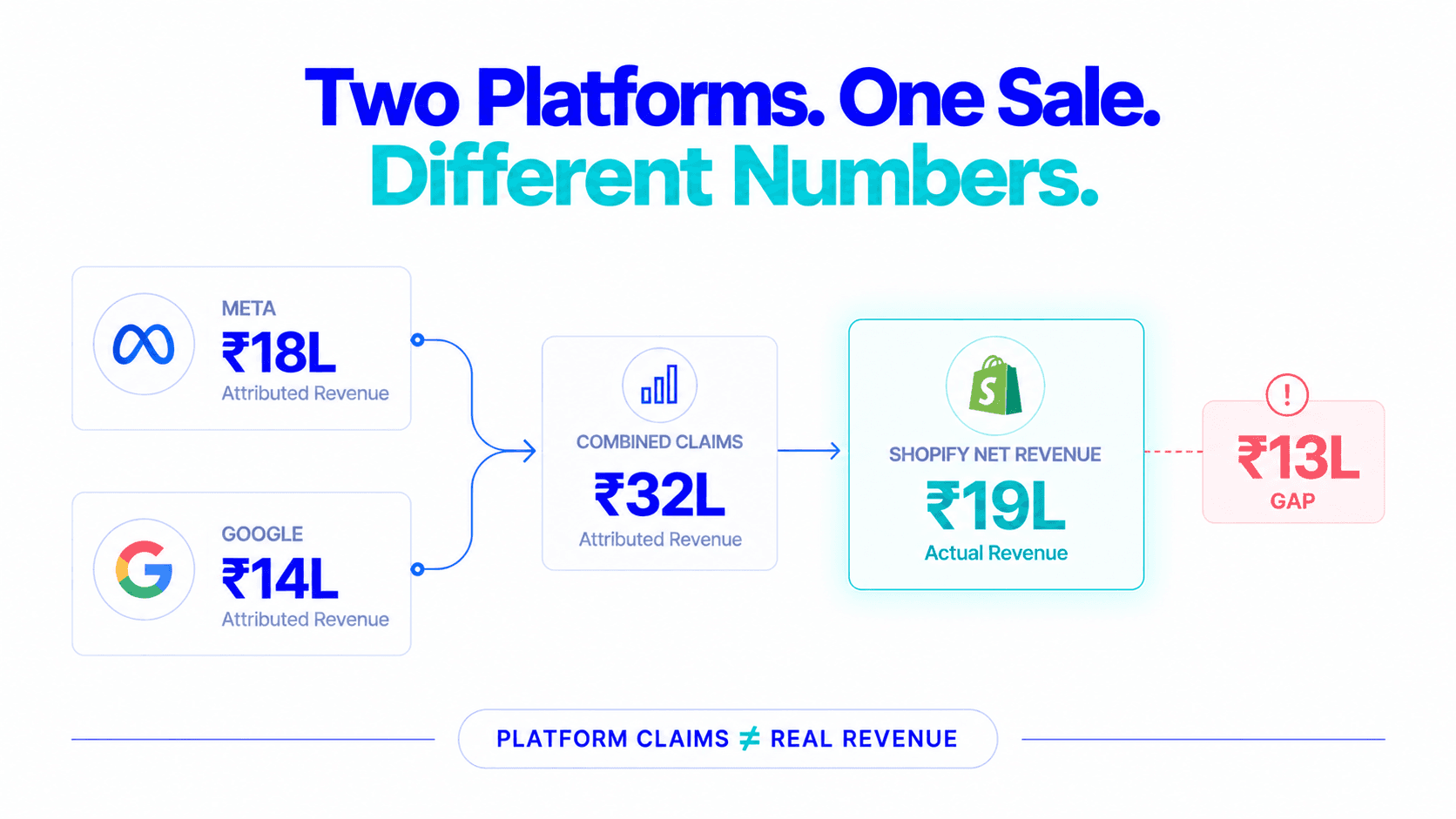
At the same time, Meta is not the only platform interacting with your users. Google Ads, email campaigns, and organic channels often influence the same conversion. Each system independently claims credit based on its own logic. Individually, they are correct. Collectively, they inflate reality.
This leads to a structural issue where the sum of attributed revenue across platforms exceeds what actually happened.
More importantly, none of these systems can answer the most critical question: would this conversion have happened without the ad?
That gap between attribution and causation is where most performance strategies break. ROAS measures who gets credit, not what actually created value.

This is where most brands go wrong.
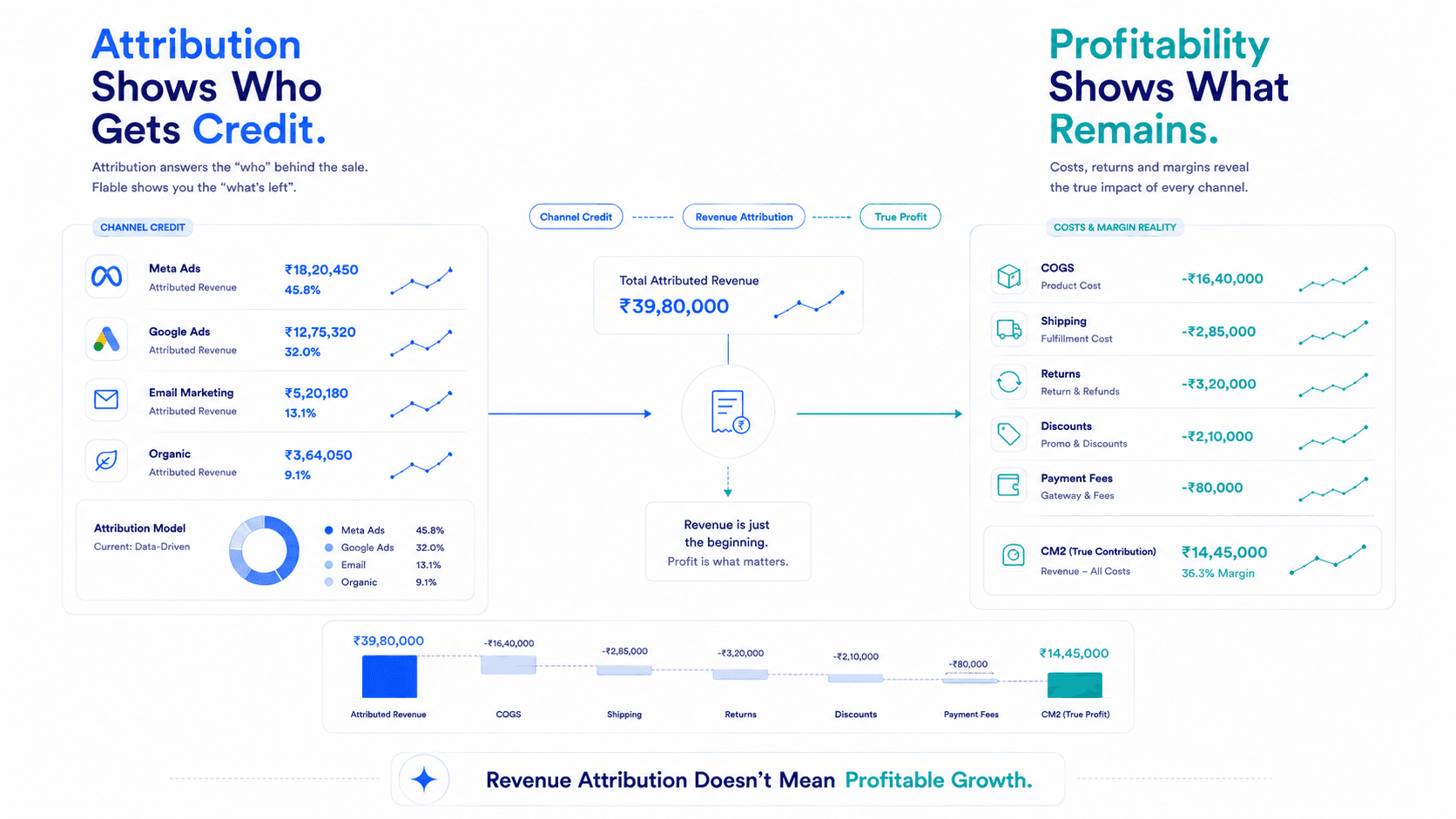
ROAS optimizes for revenue relative to ad spend. But revenue alone doesn’t reflect business health. It ignores margins, discounts, operational costs, and customer acquisition efficiency.
That’s where POAS — Profit on Ad Spend becomes critical.
POAS asks a different question:
After all costs, how much profit did this campaign actually generate?
A campaign with a high ROAS might still be unprofitable if margins are thin or costs are high. On the other hand, a campaign with a lower ROAS could be driving significantly more profit.
When you optimize purely for ROAS, you risk scaling revenue that doesn’t translate into real business growth.
Profitability — not just performance — has to be the end metric.
When ROAS becomes the primary decision-making metric, your strategy begins to inherit its biases.
Budgets naturally shift toward campaigns that show higher returns, which are typically retargeting and bottom-funnel efforts. At the same time, top-of-funnel campaigns that drive new demand start to look inefficient and get deprioritized.
Over time, this creates a subtle but dangerous imbalance. You stop feeding new users into the funnel and begin recycling the same audience. Costs increase, growth slows, and eventually plateaus.
What makes this especially risky is that the dashboard continues to look healthy. The numbers don’t immediately reflect the underlying decay.
Solving this problem requires moving beyond any single source of data.
Flable AI approaches performance as a system rather than a dashboard metric. Instead of relying on Meta alone, it combines signals across platforms, analytics tools, and customer behavior to build a unified view.
By analyzing how these signals overlap, conflict, and interact, it becomes possible to separate noise from actual impact. The question shifts from “what is being reported” to “what actually drove revenue.”
Most teams optimize for attribution because it’s visible and easy to measure. But real growth comes from understanding incrementality — what genuinely creates new demand.
This means identifying which campaigns are bringing in new customers, which ones are simply capturing existing intent, and where additional spend leads to actual revenue expansion.
Without this shift, optimization remains surface-level. With it, performance becomes a function of real business impact.
A dependable performance system isn’t built on a single tool or platform. It exists in layers.
Ad platforms provide fast but biased signals. Analytics tools offer broader but incomplete visibility. What’s needed is a final layer that reconciles these perspectives into a coherent understanding.
That is where Flable AI operates. It doesn’t replace your stack — it makes your stack interpretable.
When performance changes, most teams are left guessing why.
It’s difficult to distinguish between an actual drop in demand, a tracking issue, or a shift in attribution logic. Without a unified system, these scenarios look identical in the dashboard.
What’s missing is an audit trail — a way to connect cause and effect over time. Without it, teams react to numbers instead of understanding them.

Meta ROAS isn’t wrong. But it isn’t complete either.
It reflects what Meta can observe within its own system, measured through its own assumptions. Your business, however, operates across multiple systems, each with its own limitations.
Relying on a single perspective creates decisions based on partial truth.
The brands that scale sustainably are not the ones chasing higher ROAS. They are the ones that understand the difference between what is measurable and what is real, between what is attributed and what is caused, and between what appears efficient and what actually drives growth.
That clarity is what separates optimization from true performance.
And it’s exactly what Flable AI is built to deliver.
Frequently Asked Questions
No. Meta ROAS is not wrong — it's just incomplete. It reflects what Meta can observe within its own system, measured through its own attribution assumptions. The issue is treating it as the single source of truth when your business operates across multiple systems that Meta cannot see.
POAS stands for Profit on Ad Spend. While ROAS measures revenue relative to ad spend, POAS goes further by factoring in margins, discounts, operational costs, and customer acquisition efficiency. A campaign with a high ROAS might still be unprofitable, while a campaign with lower ROAS could be driving significantly more profit.
Meta prioritizes users who are already likely to convert — people who have visited your website or engaged with your brand. When these high-intent users convert, Meta attributes the revenue to its campaigns. This inflates ROAS but doesn't necessarily mean the ad created new demand. The user may have converted anyway.
Flable AI combines signals across platforms, analytics tools, and customer behavior to build a unified view. Instead of relying on Meta alone, it reconciles conflicting data to separate noise from actual impact — shifting the question from 'what is being reported' to 'what actually drove revenue and profit.'
Yes, but not in isolation. ROAS is useful as one signal among many. The problem arises when budget decisions are made purely on ROAS, which inherits Meta's biases — favoring retargeting, undervaluing top-of-funnel, and ignoring true incrementality. Use ROAS alongside POAS and incrementality metrics for a complete picture.
Book a Flable walkthrough and see how your performance data looks when it’s unified, reconciled, and measured on profitability — not just reported ROAS.
See Your Real Profitability →Setup in 48 hours · No credit card required · Backed by Microsoft & NVIDIA