Deep Dive
Looking for a Triple Whale alternative that goes beyond revenue tracking? Both platforms connect to your ads and Shopify. One stops at the revenue line. The other goes beneath it — into COGS, shipping, returns, and discounts — to show you what you actually keep.
At a glance
Profit-complete analytics with attribution and creative intelligence. Connects your Meta, Google, and TikTok spend to COGS, shipping, returns, coupon stacking, and payment fees. Shows contribution margin per channel, per campaign, per SKU — in real time.
Shows: "Your Meta channel made $4,200 in profit this week"Revenue analytics and attribution. First-party pixel tracks customer journeys. Centralized dashboard for ROAS, CPA, and AOV across all ad channels. Creative Cockpit for ad creative performance. AI assistant Moby.
Shows: "Your Meta channel did $48K revenue at 4x ROAS"Same Meta spend. Two very different conclusions.
Both platforms pull data from the same Shopify store and Meta ad account.
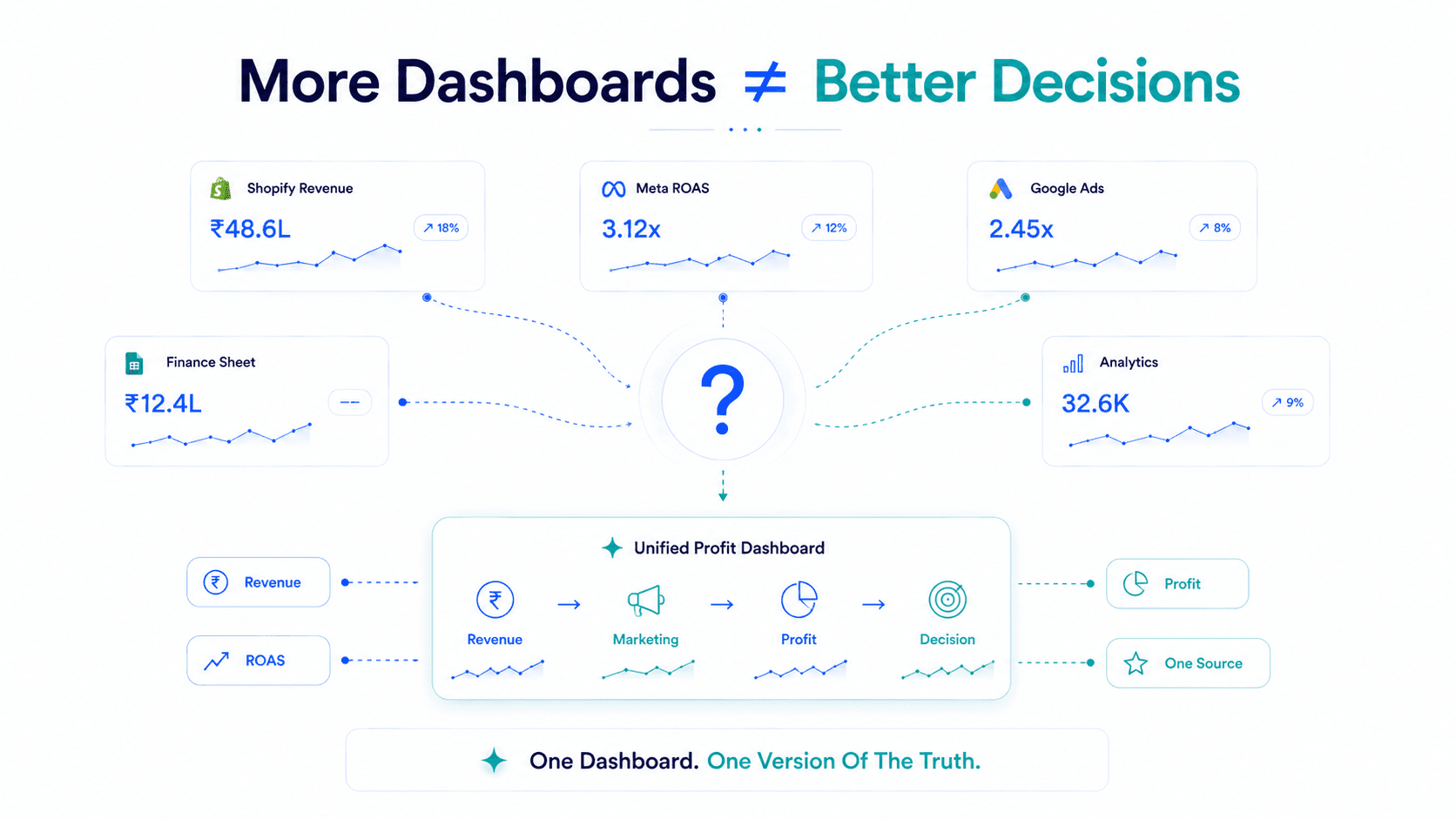
The gap: Triple Whale says this channel is performing at 4x ROAS — a signal to scale. Flable says this channel is losing $7,630 per month after real costs. Same data. Completely opposite conclusions. The difference is that Flable connects your ad performance to the cost layers Triple Whale does not see.
What each platform actually tracks
| Capability | Flable | Triple Whale |
|---|---|---|
| 💰 Profitability Intelligence | ||
| Contribution margin per channel (CM1 / CM2 / CM3) | ✅ Real-time | ❌ No |
| COGS connected to channel performance | ✅ Auto per SKU | ⚠️ Manual input |
| Shipping cost per order & per region | ✅ Yes | ❌ No |
| Return rate tracked per channel & per SKU | ✅ Yes | ❌ No |
| Coupon stacking detection | ✅ Automatic | ❌ No |
| Proactive margin risk alerts | ✅ Yes | ❌ No |
| SKU-level profitability | ✅ Yes | ❌ No |
| 📊 Channel, Campaign & Creative Performance | ||
| Meta / Google / TikTok spend & revenue | ✅ Yes | ✅ Yes |
| Channel-level ROAS | ✅ Yes | ✅ Yes |
| Campaign-level performance data | ✅ Yes | ✅ Yes |
| Channel-level profit (not just revenue) | ✅ Yes (CM3) | ❌ Revenue only |
| Creative performance analytics (your ads) | ✅ Yes | ✅ Creative Cockpit |
| Competitor creative analysis | ✅ Built-in | ❌ No |
| 🤖 AI & Automation | ||
| AI copilot — natural language queries | ✅ Profit-focused | ✅ Moby (revenue) |
| "Why is profit down?" — root cause diagnosis | ✅ Under 5 min | ❌ No |
| Ads Manager Agent (auto-optimize for profit) | ✅ Targets CM | ❌ Targets ROAS |
| AI anomaly detection | ✅ Margin-based | ✅ Revenue-based |
| ⚙️ Platform & Pricing | ||
| Multi-client agency dashboard | ✅ Built-in | ⚠️ Limited |
| Per-client profitability view | ✅ Yes | ❌ No |
| Setup time | 48 hours | ~1 week |
| Pricing model | Flat rate | GMV-based (scales up) |
The verdict
Revenue is growing but profit isn't. You want to know which channels are actually making money after COGS, shipping, returns, and discounts. Best for scaling brands ($1M+) and agencies managing D2C clients.
You need to understand which creatives and customer journeys are driving conversions. Best for early-stage Shopify brands focused on testing creatives and understanding where revenue comes from.
Triple Whale and Flable both connect to your Shopify store and your ad platforms. Both pull spend, revenue, ROAS, and CPA. Both give you a centralized dashboard. On the surface, they look like they do the same thing. The difference is what happens after the revenue number.
Triple Whale stops at revenue. It gives you sophisticated ways to measure it — first-party pixel tracking, multi-touch attribution models, creative analytics, path-to-purchase mapping. Flable goes past revenue. It connects that same channel performance data to every variable cost that sits between revenue and profit.
A 4x ROAS means $4 in revenue per $1 in ad spend. That sounds profitable. But if your all-in variable costs (COGS + shipping + returns + discounts + payment fees) consume 85% of that revenue, you are left with $0.60 of gross contribution for every $1 of ad spend. After the ad cost itself, you are negative.
The higher your ROAS, the more confident you feel about scaling. But if the underlying unit economics are negative, scaling a 4x ROAS campaign just means losing money faster and with more conviction. ROAS is the speedometer. Contribution margin is the fuel gauge. Driving faster doesn't help if the tank is empty.
The shift from ROAS to contribution margin as the primary D2C performance metric is accelerating. In 2026, with rising CAC, margin compression from discounting, and complex fulfillment economics, ROAS has become a dangerous metric to optimize around. The brands and ecommerce agencies outperforming their peers are the ones that have made this shift.
They still track ROAS, but they optimize for CM3 — contribution margin after all costs including ad spend. This is what separates a Shopify profit tracking tool from a revenue dashboard. Flable is built for CM3 optimization. Triple Whale is built for ROAS optimization. Both have their place, but in 2026, profit matters more than revenue.
Frequently Asked Questions
For brands whose primary challenge is profitability visibility (typically $1M+ in revenue), Flable provides the insights that matter most for scaling sustainably. Flable connects to the same ad platforms and Shopify store, showing channel-level spend, revenue, and ROAS — plus contribution margin, shipping costs, returns, coupon stacking, and payment fees.
Yes. Flable pulls channel-level data from Meta, Google, and TikTok — including spend, revenue, ROAS, and CPA. The key difference is that Flable connects that channel data to your full cost stack (COGS, shipping, returns, discounts, payment fees) to show you contribution margin per channel, not just revenue per channel.
Triple Whale offers a first-party tracking pixel (Triple Pixel) for enhanced conversion tracking, multiple attribution models beyond last-touch, customer journey mapping, a mobile app, and a 20,000+ brand ecosystem. Flable offers last-touch attribution, campaign-level data, creative performance analytics, and competitor creative analysis — plus the full profitability layer that Triple Whale lacks.
It depends on your cost structure. For brands with 70%+ gross margins and low return rates, 4x ROAS is profitable. For brands with 45% gross margins, 18% return rates, and heavy coupon usage, 4x ROAS can be significantly unprofitable. ROAS measures revenue per ad dollar, not profit per ad dollar.
Triple Whale uses GMV-based pricing — a brand doing $5-7M pays around $1,129/month, with AI features gated behind higher tiers. Flable uses flat pricing that does not scale with your revenue. The AI copilot, agency dashboard, and all profitability features are included at every tier.
Book a Flable walkthrough with your own data. We will show you the contribution margin behind your best-performing channels — and which ones are quietly losing money.
See Your Real Channel Profitability →Setup in 48 hours · No credit card required · Backed by Microsoft & NVIDIA