Metrics Guide
You’ve got a great product. A clean website. A strong offer. But nobody knows you exist. This guide breaks down what advertising really means for D2C brands, what it’s actually supposed to achieve, and why getting it right is the difference between scaling profitably and burning cash.

Advertising is the paid, intentional communication between a brand and its potential customers — designed to inform, persuade, or remind them to take action.
For D2C brands, that action almost always comes down to one thing: a profitable purchase.
Not just a click. Not just a view. A purchase that, after COGS, shipping, returns, and ad spend, still leaves money on the table.
Every ad you run has four core components:
What you're saying. The offer, the story, the hook. This is what makes someone stop scrolling and pay attention.
Where you're saying it. Meta, Google, YouTube, email, organic — every channel reaches a different audience in a different mindset.
Who you're saying it to. The most important variable of all. A great message shown to the wrong person is wasted spend.
What you want them to do next. Add to cart. Shop now. Learn more. Every ad needs one, and it needs to be unmistakable.
Get these four right and advertising works. Get even one wrong and the budget bleeds out quietly while the dashboard shows green.
Traditional advertising — TV, print, billboards — was built for large brands with large budgets. You paid for reach and hoped the right people were watching.
Digital advertising flipped that entirely.
Today, with over 5 billion people active on social media and 66% of the world’s population online, D2C brands can reach their exact customer — by age, location, interest, purchase behaviour, and even the products they’ve previously viewed — for a fraction of what a TV slot once cost.
This is why D2C as a model exists at all. Digital advertising removed the gatekeepers. A brand with a great product and smart targeting can reach millions without a retail distribution deal or a national media budget.
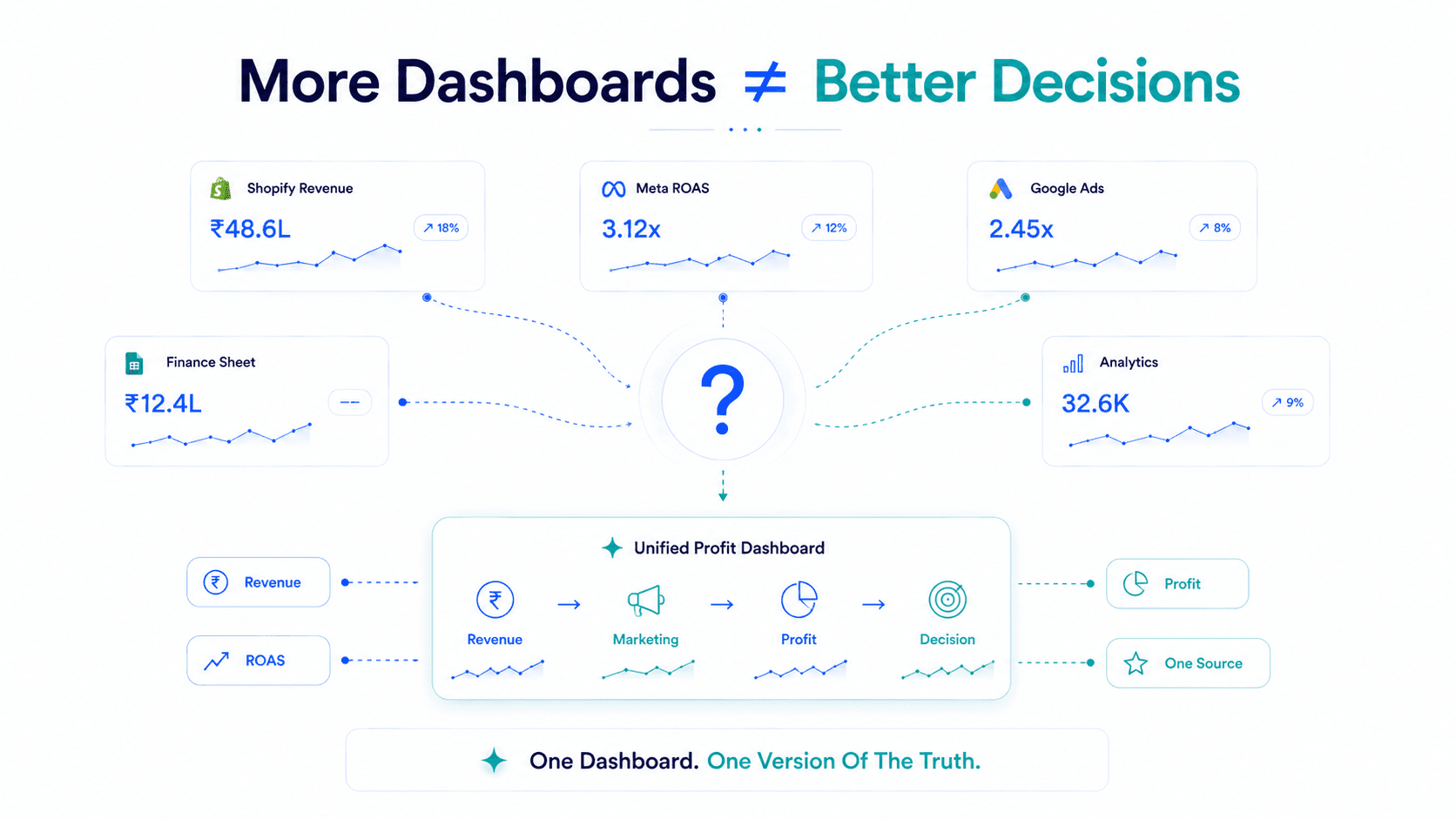
But with that power comes a trap that catches most growing D2C brands: confusing ad activity with profitable growth. More spend. More reach. More orders. Lower margins. Empty bank account.

Before anyone buys from you, they need to know you exist. Informative advertising introduces your product, explains what makes it different, and gives a potential customer a reason to pay attention.
This is top-of-funnel work — awareness campaigns, prospecting audiences, cold traffic. It’s the least efficient part of advertising in terms of immediate ROAS, and the most important for long-term growth.
Without it, you’re only selling to people who already know you. That pool is finite. Eventually it runs dry.
For D2C brands, informative advertising looks like: launch campaigns for new products, educational content that explains why your product solves a real problem, and prospecting ads that reach new audiences who’ve never heard of you.
Once someone knows you exist, the next job is to make them buy. Persuasive advertising creates desire. It answers the question every potential customer is silently asking: why should I choose this over everything else available to me?
Social proof — reviews, testimonials, UGC — is the most powerful persuasion tool available to D2C brands. Customers trust other customers far more than they trust brands.
The critical mistake D2C brands make at the persuasion stage: discounting to persuade. A 20% off code in every ad is not persuasion. It’s buying a conversion that would have happened anyway at a lower margin while training your audience to wait for the next discount.
Persuade with value, not discounts.
Most people who see your ad won’t buy immediately. Life gets in the way. They close the tab, get distracted, forget. Reminder advertising — retargeting, email sequences, repeat exposure — brings them back.
This is the highest-ROAS, lowest-effort advertising for D2C brands. The customer already knows you. They’re already warm. The job is simply to show up again at the right moment.
The trap: relying only on reminder advertising. When retargeting becomes your primary growth lever, you’re not growing — you’re recycling. ROAS looks great. New customer acquisition has quietly stopped. Growth plateaus.
Reminder advertising should amplify your prospecting, not replace it.

The point of advertising is not impressions or reach or engagement. For a D2C brand, the point of advertising is contribution margin — what’s left after every cost is accounted for.
A campaign that drives ₹50L in revenue at a 5% contribution margin is worse than a campaign that drives ₹20L at a 35% margin. Advertising that doesn’t account for what happens after the click — returns, COGS, shipping — is optimising for the wrong outcome.
D2C brands live and die by their ability to launch. Advertising is how launches happen — how you create buzz, build anticipation, and convert early interest into day-one revenue.
Without advertising, new products sit on shelves (or in warehouses) waiting for customers who never come.
Advertising to people who’ve already bought from you is significantly cheaper and more effective than advertising to cold audiences. Loyalty campaigns, win-back sequences, cross-sell ads — these are some of the highest-return advertising investments a D2C brand can make.
The brands getting this right spend as much time advertising to their existing customer base as they do chasing new ones.
Brand advertising doesn’t show up in this week’s ROAS. It shows up in lower CAC six months from now, higher repeat purchase rates, and customers who come to you directly instead of clicking an ad.
This is the long game. Most D2C brands ignore it because it’s hard to attribute. The ones who invest in it consistently find that paid performance gets cheaper over time because the brand is doing work the ads don’t have to.
There are probably three other brands selling something similar to what you sell. Advertising is how customers know why yours is different — and better.
Without advertising, differentiation lives only in your head. With it, differentiation becomes a market reality.
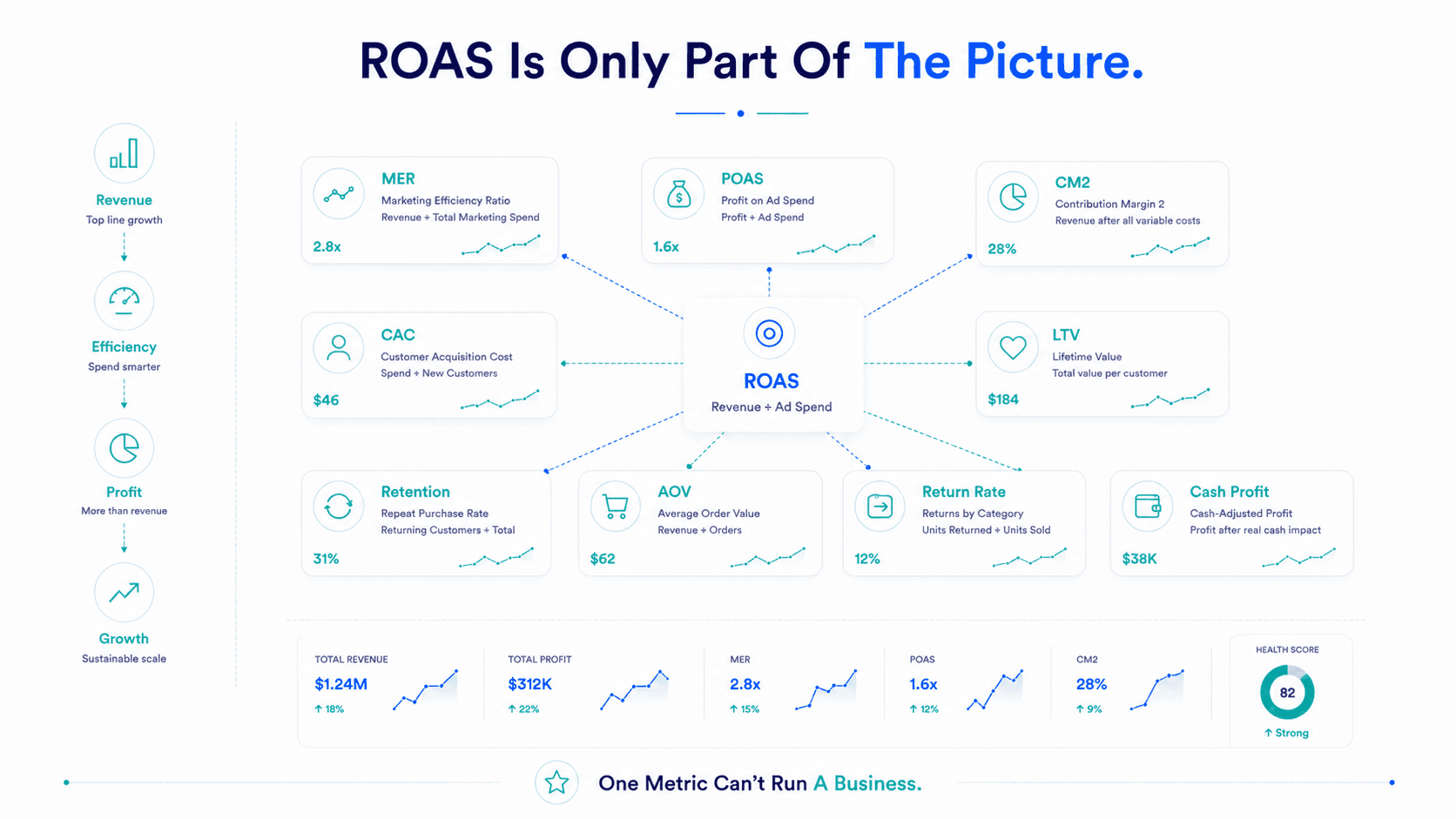
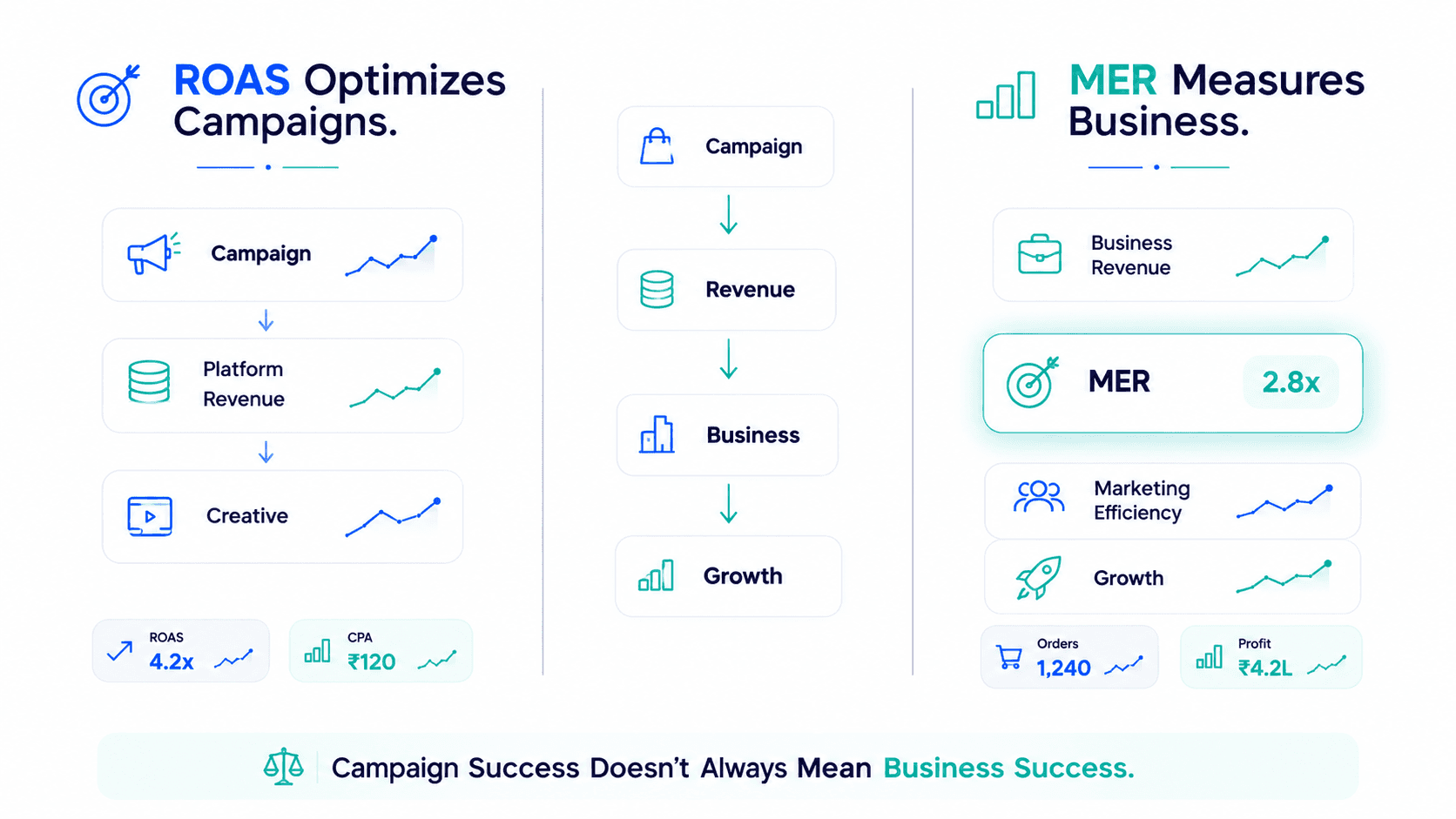
Most D2C brands measure advertising success with ROAS — return on ad spend. Revenue divided by spend.
It’s a starting point. It’s not the answer.
ROAS doesn’t know about your returns. It doesn’t know your COGS. It doesn’t know what you paid the agency, the creative team, or the UGC creator who made the ad. It doesn’t know your shipping costs or your payment processing fees.
The metric that actually matters:
Contribution margin per campaign — what the campaign returned after every cost is accounted for.
A 4x ROAS campaign with a 25% return rate and thin margins might be losing money. A 2.5x ROAS campaign on a high-margin, low-return product might be your most profitable activity.
That’s the number advertising should be held to. Not ROAS. Not CPA. Contribution margin.
This is exactly what Flable AI is built to show you — real profitability per campaign, per channel, in real time. Not what the platform reports. What actually landed.
Advertising is the engine of D2C growth.
But an engine pointed in the wrong direction just gets you to the wrong place faster.
Understanding what advertising is — and what it’s genuinely supposed to achieve for your specific business — is the foundation everything else is built on. Inform new audiences. Persuade them to buy. Remind them to come back. And measure every single rupee of it against real contribution margin, not platform-reported ROAS.
That’s not just advertising. That’s a profitable D2C business.
Frequently Asked Questions
Advertising is paid communication between a brand and its target audience, designed to inform, persuade, or remind them to take action. For D2C brands specifically, that action must ultimately result in a profitable purchase — one that generates positive contribution margin after all costs.
The three core objectives are to inform (make new audiences aware of your product), persuade (convince them to buy over alternatives), and remind (bring existing or warm audiences back to purchase again). For D2C brands, all three must be balanced — over-investing in any one at the expense of others leads to stalled growth.
Digital advertising allows D2C brands to reach highly targeted audiences at a fraction of traditional media costs. It removed the gatekeepers — retail distribution deals and national media budgets — that once prevented small brands from reaching large audiences. Today, a D2C brand with smart targeting can compete with brands 10x their size.
Contribution margin per campaign — not ROAS. ROAS only measures revenue against ad spend. It ignores returns, COGS, shipping, and the full cost of acquisition. A campaign can show excellent ROAS while actually losing money on every order.
Flable connects your ad data, revenue, returns, COGS, and logistics into one real-time view. It shows you true contribution margin per campaign and channel — so you know which advertising is actually profitable, not just which campaigns the platform is reporting as successful.
See your real contribution margin per campaign, per channel — live, automatic, no spreadsheets required.
See Your Real Profitability →Setup in 48 hours · No credit card required · Backed by Microsoft & NVIDIA